Fully filled capacitors with parallel dielectrics problem

Click For Summary
The discussion centers on calculating the electric field and surface charge density in a capacitor with two parallel dielectrics. The first dielectric occupies one-third of the surface area with a dielectric constant of er1, while the second occupies two-thirds with a dielectric constant of er2. The initial application of Gauss's theorem led to confusion regarding the assumption that electric fields in both dielectrics are equal. It was clarified that the charge density on the capacitor plates is not uniform due to the differing dielectric constants, resulting in varying induced charge densities across the dielectrics. The conversation emphasizes the importance of recognizing how dielectric properties affect charge distribution.
Amaelle
Messages
309
Reaction score
54
consider that we have two dielectrics inside a capacitor as shown in the picture, let0s consider also that Q is the charge of the capacitor and d the distance between the two plates , the first dielectric occupy a surface of S/3 with a dielectric constant of er1 and the second a surface of 2S/3 with a dielectric constant of er2, the question is calculate the electric field inside the capacitor and the surface density of the induced charge (see the uploaded image)
During the calculation I faced the following doubts: I applied gauss theorem to the flux density in both areas of the dielectrics and I got:

QEAJg.gif


σ is the surface density of the free charges =Q/S,

8YAxA.gif


doing the same with the second surface I got that

y48Zg.gif


and because my two dielectric are in parallel so E1=E2

this gives me

MHZ6c.gif


BUT this not true! so where did my logic fails??

Many thanks in advance!
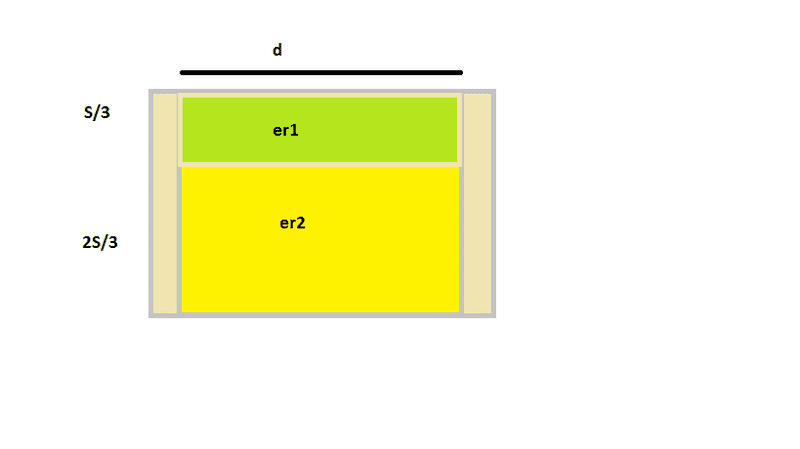
dielectric.png
dielectric.png
dielectric.png
 

Attachments

  • dielectric.png
    dielectric.png
    3.4 KB · Views: 588
  • QEAJg.gif
    QEAJg.gif
    869 bytes · Views: 446
  • 8YAxA.gif
    8YAxA.gif
    491 bytes · Views: 422
  • y48Zg.gif
    y48Zg.gif
    523 bytes · Views: 434
  • MHZ6c.gif
    MHZ6c.gif
    834 bytes · Views: 428
Physics news on Phys.org
Amaelle said:
BUT this not true! so where did my logic fails??
Charge density on the plates will not be uniform.
 
  • Like
Likes Amaelle
Thanks for your prompt reply, it makes sens but can you elborate more?
 
I just go why the charge density is different from dielectric to dielectric
many thanks !
 
The book claims the answer is that all the magnitudes are the same because "the gravitational force on the penguin is the same". I'm having trouble understanding this. I thought the buoyant force was equal to the weight of the fluid displaced. Weight depends on mass which depends on density. Therefore, due to the differing densities the buoyant force will be different in each case? Is this incorrect?

Similar threads

  • · Replies 6 ·
Replies
6
Views
2K
  • · Replies 8 ·
Replies
8
Views
2K
Replies
3
Views
2K
  • · Replies 20 ·
Replies
20
Views
4K
  • · Replies 17 ·
Replies
17
Views
3K
Replies
9
Views
3K
  • · Replies 21 ·
Replies
21
Views
3K
Replies
7
Views
2K
  • · Replies 2 ·
Replies
2
Views
1K
Replies
1
Views
2K