Science Advisor
Gold Member
- 2,856
- 12,709
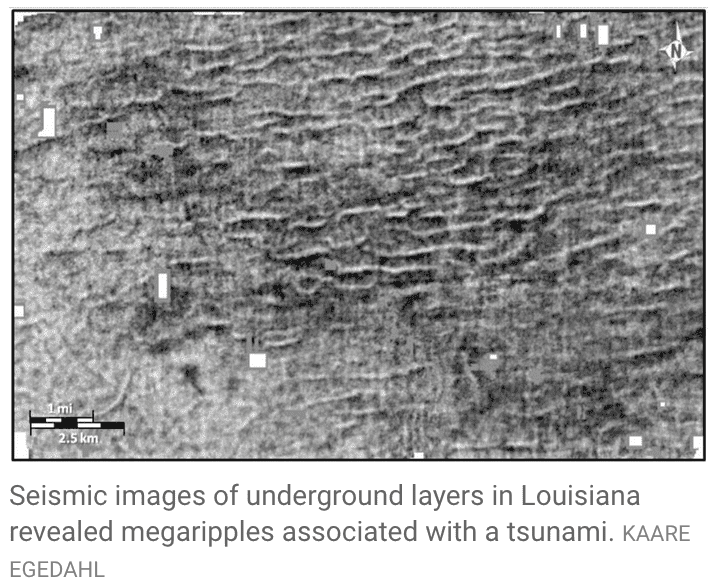
When a giant tsunami wave spread out from the site of the dinosaur killing Chicxulub impact, it left traces of its passing in giant ripples on the seafloor (as described in this news article in Science):
The research article is here (but not accessible to me).
The size of these ripples is comparable to those found in the Glacial lake Missoula, due to its sudden monstrous outflows.
Other Chicxulubian Impact threads:
When Kinsland and his colleagues analyzed a layer about 1500 meters underground—one associated with the time of the impact—they saw fossilized ripples. These “megaripples” were spaced up to 1 kilometer apart and were an average of 16 meters tall, they reported in an Earth & Planetary Science Letters study posted online on 2 July.
Kinsland believes the ripples are the imprint of the tsunami waves as they approached the shore in waters about 60 meters deep, disturbing the seafloor sediments. (Tidal waves gain their massive height only when they reach the ramp of the coastline.)
Kinsland says the orientation of the ripples was also consistent with the impact. When he drew a line perpendicular to their crests, he says, it went right to Chicxulub. He adds that the location was perfect for preserving the ripples, which would have eventually been buried in sediment. “The water was so deep that once the tsunami had quit, regular storm waves couldn’t disturb what was down there.”
The research article is here (but not accessible to me).
The size of these ripples is comparable to those found in the Glacial lake Missoula, due to its sudden monstrous outflows.
Other Chicxulubian Impact threads:
Last edited:
