Futher Mechanics: Circular Motion of a Car Going Around a Banked Turn

Click For Summary
SUMMARY

The discussion focuses on the mechanics of a car navigating a banked turn, specifically addressing the forces acting on the vehicle. Key equations derived include mg = Rcos(theta) and the centripetal force equation F = mv²/r. Participants emphasize the importance of correctly identifying the direction of forces, particularly friction, which acts centripetally when the car is moving at sufficient speed. The conversation highlights common misunderstandings regarding the role of friction and the need for clarity in diagram labeling.

PREREQUISITES
  • Understanding of Newton's laws of motion
  • Familiarity with circular motion concepts
  • Knowledge of free body diagrams
  • Basic trigonometry, particularly sine and cosine functions
NEXT STEPS
  • Study the derivation of centripetal force equations in circular motion
  • Learn about the role of friction in banked turns and its impact on vehicle dynamics
  • Explore the implications of varying angles (theta) on forces in banked curves
  • Investigate the effects of different coefficients of friction on vehicle stability
USEFUL FOR

Students of physics, automotive engineers, and anyone interested in the dynamics of vehicles navigating curves will benefit from this discussion.

RemotePhysics
Gold Member
Messages
22
Reaction score
3
Homework Statement
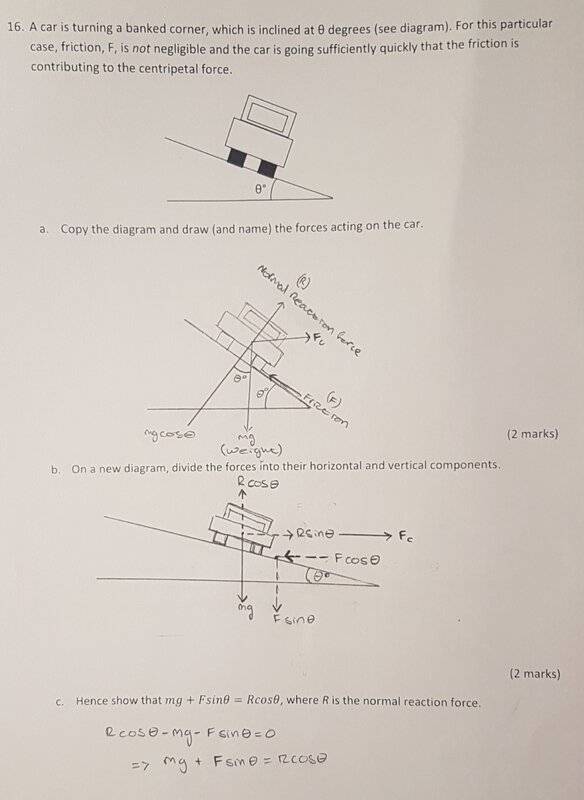
A car is turning a banked corner, which is inclined at theta degrees (see diagram). For this particular case friction, F is not negligible and the car is going sufficiantly quickly that the friction is contributing to the centripital force.

a) Copy the diagram, draw and name the forces acting on the car
b) On a new diagram, divide the forces into their horizontal and vertical components
c) Hence show that mg+Fsin(theta)=Rcos(theta)
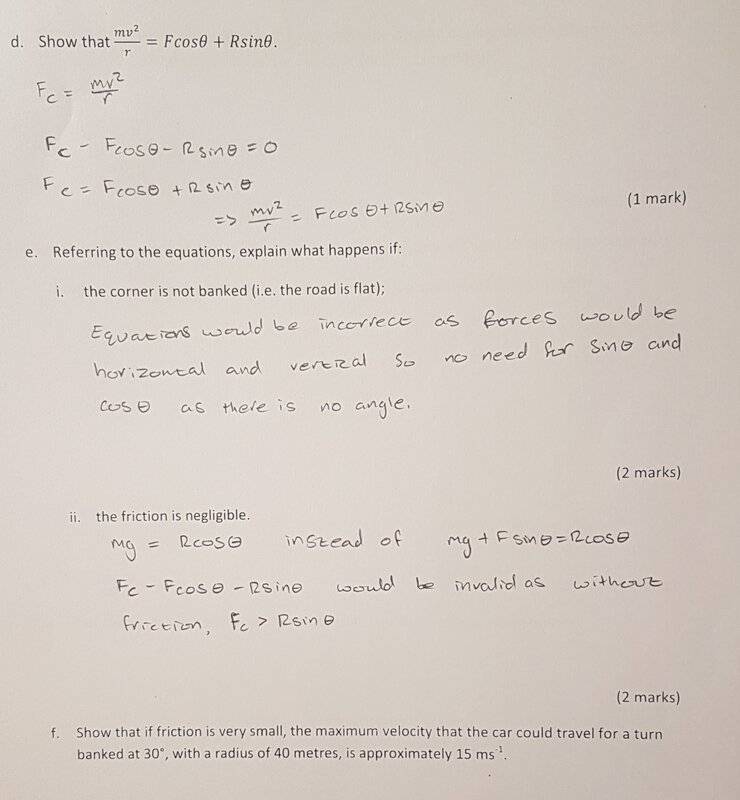
d) Show that (mv^2)/r=Fcos(theta)+Rsin(theta)
e) Refering to the equations, explain what happens if:
i) the corner is not banked. (i.e the road is flat)
ii) friction is negligible
f) Show that if friction is very small, the max velocity that the car can travel for a turn banked at
30 degrees, with a radius of 40 meters is approximately 15m/s
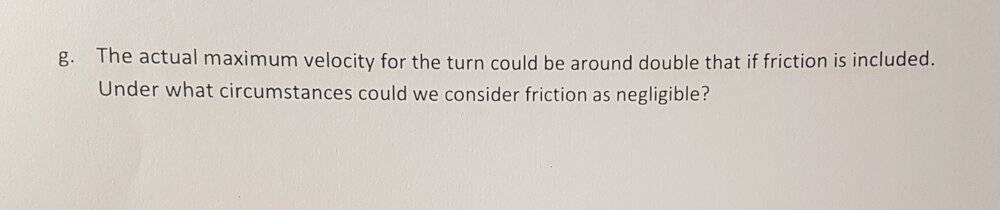
g) The actual max velocity for the turn could be around double that if the friction is included.
Under which circumstances could we consider the friction negligible.
Relevant Equations
Centripital force = mv^2/2
Friction = μR
Below is my working out. If you could have a look at my answers and see if they are correct and then advice me on how to improve my solutions for Parts I and II, and how to answer F and G with the given information. Thanks in advance!

Parts aand b are diagrams so please refer to the attached images.
Part c: They act in opposite directions on the diagram and cancel each other out. so Rcos(theta)-mg-Fsin(theta)=0. I then rearanged them to match the question.
Part d: Again the same reasoning as for part c, just different equations
Part e: Here is where I am getting slightly stuck?
Part I: Equations would be incorrect as forces would already be horizontal and vertical. As there is no angle there would be no need for sin(theta) and cos(theta)
Part II: mg=Rcos(theta) instead of mg+Fsin(theta)=Rcos(theta).
Fc-Fcos(theta)-Rsin(theta) would be invalid without friction as Fc>Rsin(theta).
Part f: Don't know which equation to use. I tried to rearrange (mv^2)/r=μRcos(theta)+Rsin(theta) for v but there is no mention of the mass of the car so I am unable to calculate the reaction force R or m. Also what consitutes as small level of friction? 0.1μ or 0.01μ?
Part g: Friction would be negligable if either the car was traveling very slowly and centripetal force was very small.

New member so please go easy on me if i have broken any rules :)
1.jpg
2.jpg
3.jpg
 
Last edited by a moderator:
  • Like
Likes   Reactions: Merlin3189
Physics news on Phys.org
RemotePhysics said:
the car is going sufficiantly quickly that the friction is contributing to the centripetal force.
What is that telling you about the direction of the frictional force?
 
haruspex said:
What is that telling you about the direction of the frictional force?
Is it acting in the same direction?
 
New member so please go easy on me if i have broken any rules :)
Hello & welcome. I wish every post were as clear and complete as yours! Well done.

it Is acting in the same direction as ?
I think you do mean the right thing, but I'd say,
in the centripetal direction, or, in the direction of the centripetal force, or, towards the centre (of turn)

Be careful with a centripetal force.
It is not another force on the object (car), but the resultant of all the other sideways forces - here friction and gravity.
It's a bit like when a car is accelerating in a straight line:
There is the friction (traction )of the wheels, there may be gravitational force due to a slope, even wind resistance, all forces acting on the car.
If you know the car is accelerating, you don't say, "Aha! There must be another force, F=ma, to accelerate it." and then add that to your diagram.
You just add up all the actual forces and say the result must be a force equal to that predicted by F=ma.

Here, you know the car follows a circular path, so there must be a sideways acceleration, given by ##F=\frac{mv^2}{r}##
So you lookat at the actual forces, add up those acting sideways and say, they must equal ##\frac{mv^2}{r}##Ok. So Haruspex was pointing out, the way you labelled Friction on your diagram was a bit misleading.
That wouldn't really matter, if you were strict about signs when you do your equations, but it's easier if it looks right as well.

You actually juggle them around so that you get the required answer, but it doesn't really match what you put on the diagram. And since they ask you to "show" it, then I think your logic needs to be clear.

I don't know how my fellow PF helpers think, but I like words (as you can see!)
So in (d) I'd like to say something like,
"net centripetal force = sum of horizontal forces"
##\frac{mv^2}{r} = R\sin{\theta} - F\cos{\theta} \text{ in my diagram } ##
"So to get your formula, friction must be acting in the opposite sense to that I've chosen as positive."

But I really don't know what your teacher would expect. IMO they've been a bit sloppy in giving a formula without defining the sense of friction. If they let you put it in how you like, they should accept the appropriate sign. I can't actually see the point of this part of the Q, since I'd expect someone to simply write that answer as the starting point! (Maybe after a few explanatory words.)

For (e) I'd show the formula with ## \theta =0 \text{ or } F=0##
then explain the physical implication of the new equation (at least in part 2. Again, I can't see the point of asking part 1.)
I don't think just saying the equation is now wrong, would be a good answer. The equation is still right, just the numbers are different and one term effectively disappears.
 
  • Like
Likes   Reactions: Lnewqban
Merlin3189 said:
Hello & welcome. I wish every post were as clear and complete as yours! Well done.
Thanks!

I really do appreciate you methodical reply. It is very helpful! As a self-taught student it is not always easy to grasp a concept and understand it fully. The question is "sloppy", I do agree with you there.
 
Thanks. Are you having a go at (f) and (g) ?
 
Merlin3189 said:
the way you labelled Friction on your diagram was a bit misleading.
That wouldn't really matter, if you were strict about signs when you do your equations
No, it is a bit more serious than that in the present context. F in this case is being defined by the question setter, and the information in the question effectively defines the positive direction for it as down slope.

If vectors are not being used in the equations then, in the absence of any verbal definition, the direction shown in the diagram indicates which way is positive for the variable. The first diagram therefore defines F differently from the given F.

Separately from that, having shown friction acting up the slope in the first diagram, F sin(θ) should point upwards in the second and lead to ##mg-F\sin(\theta)=R\cos(\theta)##. That would make @RemotePhysics' solution internally correct, only disagreeing with the given answer because of the different choices of the positive direction for F.
In short, the given answer was only obtained by accident.
 
  • Like
  • Informative
Likes   Reactions: RemotePhysics and Merlin3189
Thanks Haruspex, you're quite right. My apologies.
I had forgotten that the Q specified the car speed was such that F was acting centripetally.
And I agree he did fudge it - that's why I added the last clause of the quote.

Edit: And I owe the Q setter an apology, since I thought he hadn't specified a direction for F.
 

Similar threads

  • · Replies 14 ·
Replies
14
Views
4K
  • · Replies 7 ·
Replies
7
Views
3K
  • · Replies 27 ·
Replies
27
Views
5K
Replies
6
Views
4K
  • · Replies 19 ·
Replies
19
Views
4K
Replies
16
Views
2K
  • · Replies 20 ·
Replies
20
Views
3K
  • · Replies 21 ·
Replies
21
Views
3K
  • · Replies 19 ·
Replies
19
Views
2K
  • · Replies 5 ·
Replies
5
Views
7K