Gauss Law and Electric Field of a Dipole

Click For Summary

Discussion Overview

The discussion centers on the application of Gauss's Law to the electric field of a dipole. Participants explore the implications of the law when applied to a dipole's electric field, particularly in relation to the behavior of the electric field at infinity and the interpretation of enclosed charge within Gaussian surfaces.

Discussion Character

  • Technical explanation
  • Conceptual clarification
  • Debate/contested

Main Points Raised

  • One participant questions the compatibility of the electric field approaching zero at infinity with the assertion that the electric field must be zero for any Gaussian surface enclosing a dipole, given that the net enclosed charge is zero.
  • Another participant clarifies that while the net flux through a closed surface enclosing zero charge is zero, this does not imply that the electric field is zero at every point on the surface; rather, the contributions to the flux can cancel out.
  • A further contribution explains the dipole electric field mathematically, providing the potential and electric field equations, and notes that the average electric field over a Gaussian surface can be zero while the field itself is not uniformly zero across the surface.
  • One participant reiterates the importance of recognizing that Gauss's Law is most effective for charge distributions with symmetry, suggesting that it may not provide clear insights for dipole configurations.

Areas of Agreement / Disagreement

Participants express differing interpretations of Gauss's Law in the context of dipoles, with no consensus reached on the implications of the law for the electric field behavior near dipoles.

Contextual Notes

Participants highlight the limitations of Gauss's Law in non-symmetric charge distributions and the need for careful consideration of electric field vectors when applying the law.

Dr_Pill
Messages
41
Reaction score
0
Hi,

I don't understand this:
You got a dipole, and a resulting electric field from it like this(hyperphysics):
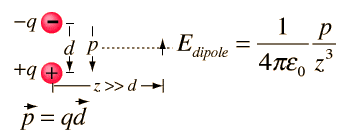
dipo2.gif

As z approaches infinity, the field becomes zero.

But if you draw a gaussian surface round the charges, then the net enclosed charge is zero.So the electric field must be zero, no matter how I draw the surface.
So If i just draw a surface tiny enough to enclose both charges, my z is totally not going to infinity and the field is zero according to Gauss' LAw.

How is this compatible with each other?What is the pitfall in my thinking.

Thanks in advance.
 
Physics news on Phys.org
Dr_Pill said:
So the electric field must be zero, no matter how I draw the surface.

No, the integral of the electric field over the entire surface (the flux of the electric field) must be zero.

On some parts of the surface, the field points outwards, which contributes a positive amount to the flux. On other parts of the surface, the field points inwards, which contributes a negative amount to the flux. The positive and negative contributions add up to zero over the entire surface.
 
Of course, you have to use the full electric field due to your dipole and an electric field is a vector. By construction any partial wave corresponds to a charge distribution with total net charge 0 except the monopole term.

The dipol field is given by the potential
\Phi(\vec{x})=\frac{\vec{p} \cdot \vec{x}}{4 \pi r^3} \quad \text{with} \quad r=|\vec{x}|.
The field is thus given by
\vec{E}=-\vec{\nabla} \Phi=\frac{1}{4 \pi r^5} [3(\vec{p} \cdot \vec{x}) \vec{x}-r^2 \vec{p}].
Here, the dipol sits at the origin of the coordinate system. The most simple surface to use is a sphere of radius a around the origin. We use spherical coordinates with the polar axis in direction of the electric moment, \vec{p}. Then we have
\mathrm{d}^2 \vec{F}=\mathrm{d} \vartheta \mathrm{d} \varphi a^2 \sin \vartheta \vec{e}_r
and thus
\int_{K_a} \mathrm{d}^2 \vec{F} \cdot \vec{E}=\int_0^{\pi} \mathrm{d} \vartheta \int_0^{2 \pi} \mathrm{d} \varphi \; \frac{p \sin \vartheta \cos \vartheta}{2 \pi a} =0.
 
Dr_Pill said:
Hi,

I don't understand this:
You got a dipole, and a resulting electric field from it like this(hyperphysics):
dipo2.gif

As z approaches infinity, the field becomes zero.

But if you draw a gaussian surface round the charges, then the net enclosed charge is zero.So the electric field must be zero, no matter how I draw the surface.
So If i just draw a surface tiny enough to enclose both charges, my z is totally not going to infinity and the field is zero according to Gauss' LAw.

How is this compatible with each other?What is the pitfall in my thinking.

Thanks in advance.

As others have pointed out, Gauss' Law tells us that if a surface encloses total charge 0, then the AVERAGE of the field over the surface is zero. That doesn't mean that it is zero at every point. In the case of a dipole, the part of surface nearest to the + charge will have a positive flux through it, and the part of the surface nearest to the - charge will have a negative flux through it.

Gauss' Law doesn't really help much in figuring out what the electric field is for a distribution of charges unless there is some kind of symmetry involved. So for instance, a flat uniform sheet of charge, a line of charge, a spherical shell of charge.
 

Similar threads

  • · Replies 7 ·
Replies
7
Views
888
  • · Replies 9 ·
Replies
9
Views
2K
  • · Replies 83 ·
3
Replies
83
Views
5K
  • · Replies 1 ·
Replies
1
Views
2K
  • · Replies 2 ·
Replies
2
Views
2K
  • · Replies 29 ·
Replies
29
Views
2K
  • · Replies 5 ·
Replies
5
Views
4K
  • · Replies 30 ·
2
Replies
30
Views
3K
  • · Replies 1 ·
Replies
1
Views
1K
  • · Replies 7 ·
Replies
7
Views
3K