Geometric Game: Fun With Matches (Safe!)

  • Thread starter Thread starter bob012345
  • Start date Start date
bob012345
Gold Member
Messages
2,321
Reaction score
1,040
TL;DR: A little geometric puzzle with matches.

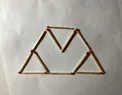
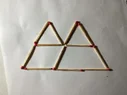
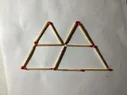
This puzzle is adapted from 100 Geometric Games by Pierre Berloquin. Twelve matches are arranged as in the image. Can you change the position of four matches to exactly form three equilateral triangles? Do not remove any of the matches.
IMG_4838.webp
 
  • Like
Likes   Reactions: Greg Bernhardt and AlexB23
Mathematics news on Phys.org
1769635988840.webp

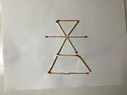
I changed the position of four matches to exactly form three equilateral triangles. I have not removed any matches.

QED
:oldbiggrin:
 
Looks like you didn't use the fourth match

If you chose the top and bottom matches you have two diamond shapes each with two equilateral triangles.

Then choose outside two matches from one triangle you'd have 3 triangles and 4 matches.
 
jedishrfu said:
Looks like you didn't use the fourth match
What do you mean? Bottom left - I flipped it!
 
  • Haha
Likes   Reactions: jedishrfu
DaveC426913 said:
View attachment 369215
I changed the position of four matches to exactly form three equilateral triangles. I have not removed any matches.

QED
:oldbiggrin:

Funny, but of course the final form of three equilateral triangles must use all the matches.
 
Here is a schematic of the puzzle.
1769636562447.webp


So, my solution is
  • translate BC northeast by a small amount
  • transate DE southeast by a small amount
  • translate AF northwest by a small amount
  • rotate EF 180 degrees.

Be careful how you word your puzzles!
 
  • Like
Likes   Reactions: bob012345
bob012345 said:
Funny, but of course the final form of three equilateral triangles must use all the matches.
So, we're moving the goalposts....
 
DaveC426913 said:
Here is a schematic of the puzzle.
View attachment 369217

So, my solution is
  • translate BC northeast by a small amount
  • transate DE southeast by a small amount
  • translate AF northwest by a small amount
  • rotate EF 180 degrees.

Be careful how you word your puzzles!

The exact wording of the source is as follows;

“Can you change the position of four matches so that exactly three equilateral triangles are formed? (Don't remove any matches.)”
 
IMG_4847.webp
 
  • Like
Likes   Reactions: Ibix, AlexB23 and renormalize
  • #10
bob012345 said:
The exact wording of the source is as follows;

“Can you change the position of four matches so that exactly three equilateral triangles are formed? (Don't remove any matches.)”
Yes. Are there any conditions I did not meet?

(Facebook is chock full of puzzles like this, and they are all always fraught with ambiguous wording, hidden assumptions and subjective interpretations.)
 
  • #11
DaveC426913 said:
View attachment 369215
I changed the position of four matches to exactly form three equilateral triangles. I have not removed any matches.

QED
:oldbiggrin:
This reminds me of the saying that the fastest way to get an answer to a question on the internet is to post an intentionally incorrect answer. -- Murphy's Law.
 
  • Agree
Likes   Reactions: DaveC426913
  • #12
FactChecker said:
the fastest way to get an answer to a question on the internet is to post an intentionally incorrect answer.
Cunningham's Law. :wink:
 
  • Like
Likes   Reactions: Borg and FactChecker
  • #13
DaveC426913 said:
Yes. Are there any conditions I did not meet?

(Facebook is chock full of puzzles like this, and they are all always fraught with ambiguous wording, hidden assumptions and subjective interpretations.)
As I read it, the condition is to form exactly three equilateral triangles without removing any matches. Moving three so they don’t touch the others is removing them from the figure. Likewise, flipping a match is not changing its position because the problem has nothing to do with the design of matches. It could be pencils or sticks or rods.
 
  • #14
bob012345 said:
As I read it,
That's my point. Ambiguity leads to subjective intepretation.

bob012345 said:
Moving three so they don’t touch the others is removing them from the figure.
Yup. That's an interpretation.

bob012345 said:
Likewise, flipping a match is not changing its position
Yup. So is that.

bob012345 said:
because the problem has nothing to do with the design of matches. It could be pencils or sticks or rods.
Yes. Which would still make my answer valid. Pencils and sticks can still be rotated 180 degrees.


I'm not bein' a troll. The real lesson in these puzzles has nothing to do with the answer itself - it has everything to do with the assumptions in the answers - but just as importantly, the assumptions in the questions themselves.
 
  • Like
Likes   Reactions: DaveE
  • #15
DaveC426913 said:
That's my point. Ambiguity leads to subjective intepretation.


Yup. That's an interpretation.


Yup. So is that.


Yes. Which would still make my answer valid. Pencils and sticks can still be rotated 180 degrees.


I'm not bein' a troll. The real lesson in these puzzles has nothing to do with the answer itself - it has everything to do with the assumptions in the answers - but just as importantly, the assumptions in the questions themselves.

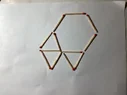
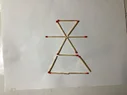
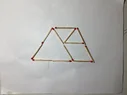
Sorry but this puzzle is not poorly written, it comes from a 1976 book by a well established puzzle authority, Pierre Berloquin. The conditions are not ambiguous but well stated. Would you have had the author set out rules such as don’t flip a match, make sure the final figure uses all 12 matches, make sure all the matches touch and only make three equilateral triangles. Make sure no other shapes are included such as these;
IMG_4840.webpIMG_4842.webpIMG_4843.webpIMG_4845.webpIMG_4839.webp

Ect…it would be no fun at all. BTW, the initial image is a big clue to how to approach the problem. It’s one whole figure.
 
  • #16
bob012345 said:
Sorry but this puzzle is not poorly written,
I have demonstrated that it is.

What is "exactly three equilateral triangles"? Even that requires lot of assumptions. You made them differently, or you wouldnt have had to state them expicitly.

What is "do not remove"? My answer did not remove them - it moved them - a legal operation.


bob012345 said:
it comes from a 1976 book by a well established puzzle authority, Pierre Berloquin. The conditions are not ambiguous but well stated.
I have demonstrated not unreasonable alternate interpretations.

In fifty years, many people have gotten a lot more sophisticafed at problem-solving. What wrked then may not work anymore.


bob012345 said:
Would you have had the author set out rules such as don’t flip a match, make sure the final figure uses all 12 matches, make sure all the matches touch and only make three equilateral triangles. Make sure no other shapes are included such as these;
Yes. "Use all 12 matches" should have been stated. "No extra shapes." as well.

That's a total of seven words. Eminently reasonable.


bob012345 said:
Ect…it would be no fun at all.
The fun is in the assumptions.

bob012345 said:
BTW, the initial image is a big clue to how to approach the problem. It’s one whole figure.
An interpretation.

My solution doen't require me to add more canvas, as yours does.
 
  • Like
Likes   Reactions: DaveE
  • #17
The pedantic and correct response is no as one cannot make an equilateral triangle because they don’t exist in the real world
 
  • #18
BWV said:
The pedantic and correct response is no as one cannot make an equilateral triangle as the don’t exist in the real world
Right. If we were to take it to its extreme.

But the problem itself implies that 3 matchstick touching end-to-end counts as a valid equailateral triangle. So that is a level of pedantry I would consider a bridge too far.

I do not consider my solution to violate any implied rules. It's a valid solution that highlights ambiguity in problem statements. Having done a lot of these, I can tell you, the trick is often in those very assumptions.


That being said, I might argue that bob012345's solution is the more elegant solution.
 
  • Like
Likes   Reactions: Jonathan Scott and bob012345
  • #19
When I saw the thread title, I thought it might be about match stick rockets. My friends and I were into them during about 5th-6th grade, about 60 years ago during the Great Space Race. :cool:

Our version was slightly different from the one in the linked article. We bent our paper clip launcher so that one prong stuck upwards at an angle, and slid that prong between the aluminum foil and the match stick. This both aimed the rocket and provided the exhaust vent for the propulsion gases. That is, we didn't use a safety pin to make the exhaust vent separately.
 
  • Like
Likes   Reactions: bob012345
  • #20
bob012345 said:
This puzzle is adapted from 100 Geometric Games by Pierre Berloquin. Twelve matches are arranged as in the image. Can you change the position of four matches to exactly form three equilateral triangles? Do not remove any of the matches.
One more solution with three congruent equilateral triangles.
1769683485390.webp
 
  • Like
Likes   Reactions: bob012345
  • #21
DaveC426913 said:
What is "exactly three equilateral triangles"? Even that requires lot of assumptions. You made them differently, or you wouldnt have had to state them expicitly.
I think "exactly" is a clear enough condition here. It means that the result is three equilateral triangles and nothing else.
 
  • Like
Likes   Reactions: bob012345
  • #22
Jonathan Scott said:
I think "exactly" is a clear enough condition here. It means that the result is three equilateral triangles and nothing else.
IMO, it is ambiguous. I wouldn't interpret it that way. I would interpret it as "exactly three" rather than 2 or 4, etc. and there could be other things that are not equilateral triangles and don't count.
 
  • Like
Likes   Reactions: DaveC426913
  • #23
FactChecker said:
IMO, it is ambiguous. I wouldn't interpret it that way. I would interpret it as "exactly three" rather than 2 or 4, etc. and there could be other things that are not equilateral triangles and don't count.
That’s what I first thought and thus the small figures above in post #15. But something bothered me and I avoided looking at the book’s answer. Then I took the work ‘exactly’ to mean what @Jonathan Scott said in post #21 and came up with my solution. Regardless of the technicalities of all the various arguments made here about interpretation, which are valid, I think the puzzle was designed for ordinary people and not math geeks who might question every assumption.
 
  • #24
Gavran said:
One more solution with three congruent equilateral triangles.
That’s adds to the class of figures in post #15 which I first considered. An interesting question is how many of these types of figures can be found, moving or rearranging only four matches but allowing additional shapes besides the three equilateral triangles? I see two classes, one with entirely closed shapes, such as what I call ‘mountains’ and one which allows shapes such as ‘snowman’ which your solution fits into.
IMG_4839.webpIMG_4843.webp
 
  • #25
bob012345 said:
That’s what I first thought and thus the small figures above in post #15. But something bothered me and I avoided looking at the book’s answer. Then I took the work ‘exactly’ to mean what @Jonathan Scott said in post #21 and came up with my solution. Regardless of the technicalities of all the various arguments made here about interpretation, which are valid, I think the puzzle was designed for ordinary people and not math geeks who might question every assumption.
I think the difference is whether the phrase "exactly three equilateral triangles" is taken alone versus in the context of the puzzle. Taken alone, I would interpret the English phrase one way, but having seen many puzzles like this, I make a different assumption.
 
  • Like
Likes   Reactions: bob012345
  • #26
FactChecker said:
I think the difference is whether the phrase "exactly three equilateral triangles" is taken alone versus in the context of the puzzle. Taken alone, I would interpret the English phrase one way, but having seen many puzzles like this, I make a different assumption.
I think the author knew his target audience and generally what they would assume from his setup of the puzzle. And it takes some skill to do it in a concise and captivating manner.
 
  • Like
Likes   Reactions: FactChecker
  • #27
Jonathan Scott said:
I think "exactly" is a clear enough condition here. It means that the result is three equilateral triangles and nothing else.
I interpreted it to mean three triangles, no more, no less. (Ruling out solutions that produce four triangles.) I might even extend it to mean and no other shapes (ruling out at least one solution that produces a hexagon).
 
  • Like
Likes   Reactions: bob012345
  • #28
bob012345 said:
I think the author knew his target audience and generally what they would assume from his setup of the puzzle. And it takes some skill to do it in a concise and captivating manner.
I agree with this. The era and context provided additional ... context, of which we are bereft.

As I mentioned, these puzzle now show up online so often that a new context is formed organically. A lot of puzzles rely on the leaky margins of specifications to solve.

For example - the classic matchstick puzzle: can you make four identical equilateral triangles using only six matchsticks?
 
  • Like
Likes   Reactions: bob012345
  • #29
DaveC426913 said:
I agree with this. The era and context provided additional ... context, of which we are bereft.

As I mentioned, these puzzle now show up online so often that a new context is formed organically. A lot of puzzles rely on the leaky margins of specifications to solve.

For example - the classic matchstick puzzle: can you make four identical equilateral triangles using only six matchsticks?
I believe so, yes. How is that leaky though?
Make a 3D pyramid.
[\spoiler]
 
  • #30
DaveC426913 said:
I interpreted it to mean three triangles, no more, no less. (Ruling out solutions that produce four triangles.) I might even extend it to mean and no other shapes (ruling out at least one solution that produces a hexagon).
But isn’t there usually a class of trivial solutions which can be discounted? Maybe because they seem to violate the spirit of the puzzle.
 

Similar threads

  • · Replies 31 ·
2
Replies
31
Views
4K
Replies
2
Views
795
  • · Replies 10 ·
Replies
10
Views
2K
  • · Replies 1 ·
Replies
1
Views
3K
  • · Replies 101 ·
4
Replies
101
Views
14K
  • · Replies 0 ·
Replies
0
Views
4K
  • · Replies 29 ·
Replies
29
Views
7K
  • · Replies 83 ·
3
Replies
83
Views
22K
Replies
10
Views
5K
  • · Replies 67 ·
3
Replies
67
Views
16K