Geometric intuition of a rank formula

Click For Summary
SUMMARY

The discussion centers on the geometric intuition behind the rank formula for linear transformations, specifically the equation ##\rho(\tau)=\rho(\tau\sigma)+d[Im(\sigma)\cap K(\tau)]##. Participants analyze the implications of projecting a 3D object onto 2D and 1D spaces, emphasizing that such projections result in a loss of information and a decrease in rank. The conversation highlights the importance of understanding projectors and their properties, particularly in relation to linear independence and the kernel of transformations.

PREREQUISITES
  • Understanding of linear transformations and their ranks
  • Familiarity with the concepts of image and kernel in linear algebra
  • Knowledge of projection operators and their properties
  • Basic comprehension of geometric representations in algebra
NEXT STEPS
  • Study the properties of projection operators in linear algebra
  • Explore the geometric interpretation of rank in linear transformations
  • Learn about the implications of dimensionality reduction in data representation
  • Investigate applications of rank in discrete mathematics and data analysis
USEFUL FOR

Mathematicians, students of linear algebra, data scientists, and anyone interested in the geometric interpretation of mathematical concepts related to rank and transformations.
Terrell
Messages
316
Reaction score
26
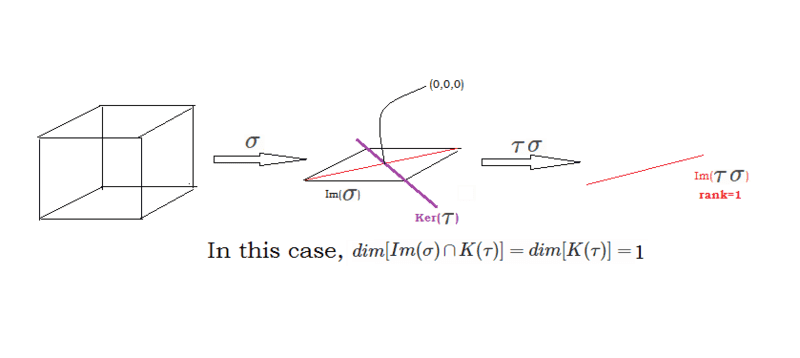
I am trying to understand the geometric intuition of the above equation. ##\rho(\tau)## represents the rank of the linear transformation ##\tau## and likewise for ##\rho(\tau\sigma)##. ##Im(\sigma)## means the image of the linear transformation ##\sigma## and lastly, ##K(\tau)## is the kernel of ##\tau##.
The equation: ##\rho(\tau)=\rho(\tau\sigma)+d[Im(\sigma)\cap K(\tau)]##
rank of tau.png
 

Attachments

  • rank of tau.png
    rank of tau.png
    9.6 KB · Views: 771
Last edited:
Physics news on Phys.org
I'm not certain of what your picture is trying to get across, but a nice underlying idea would be of the use of the projection operator. They exist over many fields though I think you're talking about Reals here for geometry.

In your example's case it would be a 3x3 matrix, but in general its some ##n## x ##n## matrix, where ##\mathbf P^2 = \mathbf {PP} = \mathbf P##. If you play around with it a little, you see it must be diagonalizable (over reals) and only has 0s and 1s for eigenvalues (technically you could include the identity matrix and zero matrix, but they aren't really what people mean when talking about projectors). From here there are a lot of similarity transforms that can be done. My sense is your picture is showing the application of two different projectors.

- - - -
I actually think your picture is wrong. From what I can tell the LHS is a cube with non-zero volume (hence non-zero determinant) and thus full rank. It gets mapped down to a parallelogram given by those two black lines. It seems to be showing that they are linearly independent and if you add them together you get the red line. (It actually seems to be showing an affine space -- I don't get the motivation for not having the vectors oriented at zero or why the origin is only referenced in the middle picture.) The nullspace / kernel / purple line should be perpendicular to this plane, though it doesn't really look like it is to me.

Full circle / meta take:
it strikes me as almost perverse to have a picture showing a 3d space being mapped to a 2d space then mapped to a 1d space, when the original picture is "3d" but is in fact itself projected onto a 2d space (i.e. a piece of paper or your computer screen). So stepping back, the geometric intuition is: when you have a structure that is 3d but project it down/ try to represent it in 2d, you lose some information, making it harder to interpret clearly. In algebraic terms we call this a decrease in rank. And when you project from 2d to 1d you lose even more information.

Conversely, if you wanted an example showing the above phenomenon, and for the example itself to not be rank deficient, I think you'd either (a) want to build a 3d model yourself (perhaps with toothpicks) or (b) have an interactive 3d graphics program that while technically any given picture is 2d, it would allow you to drag and rotate enough to get some appreciation for depth and angles, etc. There is a big difference between being actually 3d and just drawing something on a piece of paper.
 
Last edited:
  • Like
Likes   Reactions: Terrell
StoneTemplePython said:
It gets mapped down to a parallelogram given by those two black lines. It seems to be showing that they are linearly independent and if you add them together you get the red line
The red line is what about to be the ##Im(\tau\sigma)## which is why I matched a red line on the rightmost image.
StoneTemplePython said:
It gets mapped down to a parallelogram
This is not intended to be a parallelogram. This is a square drawn from a different perspective. So the transformation ##\sigma## flattens the cube into a square plane. Thus, the purple line,##K(\tau)##, is perpendicular to the red one. Although, I think that the purple line should not be ##K(\tau)##, but rather the kernel of some transformation ##\tau'##; ##K(\tau')##.
StoneTemplePython said:
The nullspace / kernel / purple line should be perpendicular to this plane
Shouldn't the one that must be perpendicular to the square plane be the kernel of ##\sigma##, ##K(\sigma)##? (Which I didn't include in the picture)
StoneTemplePython said:
when you have a structure that is 3d but project it down/ try to represent it in 2d, you lose some information, making it harder to interpret clearly
I agree, which is why I think that representing this graphically may not really be a good idea. Since the transformations are arbitrary, there's no way of telling what would happen to the cube if the transformation ##\tau## was performed before ##\sigma##, right?
 
I am sorry for the week late response. I did not expect anyone would respond after a day of not getting any responses :D
 
Terrell said:
I agree, which is why I think that representing this graphically may not really be a good idea. Since the transformations are arbitrary, there's no way of telling what would happen to the cube if the transformation ##\tau## was performed before ##\sigma##, right?

I mean this really is the point -- when you use a low rank representation of some structure /data, etc, you lose something in the process. In this case the 2-D representation of a cube is the low rank representation of your 3-d object. As a meta-point I think that's as good an interpretation you can get on the geometry of rank. Spend some time thinking about projectors. Beyond that the picture is not great for interpretation.

There are also some rather stunning uses of rank in discrete math -- e.g. if you want to tell if some finite (or perhaps sampled) sequence of data has only finite support.
Terrell said:
I am sorry for the week late response. I did not expect anyone would respond after a day of not getting any responses :D

According to time stamps, there is a less than 12 hour difference between your original post and my response?
 
  • Like
Likes   Reactions: Terrell
StoneTemplePython said:
Spend some time thinking about projectors. Beyond that the picture is not great for interpretation.

There are also some rather stunning uses of rank in discrete math -- e.g. if you want to tell if some finite (or perhaps sampled) sequence of data has only finite support.
Haven't studied projections in depth, yet. I will be on the look out for connections when I get to study it again. thank you!
 

Similar threads

  • · Replies 11 ·
Replies
11
Views
2K
  • · Replies 3 ·
Replies
3
Views
1K
  • · Replies 4 ·
Replies
4
Views
3K
  • · Replies 1 ·
Replies
1
Views
2K
  • · Replies 13 ·
Replies
13
Views
1K
  • · Replies 4 ·
Replies
4
Views
5K
  • · Replies 4 ·
Replies
4
Views
2K
  • · Replies 1 ·
Replies
1
Views
2K
Replies
6
Views
2K
  • · Replies 6 ·
Replies
6
Views
2K