Geometric Methods for Adding Vectors: Are You Doing It Right?

  • Thread starter Thread starter Qube
  • Start date Start date
  • Tags Tags
    Vectors
Click For Summary
SUMMARY

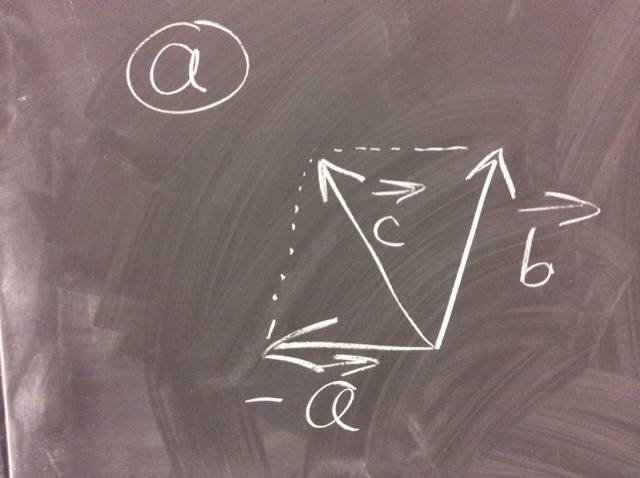
The discussion focuses on the geometric representation of vector addition, specifically the relationship defined by the equation "Vector a - vector b = vector c." The user illustrates this relationship using two methods: the parallelogram rule and an alternative method for adding vectors. Feedback indicates that the user correctly understands the concept but made a minor error in the representation of the vectors in their drawings. The discussion emphasizes the importance of accurately depicting vector directions when performing vector addition.

PREREQUISITES
  • Understanding of vector operations, specifically vector addition and subtraction.
  • Familiarity with the parallelogram rule for vector addition.
  • Basic knowledge of geometric representation of vectors.
  • Ability to interpret vector diagrams and their implications.
NEXT STEPS
  • Study the geometric interpretation of vector subtraction in detail.
  • Explore alternative methods for vector addition beyond the parallelogram rule.
  • Learn about vector components and how they affect vector addition.
  • Review resources on vector diagrams and their accuracy in representation.
USEFUL FOR

Students in physics or mathematics, educators teaching vector concepts, and anyone interested in mastering geometric methods for vector addition.

Qube
Gold Member
Messages
461
Reaction score
1
Represent the below vector relationship geometrically, illustrating two different ways of adding vectors.

Vector a - vector b = vector c.

I know the above relationship can also be expressed as:

Vector a + (-vector b) = vector c.

In other words, we flip the direction of vector b and add as usual.

Attached are two pictures of me adding two *arbitrary* vectors a and b (vectors a and b change in the two attached photos).

In the first picture, I use the parallelogram rule. In the second picture, I use another method to add the arbitrary vectors a and b.

Did I add the two vectors together correctly?
ImageUploadedByTapatalk1391299475.883452.jpg

ImageUploadedByTapatalk1391299487.617555.jpg
 
Physics news on Phys.org
Qube said:
Represent the below vector relationship geometrically, illustrating two different ways of adding vectors.

Vector a - vector b = vector c.

I know the above relationship can also be expressed as:

Vector a + (-vector b) = vector c.

In other words, we flip the direction of vector b and add as usual.

Attached are two pictures of me adding two *arbitrary* vectors a and b (vectors a and b change in the two attached photos).

In the first picture, I use the parallelogram rule. In the second picture, I use another method to add the arbitrary vectors a and b.

Did I add the two vectors together correctly?
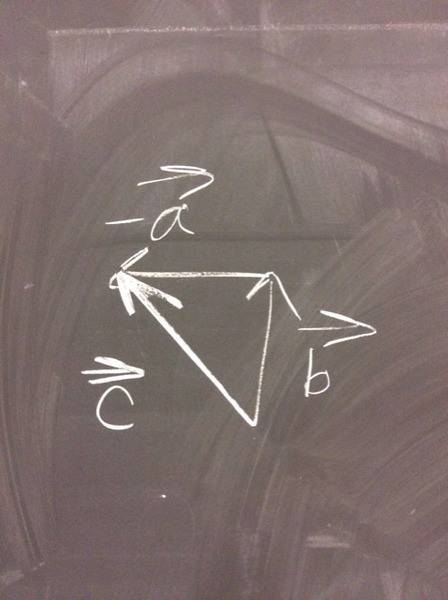
Your problem statement has the "-" sign with vector b, but your drawing has the "-" sign on vector a instead. Other than that, you have the right idea.
 

Similar threads

Replies
14
Views
2K
Replies
1
Views
1K
  • · Replies 7 ·
Replies
7
Views
2K
  • · Replies 8 ·
Replies
8
Views
1K
Replies
4
Views
3K
  • · Replies 1 ·
Replies
1
Views
1K
Replies
2
Views
2K
Replies
13
Views
2K
Replies
5
Views
2K
Replies
11
Views
3K