What is the focal point of a lens in a geometrical optics problem?

Click For Summary
SUMMARY

The focal point of a lens in geometrical optics can be determined using the relationship f = R/2, where R is the radius of curvature of the lens surface. In this discussion, the focal point was identified as -25.5 cm, indicating a concave lens. The problem-solving approach suggested involves treating the first surface of the lens as a spherical mirror to deduce the radius of curvature, followed by applying the Lensmaker's equation to find the overall focal length of the system.

PREREQUISITES
  • Understanding of geometrical optics principles
  • Familiarity with the Lensmaker's equation
  • Knowledge of spherical mirrors and their properties
  • Basic skills in solving optics problems
NEXT STEPS
  • Study the derivation and application of the Lensmaker's equation
  • Learn about the properties of spherical mirrors and their focal points
  • Explore examples of concave and convex lenses in optical systems
  • Investigate the impact of refractive index on lens design
USEFUL FOR

Students and educators in physics, particularly those focusing on optics, as well as anyone seeking to deepen their understanding of lens behavior and focal point calculations.

Marioweee
Messages
18
Reaction score
5
Homework Statement
We have a divergent lens on which a beam of parallel rays strikes from left to right. Part of the light reflects off the first face and the reflected rays converge at the point indicated by the arrow, which is - 25.5 cm from the vertex of the first lens surface. Assuming that the lens is symmetrical, that is, that "R1= -R2 &, which is thin, and whose refractive index is 1.5, state the value of the focal point of the lens with its sign.
Relevant Equations
---
I have recently started with geometric optics and I do not quite understand what this problem asks of me. According to the statement, the focal point of the lens would be -25.5cm, right? That is, it is only a problem of concepts where it is not necessary to take into account the radii of the lenses or the refractive index, right?
Maybe I am very wrong that is why I ask for some help.
This is the picture of the problem that I have done.
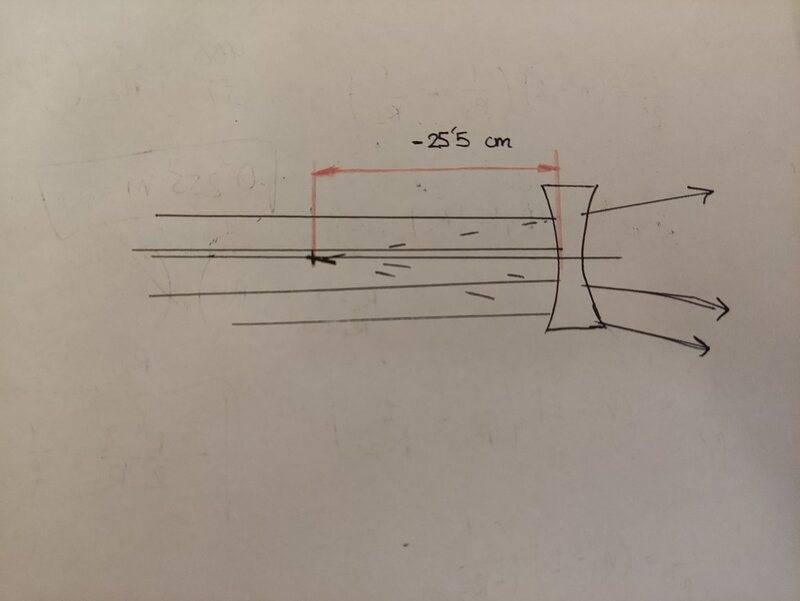
WhatsApp Image 2021-10-03 at 20.02.34.jpeg
 
Physics news on Phys.org
Marioweee said:
According to the statement, the focal point of the lens would be -25.5cm, right?
Why would you think that? Hint: Solve the problem in two steps. Step one: Treat the first surface of the lens as a mirror. What can you then deduce?
 
If the first surface is treated as a spherical mirror then f=R/2. From this equation we can determine the value of R1. Then, from the Lensmarker's equation I could determine the focal length of the system, right?
 
Marioweee said:
If the first surface is treated as a spherical mirror then f=R/2. From this equation we can determine the value of R1. Then, from the Lensmarker's equation I could determine the focal length of the system, right?
Right!
 
Thank you very much for your help
 

Similar threads

  • · Replies 3 ·
Replies
3
Views
1K
Replies
1
Views
2K
  • · Replies 7 ·
Replies
7
Views
2K
  • · Replies 3 ·
Replies
3
Views
1K
  • · Replies 13 ·
Replies
13
Views
3K
  • · Replies 3 ·
Replies
3
Views
2K
Replies
12
Views
1K
  • · Replies 10 ·
Replies
10
Views
2K
  • · Replies 2 ·
Replies
2
Views
2K
  • · Replies 16 ·
Replies
16
Views
2K