Gimbaled Gyroscope: Do I Need Constant Torque?

  • Context: High School 
  • Thread starter Thread starter Viroos
  • Start date Start date
  • Tags Tags
    Gyroscope
Click For Summary
SUMMARY

The discussion centers on the torque requirements of a gimbal motor in relation to a rotating flywheel. It is established that the torque applied by the gimbal motor does not accelerate the flywheel; instead, it induces precessional motion at a constant angular velocity. To alter the velocity of precession, the torque must be adjusted. The conversation highlights that the same torque is necessary to accelerate the flywheel regardless of its rotational state, but the gyroscopic couple will create a bending moment on the gimbal shaft.

PREREQUISITES
  • Understanding of gyroscopic motion and precession
  • Familiarity with torque and moment of inertia concepts
  • Knowledge of angular velocity and its effects
  • Basic principles of gimbal mechanics
NEXT STEPS
  • Research the principles of gyroscopic precession in detail
  • Study the relationship between torque and angular momentum
  • Explore the mechanics of gimbal systems and their applications
  • Learn about the effects of gyroscopic couples on structural components
USEFUL FOR

Engineers, physicists, and hobbyists interested in robotics, aerospace applications, or any field involving gyroscopic systems will benefit from this discussion.
Viroos
Messages
4
Reaction score
0
Hi !
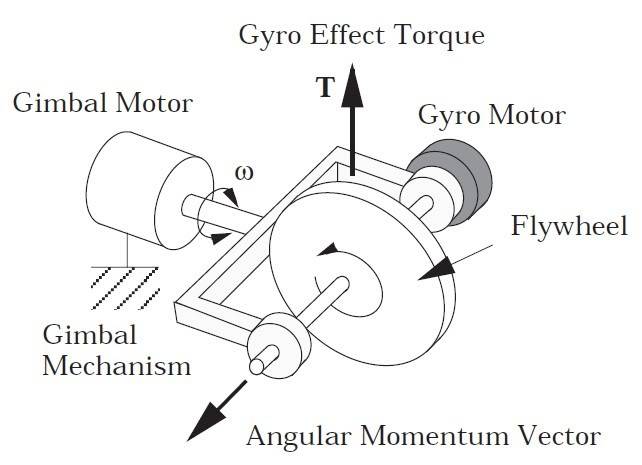
I have very basic question about gyroscopes: do I need same torque from gimbal motor to accelerate the flywheel whenever it's rotating or not ? (and the gimbal motor is attached to the floor)

cmg.jpg


Thanks in advance :)
 
Physics news on Phys.org
Anybody ?
 
The torque applied from the gimbal motor is not going to accelerate it, it is only going to cause precessional motion at a particular constant angular velocity. You'd have to change the torque to change the velocity of precession. The couple is equal to moment of inertia times the cross product of velocity of precession and vel. of spin.
There's something wrong with your diagram. The input couple causes precession about a perpendicular axis but this kind of motion is not possible from what is seen in the drawing.
 
Last edited:
That's what is confusing me-the gimbal motor is fixed to the floor, so the precession is impossible and the only possible rotation is "omega", and that's exactly the problem-is there any difference in the gimbal motor torque when the flywheel is rotating and when it's not ?
 
The same amount of torque will be required to accelerate the flywheel irrespective of whether it's rotating or not, but the gyroscopic couple will produce bending moment of the gimbal shaft.
 

Similar threads

  • · Replies 19 ·
Replies
19
Views
2K
  • · Replies 0 ·
Replies
0
Views
1K
Replies
4
Views
2K
  • · Replies 1 ·
Replies
1
Views
1K
  • · Replies 8 ·
Replies
8
Views
3K
  • · Replies 10 ·
Replies
10
Views
3K
  • · Replies 10 ·
Replies
10
Views
4K
  • · Replies 1 ·
Replies
1
Views
7K
  • · Replies 23 ·
Replies
23
Views
3K
  • · Replies 2 ·
Replies
2
Views
1K