Gradient equal to multiplying by vector?

  • Context: Undergrad 
  • Thread starter Thread starter Isaac0427
  • Start date Start date
  • Tags Tags
    Gradient Vector
Click For Summary

Discussion Overview

The discussion revolves around the mathematical properties of the gradient operator in the context of electric fields, specifically examining the relationship between the gradient of scalar functions and vector multiplication. Participants explore specific cases involving the function \( \frac{1}{|r|} \) and its gradient, as well as related expressions.

Discussion Character

  • Technical explanation
  • Mathematical reasoning
  • Debate/contested

Main Points Raised

  • One participant suggests that taking the negative gradient of \( \frac{1}{|r|} \) results in \( \frac{\hat{\mathbf{r}}}{|r|^2} \), indicating a specific case of the gradient operator.
  • Another participant confirms the previous claim regarding the gradient of \( \frac{1}{|r|} \) and poses a question about the gradient of \( \frac{2}{|r|} \), asking if it would yield \( \frac{2\hat{\mathbf{r}}}{|r|^2} \).
  • A subsequent post reiterates the question about the gradient of \( \frac{2}{|r|} \) and seeks clarification on the mathematical expression, indicating uncertainty about the notation used.
  • Another participant asserts that a multiplicative constant can be factored out of the gradient, implying a general property of the gradient operator.

Areas of Agreement / Disagreement

Participants generally agree on the gradient of \( \frac{1}{|r|} \) but there is uncertainty regarding the gradient of \( \frac{2}{|r|} \), with some participants seeking clarification and others affirming the mathematical properties involved.

Contextual Notes

There are unresolved aspects regarding the notation and specific mathematical steps in the discussion, particularly in relation to the expressions used and the assumptions made about the functions involved.

Isaac0427
Insights Author
Gold Member
Messages
718
Reaction score
163
Hi guys!
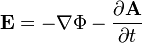
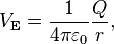
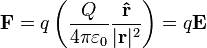
So I have been researching the electric field, and I have come upon some interesting equations that confused me a little (all from wikipedia):
fe40e6e5030963130cd36c93ca29f634.png
,
400073dd9ef3633c03d01c35c9f6281e.png
, and
8757428f7aeb787795811caa40897baa.png
with V being the same as psi. Doing the algebra, I would get (Q/4πε0)*(r-hat/|r|2)=-∇(Q/4πε0r)-∂A/∂t. Now in the case that A does not change with time, we would get that taking the negative gradient is equal to multiplying by r-hat/|r|. Is this correct?
 
Physics news on Phys.org
Yes, this is true for the gradient of ##\frac{1}{|r|}##. $$-\nabla \frac{1}{|r|} = \frac{\hat{\mathbf{r}}}{|r|^2}, \;\;\;\;\;\;\;\;r\neq0.$$
 
MisterX said:
Yes, this is true for the gradient of 1|r|\frac{1}{|r|}.

Would the negative gradient of 2|r|\frac{2}{|r|} be 2r-hat over |r|2?
 
Isaac0427 said:
Would the negative gradient of 2|r|\frac{2}{|r|} be 2r-hat over |r|2?

Sorry, I don't know what happened with the code. I was asking bout 2/|r|
 
Isaac0427 said:
Would the negative gradient of 2|r|\frac{2}{|r|} be 2r-hat over |r|2?
you can always take a moltiplicative constant out of the gradient.

--
lightarrow
 

Similar threads

  • · Replies 1 ·
Replies
1
Views
2K
  • · Replies 8 ·
Replies
8
Views
3K
  • · Replies 8 ·
Replies
8
Views
2K
  • · Replies 3 ·
Replies
3
Views
967
  • · Replies 3 ·
Replies
3
Views
2K
  • · Replies 4 ·
Replies
4
Views
2K
  • · Replies 9 ·
Replies
9
Views
2K
  • · Replies 4 ·
Replies
4
Views
1K
  • · Replies 25 ·
Replies
25
Views
3K
  • · Replies 38 ·
2
Replies
38
Views
7K