Graphical Four Bar Linkage question

  • Context: Engineering 
  • Thread starter Thread starter jojosg
  • Start date Start date
jojosg
Messages
35
Reaction score
5
Homework Statement
In a four-bar mechanism, the length of crank AB-15 mm, length of coupler BC-40 mm. length of rocker CD-30 mm, and length of frame DA=45 mm. Graphically determine the following.(1)The throw yof rocker CD,
(2)The maximum value of pressure angle a., and(3) The time ratio.
Relevant Equations
nil
1777207668999.webp

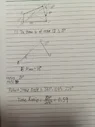
Did I do mine correctly?
 

Attachments

  • att.webp
    att.webp
    22.6 KB · Views: 1
Physics news on Phys.org
How the instantaneous position of the mechanism can be determined from the description?
 
jojosg said:
Homework Statement: In a four-bar mechanism, the length of crank AB-15 mm, length of coupler BC-40 mm. length of rocker CD-30 mm, and length of frame DA=45 mm. Graphically determine the following.(1)The throw yof rocker CD,
(2)The maximum value of pressure angle a., and(3) The time ratio.
Relevant Equations: nil

View attachment 371186
Did I do mine correctly?
I find your diagram illegible. If I expand it at all it becomes very fuzzy.
 
haruspex said:
I find your diagram illegible. If I expand it at all it becomes very fuzzy.
pic.webp
 
I don’t fully understand your diagram. It looks like you have superimposed three states in one picture:
1. Joint B is down to the left from A, with AB and BC at 180° to each other.
2. Joint B has been rotated so that angle CAB is 180°-134°=46°.
3. Joint B is further rotated so that ABC form a straight line.
The throw, then, would be the change in angle of CD from position 1 to position 3.
So what is position 2 and where does the 134° come from? I see no basis for it in the question text.
I agree with your 55° (well, 54 point something).
 
Last edited:
I'm also not not sure about 134 degrees. I'm not sure how to measure pressure angle
 
jojosg said:
I'm also not not sure about 134 degrees.
You must have written it for a reason. Where does it come from?
jojosg said:
I'm not sure how to measure pressure angle
What do you mean by a "pressure angle"?
 
haruspex said:
You must have written it for a reason. Where does it come from?

What do you mean by a "pressure angle"?
For the 134 degrees I drew the case where link AB and link BC are coincident and fold together. The I measured the angle between AB original position to the folded position which gives me 134 degrees. Maximum pressure angle occurs when the transmission angle is minimal, typically at extreme positions of the linkage. Thats what I think it is.
 
jojosg said:
The I measured the angle between AB original position
What original position? Are you basing that on a diagram provided with the question?
If so, I would think it is purely illustrative of a general position, not indicating any specific angles of interest.

What angle, or difference of two angles, do you consider to be the 'throw', and what value do you get for it?

After some research, it seems that the "transmission angle" is BCD in your diagram. I'm still unclear what the "maximum pressure angle" is, but I here assume it is a particular value of the transmission angle, namely, that which corresponds to maximum pressure somewhere.
You wrote that it corresponds to the minimum transmission angle, so if my assumption is correct it would be that minimum value.
However, my intuition is that it means an angle at which the maximum pressure is exerted on joint C, and that would be when ABC is a straight line, yes?
In the actual setup, it can go past straight, making the transmission angle smaller.
Can you provide a link where all these terms are defined?
 
Last edited:
  • #10
haruspex said:
What original position? Are you basing that on a diagram provided with the question?
If so, I would think it is purely illustrative of a general position, not indicating any specific angles of interest.

What angle, or difference of two angles, do you consider to be the 'throw', and what value do you get for it?

After some research, it seems that the "transmission angle" is BCD in your diagram. I'm still unclear what the "maximum pressure angle" is, but I here assume it is a particular value of the transmission angle, namely, that which corresponds to maximum pressure somewhere.
You wrote that it corresponds to the minimum transmission angle, so if my assumption is correct it would be that minimum value.
However, my intuition is that it means an angle at which the maximum pressure is exerted on joint C, and that would be when ABC is a straight line, yes?
In the actual setup, it can go past straight, making the transmission angle smaller.
Can you provide a link where all these terms are defined?
Textbook This is the textbook I'm using for this course. The original position I refer to is based of the diagram provided.
 
  • #11
jojosg said:
Textbook This is the textbook I'm using for this course. The original position I refer to is based of the diagram provided.
It confirms that the position you measured the 134° from is purely illustrative. It is not relevant to the actual question. Just use the B'C' and B"C" positions.
I can’t find any description of pressure angle as it applies to a linkage.
For cams and gears it is defined as the angle between the pressure applied by the driver on the follower (which is normal to the contact plane) and the instantaneous direction of movement of the follower. But here we have two transfers: from AB to BC and from BC to CD. My guess is that it is angle between BC and the direction of movement of C. Note that the angle could be maximised after passing through position B"C", at which point it will be pulling on C, not pushing.
 

Similar threads

  • · Replies 3 ·
Replies
3
Views
3K
  • · Replies 1 ·
Replies
1
Views
2K
  • · Replies 1 ·
Replies
1
Views
2K
Replies
1
Views
2K
  • · Replies 1 ·
Replies
1
Views
3K
  • · Replies 2 ·
Replies
2
Views
2K
  • · Replies 2 ·
Replies
2
Views
2K
  • · Replies 3 ·
Replies
3
Views
3K
  • · Replies 21 ·
Replies
21
Views
4K
  • · Replies 62 ·
3
Replies
62
Views
6K