Graphical Vector Problem (What are they asking for?)

  • Thread starter Thread starter Saladsamurai
  • Start date Start date
  • Tags Tags
    Vector
Click For Summary

Homework Help Overview

The discussion revolves around a graphical vector problem where participants are trying to interpret the requirements of the problem statement. The original poster expresses confusion about whether numerical values are needed or if measurements should be taken physically.

Discussion Character

  • Exploratory, Assumption checking

Approaches and Questions Raised

  • Participants discuss the interpretation of the problem, with some suggesting graphical methods such as drawing vectors and constructing parallelograms. Questions arise about how to measure lengths and the implications of vector orientation.

Discussion Status

There is a mix of interpretations being explored, with some participants offering guidance on how to approach the problem graphically. However, there is no explicit consensus on the best method to proceed, as confusion remains about the setup of the vectors.

Contextual Notes

Participants note the possibility of needing to consider negative coefficients for the vectors and the challenge of visualizing the correct arrangement of vectors A, B, and C in the parallelogram.

Saladsamurai
Messages
3,009
Reaction score
7
"Graphical" Vector Problem (What are they asking for?)

Homework Statement


Here is the problem statement. I honestly don't understand what it is they are asking for? Do they want actual numbers? Am I supposed to measure the lengths with a ruler or something? I know it's easy once I interpret the question correctly :smile:
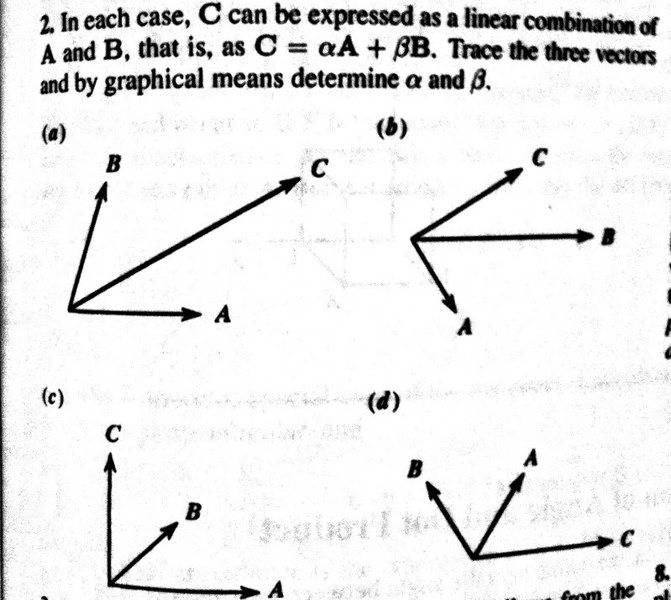
Doc-11_14_105_08PM-page-1.jpg


How would you interpret this one?
 
Physics news on Phys.org


Hey, that vector A in part (c) is bent. Must have a non-zero curl :-p

Yup, that's what I would do. Draw them carefully, construct the corresponding parallelograms and figure out the alpha and beta by measuring to scale things. "Trace" them certainly suggests that.


LCKurtz said:
Hey, that vector A in part (c) is bent. Must have a non-zero curl :-p

Yup, that's what I would do. Draw them carefully, construct the corresponding parallelograms and figure out the alpha and beta by measuring to scale things. "Trace" them certainly suggests that.

Haha! :smile: Thanks LCKurtz! Don't quit your day job (assuming you have one!)!


By "graphical means" they mean for you to extend the vectors A and B so that the lengthened vectors form two sides of a parallelogram whose diagonal is C. You'll need to find the lengths of A and B with a ruler so that you can determine the values of [itex]\alpha[/itex] and [itex]\beta[/itex] so that [itex]\alpha[/itex]A + [itex]\beta[/itex]B = C.

For example, if you have to double the lengths of A and B to form the parallelogram, then [itex]\alpha[/itex] = [itex]\beta[/itex] = 2.

Your mileage may vary...


I must be an idiot. I cannot see a way to extend or shorten A and B such that C becomes the diagonal of the parallelogram. My brain keeps making B the diagonal since it is more intuitive to me.


Don't forget that your coefficients of A and/or B may be negative so you also have to consider the opposite of A or B when making your parallelogram.
 

Similar threads

  • · Replies 4 ·
Replies
4
Views
2K
  • · Replies 4 ·
Replies
4
Views
3K
  • · Replies 1 ·
Replies
1
Views
2K
  • · Replies 4 ·
Replies
4
Views
2K
Replies
1
Views
1K
  • · Replies 4 ·
Replies
4
Views
2K
  • · Replies 15 ·
Replies
15
Views
3K
  • · Replies 2 ·
Replies
2
Views
4K
  • · Replies 6 ·
Replies
6
Views
4K
  • · Replies 3 ·
Replies
3
Views
5K