Graphing θ=π/4 on a Polar Coordinate System

Click For Summary

Homework Help Overview

The discussion revolves around graphing the equation θ=π/4 on a polar coordinate system. Participants explore the implications of this equation, particularly why the line extends into multiple quadrants and the nature of the radius r in polar coordinates.

Discussion Character

  • Exploratory, Conceptual clarification, Assumption checking

Approaches and Questions Raised

  • Participants discuss the non-uniqueness of angles in polar coordinates and question the implications of positive and negative values for r. They explore how the angle θ can represent points in different quadrants and the conventions that govern these representations.

Discussion Status

The conversation is ongoing, with participants providing insights into the conventions of polar coordinates. Some have suggested that the sign of r and θ is determined by the direction of traversal from the polar axis, while others are questioning the definitions and implications of these conventions.

Contextual Notes

There is a focus on the conventions used in polar coordinates, including how angles are defined based on direction and how the radius can be positive or negative. Participants are considering the implications of these conventions on graphing and interpreting polar equations.

lightlightsup
Messages
100
Reaction score
11
Homework Statement
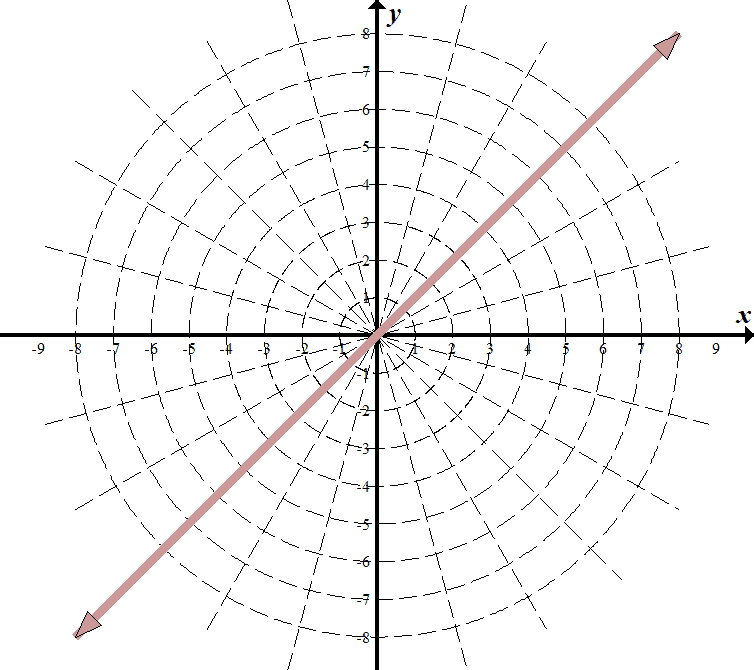
Graph ##θ=\frac{π}{4}## on a Polar Coordinate System.
Relevant Equations
Why does the line go into the opposite quadrant as well?
When you graph something like ##θ=\frac{π}{4}## on a Polar Coordinate System:
Why does the line go into the opposite quadrant as well?
I can intuitively understand why it is in the first quadrant: ##θ = 45°## there and so all possible values of ##r## would apply there, giving you a straight line headed outwards at an angle of ##45°##.
So, why does the line go into the opposite quadrant as well?
Isn't ##r## always positive? Or, is that something we define beforehand as being either positive or negative?
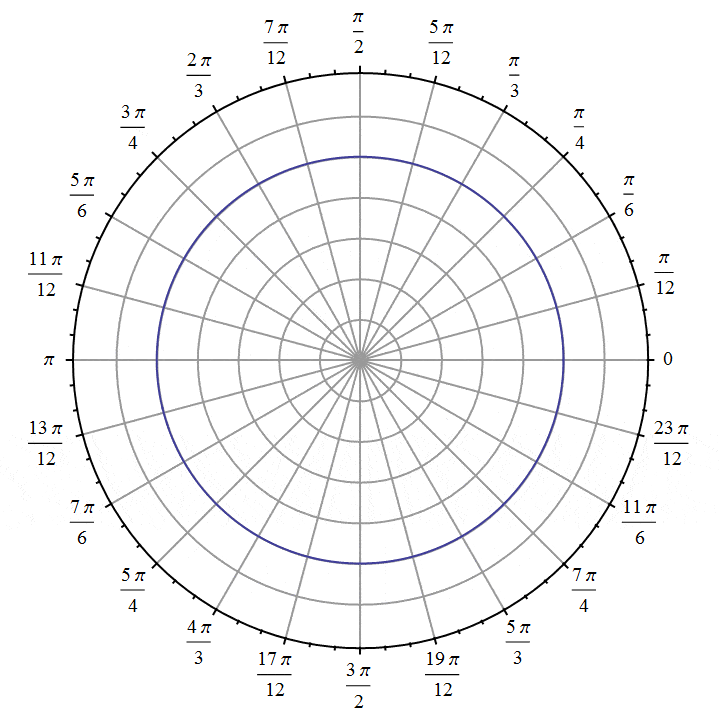
polargraph.gif
Line.png
 
  • Like
Likes   Reactions: member 587159
Physics news on Phys.org
In polar coordinates, the angle that corresponds to a certain point is not unique. For example, let's say that we have a point, at a distance of 2 units from the origin on the radius with ##θ=30^0##. It has polar coordinates ##r=2,θ=30^0##. It has also coordinates ##r=2,θ=−330^0## and ##r=2,θ=390^0##. So, it depends on what direction we traverse the circle - as in Trigonometry an angle ##θ## is positive when it runs counter-clockwise, and how many times we traverse the circle.

EDIT: Also, the radius ##r##, can be negative. So, we talk about an oriented distance. For instance, the radius with ##θ=30^0## and the one with ##θ=210^0## form a straight line which passes through the origin. The point, say, ##P(2,210^0)## which is at a distance of ##2## units from the origin on the radius with ##θ=210^0##, has polar coordinates ##r=2,θ=210^0##. We can reach this point if we go in the positive direction ##210^0## and walk ##2## units forward. We can also reach the same point if we turn ##30^0## in the positive direction and walk ##2## units backwards. The turns we take are with reference to the initial radius (##\theta = 0##), given that we are at the origin (##O##). So, the previous point we talked about, has also polar coordinates ##r = -2, \theta = 30^0##.
 
Last edited:
  • Like
Likes   Reactions: lightlightsup
QuantumQuest said:
In polar coordinates, the angle that corresponds to a certain point is not unique. For example, let's say that we have a point, at a distance of 2 units from the origin on the radius with ##\theta = 30^0##. It has polar coordinates ##r = 2, \theta = 30^0##. It has also coordinates ##r = 2, \theta = -330^0## and ##r = 2, \theta = 390^0##. So, it depends on what direction we traverse the circle - as in Trigonometry an angle ##\theta## is positive when it runs counter-clockwise, and how many times we traverse the circle.
But, in my question above, isn't the opposite angle ##225°## and not some other angle equivalent to ##45°## (like ##-315°## or ##405°##)?
Am I stuck thinking in terms of the unit circle definition?
 
If you don't allow negative radius, I think you are right. Then it should be a half line in the first quadrant. Changing the angle to an equivalent doesn't change this.
 
  • Like
Likes   Reactions: lightlightsup
QuantumQuest said:
EDIT: Also, the radius rr, can be negative. So, we talk about an oriented distance. For instance, the radius with θ=300θ=30^0 and θ=2100θ=210^0 form a straight line which passes through the origin. The point P(2,2100)P(2,210^0) which is at a distance, say, of 2 units from the origin on the radius with θ=2100θ=210^0, has polar coordinates r=2,θ=2100r=2,θ=210^0. We can reach this point if we go in the positive direction 2100210^0 and walk 2 units forward. We can also reach the same point if we turn 30030^0 in the positive direction and walk 2 units backwards. The turns we take are with reference to the initial radius (θ=0\theta = 0), given that we are at the origin (OO). So, the previous point we talked about has also polar coordinates r=−2,θ=300r = -2, \theta = 30^0.
So, it's kind of like ##-\hat{r}##?
But, in the formal/mathematical case, we would explicitly have to state what ##r## is allowed to be (like ##-r##)?

So, the way I'm understanding the sign on ##θ## is that it is defined independently in each quadrant based on whether it is counterclockwise (+) or clockwise (-):
For example: ##+30°## would occur in Quadrants I and III because it would be ##30°## counterclockwise from the Polar x-Axis there. ##-30°## would occur in Quadrants II and IV because it would be clockwise from the Polar x-Axis there.
So, the mystery remains: how is ##r##'s sign defined? Left or Right from the Polar y-Axis?
Polar-Coordinates-Intro.png
 
lightlightsup said:
So, the mystery remains: how is ##r##'s sign defined?

There is no mystery. It's all a matter of convention. In math, conventions are there in order to talk about the same things in the same way. For the angle ##\theta## we use the positive sign (##+##) when we traverse the circle counter-clockwise and negative sign (##-##) when we traverse it clockwise. For the radius ##r## we use positive sign when we move from the origin to the outer side of the circle(s) on a certain radius and negative sign in the opposite case.
 
  • Like
Likes   Reactions: lightlightsup
So, the convention is that ##r## is ##+## when it is in the ##+## direction of the Polar x-Axis.
And, ##θ##'s signage is determined by clockwise/counterclockwise angling relative to the Polar x-Axis.
Does that seem like a correct interpretation?
I can't think of any other explanation for why, by convention, ##(−r,−θ)## is in Quadrant II and ##(r,−θ)## is in Quadrant IV.
Another convention I've seen is that ##r## is always pointing outwards based on how the ##θ (+ or -)## guides it. But, it can point it in the opposite direction with a ##-## before the ##r##. This is the correct answer, I think. Determine the angle first, then figure out which direction you're heading in.
Polar-Coordinates-Intro.png

This is why when you graph ##θ=\frac{π}{4}##, you include it in Quadrants I and III: you are considering all values of ##r## for which ##θ=\frac{π}{4}##?
 
Last edited:
lightlightsup said:
So, the convention is that ##r## is ##+## when it is in the ##+## direction of the Polar x-Axis.
And, ##θ##'s signage is determined by clockwise/counterclockwise angling relative to the Polar x-Axis.
Does that seem like a correct interpretation?
I can't think of any other explanation for why, by convention, ##(−r,−θ)## is in Quadrant II and ##(r,−θ)## is in Quadrant IV.
Another convention I've seen is that ##r## is always pointing outwards based on how the ##θ (+ or -)## guides it. But, it can point it in the opposite direction with a ##-## before the ##r##. This is the correct answer, I think. Determine the angle first, then figure out which direction you're heading in.
View attachment 255485
This is why when you graph ##θ=\frac{π}{4}##, you include it in Quadrants I and III: you are considering all values of ##r## for which ##θ=\frac{π}{4}##?

The whole point is the reference you use. In my example in post #2 I talked about the different polar coordinates of the same point. In the diagram you give, there is the same angle ##\theta## with different sign per case. So, in the first quadrant as per your diagram, we have obviously ##(r,\theta)##. In the second quadrant the angle is ##-\theta## as it is seen clockwise beginning from the negative ##-x## axis. Then, the radius is ##-r## with respect to the direction we move. In the same manner we find the signs of ##r## and ##\theta## in the rest two quadrants.
 
Last edited:
  • Like
Likes   Reactions: lightlightsup
  • #10
Think about the equation y = 2 in a rectangular coordinate system. Why is this a line that goes both to the left and the right? Because x can be any real value and the statement is still true. It is the same for polar coordinates. If I say θ=π/4, then r can be any value, positive or negative.
 
  • Like
Likes   Reactions: lightlightsup

Similar threads

  • · Replies 9 ·
Replies
9
Views
3K
  • · Replies 8 ·
Replies
8
Views
3K
Replies
13
Views
2K
Replies
2
Views
2K
  • · Replies 1 ·
Replies
1
Views
1K
  • · Replies 4 ·
Replies
4
Views
2K
  • · Replies 6 ·
Replies
6
Views
2K
  • · Replies 8 ·
Replies
8
Views
2K
  • · Replies 3 ·
Replies
3
Views
2K
  • · Replies 2 ·
Replies
2
Views
1K