Greater electric potential but less electric potential energy?

Click For Summary

Homework Help Overview

The discussion revolves around the concepts of electric potential and electric potential energy in the context of a parallel-plate capacitor. The original poster questions the relationship between electric potential and electric potential energy, particularly for an electron moving between two points within the capacitor.

Discussion Character

  • Conceptual clarification, Assumption checking

Approaches and Questions Raised

  • Participants explore the differences between electric potential and electric potential energy, questioning how the negative charge of an electron affects its potential energy compared to a positive charge. They discuss analogies with gravitational potential energy and the implications of moving against the electric field.

Discussion Status

Participants are actively engaging with the concepts, raising questions about the direction of forces on charged particles and the implications of moving an electron within an electric field. Some have offered clarifications regarding the nature of electric fields and potential energy, while others express confusion about the relationship between electric potential and potential energy.

Contextual Notes

There is an ongoing discussion about the terminology used in physics, particularly the distinction between electric potential and electric potential energy, which some participants find misleading. The original poster and others are grappling with the implications of these concepts in the context of their homework problem.

Lo.Lee.Ta.
Messages
217
Reaction score
0
Greater electric potential but less electric potential energy??

The picture in my book looks like this:
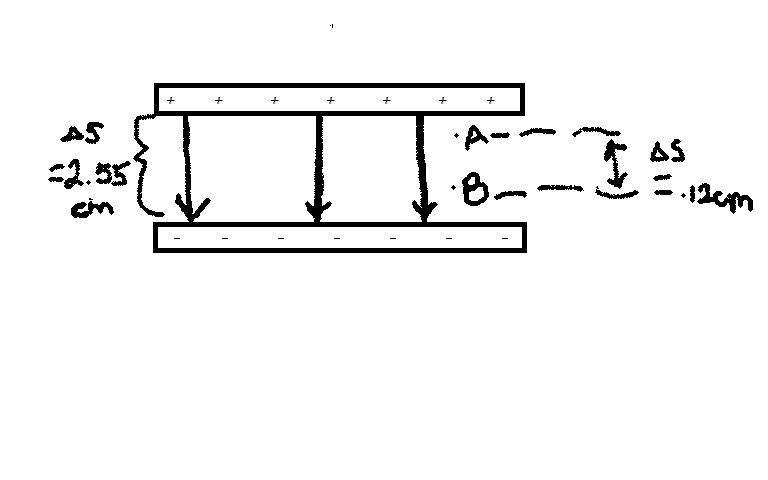
capacitorpicture_zps17372481.png


1. The electric potential at pt. B in the parallel-plate capacitor shown here is less than the electric potential at pt. A by 4.50V. The separation between pts. A and B is .120cm, and the separation between the plates is 2.55cm.

Question:
Is the electric potential energy of an electron at pt. A greater than or less than its electric potential energy at pt. B?2. My book says electric potential energy (U) is comparable to gravitational potential energy.
So if you move a charged particle in the opposite direction of the electric field, it is like lifting a ball in the opposite direction of the gravitational field.
Since both the charged particle and ball are further away from the electric/gravitational field, the potential energy increases.
Increasing the distance between the ball and the ground releases more energy when it falls.
Similarly, increasing the distance between a charged particle and the electric field releases more energy when the particle falls.

This is what a garnered from reading the book... Let me know if I'm understanding wrong...

From the picture, it looks like an electron at point A would have a greater distance to fall than an electron at point B.
So why wouldn't the electric potential energy at A be greater than at B?The answer is that B's electric potential energy is GREATER that A's!...This makes no sense to me... =_=
Would someone please explain this to me?

Thank you so much! :)
 
Physics news on Phys.org
Electrons have negative charge, as opposed to positive charge. How does that fit into all this? :wink:

If you were to put an electron at point A, what direction is the electric force? When you slowly move the electron to point B, are you moving the electron in the same direction as the electric force or against it? How does that compare with the gravity/ball analogy?
 
Okay, so even though our electric field flows from top to bottom (+ to -) in the picture, our charged particle can move differently?


Since we are dealing with electrons (-), they flow towards the positive region.
So our electrons flow against the electric field, from bottom to top (- to +)?


Now, is it safe to say that the (+) end of a capacitor is always the HIGH electric potential region, and the (-) end of the capacitor is always the LOW electric potential region?

This electric potential energy part I still don't understand, though! #=_=
My thinking is this:
If \downarrowE and \uparrow(-)particle,
then energy is needed to counteract electric field, causing Kinetic Energy to increase, Work done by the electric field to decrease, and Potential Energy to increase (+ΔU).

I would compare this to lifting a ball against the gravitational field- it requires kinetic energy but gains potential energy.

So it still seems like B would have lower electric potential energy, and A would have higher electric potential energy.
(ex. B closer to ground and A higher off ground) <--My rationale...

Confused. :confused: Help please? Thanks!
 
Lo.Lee.Ta. said:
Okay, so even though our electric field flows from top to bottom (+ to -) in the picture, our charged particle can move differently?


Since we are dealing with electrons (-), they flow towards the positive region.
So our electrons flow against the electric field, from bottom to top (- to +)?
I wouldn't describe a static (by that I mean unchanging with time), electric fields as "flowing." It's just there. It points in a certain direction (for a given point in space). But it doesn't flow. It just sits there pointing.

Also, for this particular problem, don't consider the electron as flowing either. Yes, there are forces on the electron: there's the electric force on the electron, and if the electron is not accelerating, there's some other force counteracting the electric force, holding it in place. Let's concentrate on the latter and assume that somehow or another you are able to hold the electron in place, and perhaps slowly move it from A to B.

The force on a charge particle q is
\vec F = q \vec E
So what's the relationship between the force and the electric field if q is negative?

Now, is it safe to say that the (+) end of a capacitor is always the HIGH electric potential region, and the (-) end of the capacitor is always the LOW electric potential region?
Yes, that sounds like a reasonable thing to say.

This electric potential energy part I still don't understand, though! #=_=
My thinking is this:
If \downarrowE and \uparrow(-)particle,
then energy is needed to counteract electric field, causing Kinetic Energy to increase, Work done by the electric field to decrease, and Potential Energy to increase (+ΔU).

I would compare this to lifting a ball against the gravitational field- it requires kinetic energy but gains potential energy.

So it still seems like B would have lower electric potential energy, and A would have higher electric potential energy.
(ex. B closer to ground and A higher off ground) <--My rationale...

Confused. :confused: Help please? Thanks!
Thinking about things in terms of work is good. :smile: Very nice.

Recall,
\Delta W = \vec F \cdot \vec{\Delta s}
where \vec{\Delta s} is a measure of displacement.

So if you slowly move the electron in a direction which opposes the electric force (we move it slowly so we don't have to worry about kinetic energy), all the work done goes into the system's potential energy. (Or if we move the electron such that it is in the same direction as the electric force, the electric force does work on you, decreasing the system's potential energy.)
 
(+) Particle~ proton

\vec{F} = q\vec{E}

Since everything is positive, the Force and \vec{E} point in the same direction?

(-) Particle~ electron

\vec{F} = -q\vec{E}

\vec{E} and the force of the electron point in opposite directions.

The electron goes from B to A to high potential (+) region. A is closer to its destination than B.
(I'm thinking of the high potential end as the ground and A and B as an objects away from the ground.)
Since B is further off the "ground," it would have greater electric potential energy.

Is this right?
Thanks! :)
 
Lo.Lee.Ta. said:
(+) Particle~ proton

\vec{F} = q\vec{E}

Since everything is positive, the Force and \vec{E} point in the same direction?

(-) Particle~ electron

\vec{F} = -q\vec{E}

\vec{E} and the force of the electron point in opposite directions.
Yes, that's right. Very nice. :approve:

The electron goes from B to A to high potential (+) region.
Yes, A has the higher electric potential. (Not necessarily to be equated with higher potential energy -- certainly not in this case anyway.)

A is closer to its destination than B.
(I'm thinking of the high potential end as the ground and A and B as an objects away from the ground.)
Since B is further off the "ground," it would have greater electric potential energy.

Is this right?
Thanks! :)

Yes, an electron at location B has a higher potential energy than it would if it were at location A (only concerning ourselves with electrostatic forces).

I sympathize with you that the naming of "electric potential" was a poor choice of naming to describe the phenomenon. It's so easily confused with "potential energy" by its name. You are not alone in being a bit confused by naming. Unfortunately, it's probably here to stay. "Electric potential" is so ingrained in the vernacular of the subject that there's no chance of it changing any time soon. Just try to keep in mind that "electric potential" and "potential energy," while related, are separate concepts.

If it helps, electric potential gives you the potential energy of a positive test charge. But it has to be a positive test charge. If the charge you are working with is negative, the potential energy needs to flip signs too, for the same electric potential.
 

Similar threads

  • · Replies 2 ·
Replies
2
Views
1K
Replies
6
Views
2K
Replies
11
Views
2K
  • · Replies 2 ·
Replies
2
Views
2K
  • · Replies 6 ·
Replies
6
Views
2K
  • · Replies 22 ·
Replies
22
Views
4K
  • · Replies 17 ·
Replies
17
Views
3K
  • · Replies 23 ·
Replies
23
Views
2K
Replies
5
Views
2K
Replies
15
Views
2K