Green's theorem and regular region

Click For Summary

Discussion Overview

The discussion revolves around Green's theorem, specifically the necessity of using a unit normal vector in its vector form, and the concept of a "regular region" in relation to compact sets in Rn. Participants explore the implications of these concepts in the context of surface integrals and the equivalence of definitions regarding regular regions.

Discussion Character

  • Technical explanation
  • Debate/contested
  • Mathematical reasoning

Main Points Raised

  • Some participants question whether the normal vector n must be a unit vector in the context of Green's theorem, with one arguing that the length of the normal vector is important in the integral.
  • Another participant suggests that the normal vector's length cancels out in calculations, raising the question of why it matters.
  • There is a discussion about the equivalence of definitions of a "regular region," with one participant seeking clarification on why being the closure of its interior is equivalent to having every neighborhood of boundary points contain points in the interior.
  • Some participants provide reasoning about the implications of points not being in the closure of the interior of a set, suggesting that such points cannot be boundary points of the interior.
  • One participant inquires about substituting any normal vector (not necessarily unit length) in surface integrals of vector fields, questioning if this is valid for evaluating such integrals.
  • A later reply confirms that using a non-unit normal vector is acceptable in certain contexts, specifically when forming the differential area element dS.

Areas of Agreement / Disagreement

Participants express differing views on the necessity of using a unit normal vector in Green's theorem and the implications of this choice. The equivalence of definitions regarding regular regions also remains a point of contention, with no consensus reached on the clarity of these concepts.

Contextual Notes

Some participants mention the potential for confusion regarding the definitions and implications of normal vectors and regular regions, indicating that further clarification may be needed. There are also references to the handling of isolated points in the context of regular regions.

kingwinner
Messages
1,266
Reaction score
0
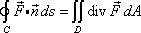
1) A vector form of Green's theorem states that under certain conditions,
eq0046M.gif

where n is the unit[/color] outward normal to the curve C and D is the region enclosed by C

[Now, my question is: must n be a unit vector? Why or why not?]


2) A "regular region" is a compact set S in Rn that is the closure of its interior. Equivalently[/color], a compact set S in Rn is a regular region if every neighborhood of every point on the boundary of S contains points in the interior of S

[I don't understand at all why these are equivalent. Can somebody please explain?]

Thanks a lot!
 

Attachments

  • eq0046M.gif
    eq0046M.gif
    372 bytes · Views: 479
Last edited:
Physics news on Phys.org
kingwinner said:
1) A vector form of Green's theorem states that under certain conditions,
eq0046M.gif

where n is the unit[/color] outward normal to the curve C and D is the region enclosed by C

[Now, my question is: must n be a unit vector? Why or why not?]
That's a strange question! Do you think the length of the vectors is not important in this integral? Of course the normal must be of unit length.

2) A "regular region" is a compact set S in Rn that is the closure of its interior. Equivalently[/color], a compact set S in Rn is a regular region if every neighborhood of every point on the boundary of S contains points in the interior of S

[I don't understand at all why these are equivalent. Can somebody please explain?]

Thanks a lot!
Obviously the only difference is that one says "is the closure of its interior" and the other says "every neighborhood of every point on the boundary of S contains points in the interior of S".

A consists precisely of its interior and its boundary. If there were points on the boundary of S having a neighborhood that did NOT "contain points in the interior of S", then that point would not be on the boundary of the interior of S and so would not be in the closure of the interior of S. Conversely, it there were points of S that were not in the closure of the interior of S, then that point could not have every neighbothood containing points of the interior.
Under what conditions would a set, A, NOT be "the closure of its interior"? Certainly the closure of the interior of A must be at least a subset of A. Only if A has "isolated points"
 
Thanks!

1) Let N be any normal
Let n be unit normal
n=N/||N||
dS=||N||dt
The ||N|| just cancels, right? So why does the length matters?


2) "Conversely, it there were points of S that were not in the closure of the interior of S, then that point could not have every neighbothood containing points of the interior."
I get your first part, but I am still having trouble understanding this...
 
1) That's a slightly different question than what you originally asked. Originally, you asked whether the unit vector [itex]\vec{n}[/itex] was necessary in
[tex]\int \vec{f}\cdot\vec{n} dS[/itex]<br /> and I responded that it obviously was necesary.<br /> <br /> But, clearly, no reasonably intelligent person is going to calculate [itex]||\vec{N}||[/itex], in order to find [itex]\vec{n}= \vec{N}/||\vec{N}||[/itex], then calculate it <b>again</b> in order to find [itex]ds= ||\vec{N}||dt[/itex] and watch in amazement when they cancel. Not more than once, anyway!<br /> <br /> That's why I prefer to use the notatation [itex]d\vec{S}= \vec{N} dS[/itex] and write<br /> [tex]\int \vec{f}\cdot d\vec{S}[/tex]<br /> rather than<br /> [tex]\int \vec{f}\cdot\vec{n} dS[/itex]<br /> <br /> (Surely you understand that dS is <b>not</b> [itex]||\vec{S}||[/itex]dt for just <b>any</b> normal? If [itex]\vec{N}[/itex] is the vector formed by the cross product of [itex]d\vec{r}/du[/itex] and [itex]d\vec{r}/dv[/itex] ([itex]\vec{r}(u, v)[/itex] is the "position vector" of a point on the surface in terms of the parameters u and v) then [itex]dS= ||\vec{N}||du dv[/itex].)<br /> <br /> 2) If p is a point that is <b>not</b> in "the closure of the interior of S", then, since closure of a set includes point in the set and boundary points of the set, p cannot be a boundary point of the interior of S. That, in turn, means that there is some neighborhood of p that contains no interior points of S.[/tex][/tex]
 
1) I have a related question about surface integrals of vector fields.
eq0036M.gif


ru x rv is simply a (not necessarily unit) normal to the surface

The norms ||...|| always cancel, so can I directly jump to the last line and just substitute ANY normal N (in the right direction of course, but not unit length) for ru x rv on the last line?

For example,
z = f(x,y) is a surface
=> g(x,y,z) = z - f(x,y)=0
=> grad g = N = (a not necessarily unit) normal vector
Can I just simply substitute this grad g for ru x rv directly on the last line?

So to evaluate surface integrals of vector fields, all we need is a normal in the right direction, and not necessarily a unit normal, right?
 
I think this is now the third time you have asked that question! YES, if you form
[itex]d\vec{S}[/itex] as [itex](\vec{r}_u\times \vec{r}_v)dudv[/itex] then [itex]\vec{f}\cdot\vec{n}dS= \vec{f}\cdot d\vec{S}[/itex] and you do not need to calculate the normal vector separately.
 

Similar threads

  • · Replies 5 ·
Replies
5
Views
3K
  • · Replies 20 ·
Replies
20
Views
4K
Replies
3
Views
2K
  • · Replies 4 ·
Replies
4
Views
7K
  • · Replies 1 ·
Replies
1
Views
3K
  • · Replies 3 ·
Replies
3
Views
3K
  • · Replies 7 ·
Replies
7
Views
2K
  • · Replies 3 ·
Replies
3
Views
5K
  • · Replies 5 ·
Replies
5
Views
3K
  • · Replies 4 ·
Replies
4
Views
9K