Hard time with this Vector Velocity Problem

Click For Summary

Homework Help Overview

The discussion revolves around a vector velocity problem involving a plane's speed and the effect of wind on its trajectory. The original poster expresses confusion regarding the resultant velocity calculation when the plane is moving at 200 km/h and the wind at 85 km/h.

Discussion Character

  • Exploratory, Assumption checking, Conceptual clarification

Approaches and Questions Raised

  • Participants discuss the use of the Pythagorean theorem to determine the resultant velocity and question the correct interpretation of the hypotenuse in the context of the problem. There are attempts to clarify the relationship between the plane's velocity relative to the air and the ground.

Discussion Status

Participants are actively engaging with each other's reasoning, questioning assumptions about the direction and magnitude of the velocities involved. Some guidance has been offered regarding the need to visualize the problem through diagrams and vector components, but no consensus has been reached on the correct approach.

Contextual Notes

There is an ongoing discussion about the definitions of airspeed and ground speed, as well as the implications of the wind's direction on the plane's intended path. The original poster's confusion appears to stem from differing interpretations of these concepts.

KevMilan
Messages
12
Reaction score
0
Summary: I've posted this in a few forums but still confused on this problem. If the plane is moving at 200km/h and the wind pushes the plane with a velocity of 85km/h, then the resultant velocity would be 217km/h, and using sine inverse, 217.sin(theta=85, I got 23°, which is B, but the answer key shows D.
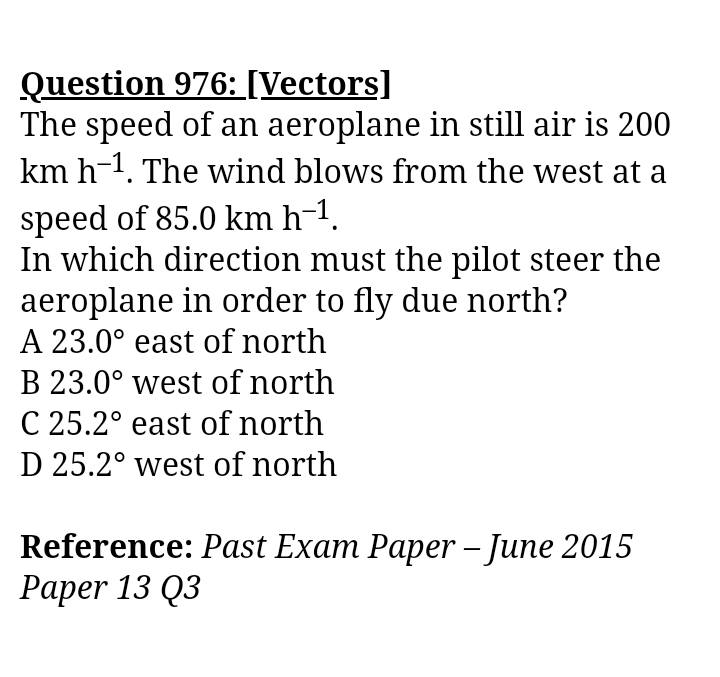
243370

[Moderator's note: Moved from a technical forum and thus no template.]
 
Last edited by a moderator:
Physics news on Phys.org
Where did you get the 217km/h?

Did you draw a diagram?
 
PeroK said:
Where did you get the 217km/h?

Did you draw a diagram?
I used pythagoras theorem, I assumed 200km/h as facing north and 85km/h facing east, and the hypotenuse would be 217km/h.
 
The hypotenuse should be the 200 km/h in this problem
 
KevMilan said:
I used pythagoras theorem, I assumed 200km/h as facing north and 85km/h facing east, and the hypotenuse would be 217km/h.

But then the 217km/h is not is a northerly direction (relative to the ground). It is north relative to the air. That's what would happen if you tried to fly north, but didn't take into account the air which is then blowing you eastwards.
 
Dale said:
The hypotenuse should be the 200 km/h in this problem
A lot of sites have been saying this but I still don't get why the hypotenuse is 200, can you kindly explain this in detail?
 
KevMilan said:
A lot of sites have been saying this but I still don't get why the hypotenuse is 200, can you kindly explain this in detail?

Draw a diagram with the paper being the ground. You want to fly north relative to the ground. You might like to draw the air velocity vector first. Then, you should see the direction of the "plane relative to air" vector that is needed to result in a northerly path.

With your approach you are defintely going east. Imagine you were trying to walk across a room and I was pushing you sideways. If you try to walk straight, then you'll end up off course. In order to move directly across the room, you would have to walk into me slightly. In this case, and in the case of your problem, the external force is slowing you down, because you are moving into it. That's why the ground speed will be less than 200km/h.
 
Let ##\vec{e}_x## point from west to east and ##\vec{e}_y## from south to north. Then
$$\vec{v}=v_{\text{wind}} \vec{e}_x + \vec{v}_{\text{plane}}.$$
You want the plane going towards north, i.e.,
$$\vec{e}_x \cdot \vec{v}=0 \; \Rightarrow \; v_{\text{plane} x=-v_{\text{wind}}.$$
Now you only need ##|\vec{v}_{\text{plane}}|=200 \;\text{km}/{\text{h}}## to get ##v_{\text{plane}y}##, and from this result you also get the angle.
 
KevMilan said:
A lot of sites have been saying this but I still don't get why the hypotenuse is 200, can you kindly explain this in detail?
You have three velocities:

The plane wrt the air (direction unknown, magnitude 200 kph)
The air wrt the ground (direction west, magnitude 85 kph)
The plane wrt the ground (direction north, magnitude unknown)

The last two form a right angle (north and west) so the first must be the hypotenuse.
 
  • #10
Dale said:
You have three velocities:

The plane wrt the air (direction unknown, magnitude 200 kph)
The air wrt the ground (direction west, magnitude 85 kph)
The plane wrt the ground (direction north, magnitude unknown)

The last two form a right angle (north and west) so the first must be the hypotenuse.
When you say with respect to air, basically whatever the wind speed is, it'll always be moving at 200km/h in the wind's perspective, right? So the word 'still air' in the question is crucial to finding this solution?
 
  • #11
Yes. It is also called “air speed”
 
  • #12
Another way to describe what needs to be done: The plane needs a heading such that its East-West component of its 200 km/hr cancels the wind's 85 km/hr.
 
  • Like
Likes   Reactions: vanhees71 and PeroK
  • #13
That's what I've said in #8. All you have to do is to put the numbers in. It also may help a lot to draw the vectors to immediately see, how it works out geometrically (it's simple trigonometry of a right triangle).
 

Similar threads

  • · Replies 26 ·
Replies
26
Views
3K
  • · Replies 4 ·
Replies
4
Views
2K
  • · Replies 16 ·
Replies
16
Views
2K
  • · Replies 3 ·
Replies
3
Views
1K
  • · Replies 9 ·
Replies
9
Views
2K
  • · Replies 5 ·
Replies
5
Views
5K
  • · Replies 3 ·
Replies
3
Views
2K
Replies
2
Views
3K
  • · Replies 16 ·
Replies
16
Views
3K
  • · Replies 3 ·
Replies
3
Views
880