George Keeling
Gold Member
- 183
- 42
- TL;DR
- I have a question on cosmological redshift which I have just learned about from Sean Carroll. After calculating it for an expanding universe he does a thought experiment to show that it is different to Doppler redshift which would be detected if two galaxies were flying away from each other in a flat (therefore not expanding) universe.
Summary: I have a question on cosmological redshift which I have just learned about from Sean Carroll. After calculating it for an expanding universe he does a thought experiment to show that it is different to Doppler redshift which would be detected if two galaxies were flying away from each other in a flat (therefore not expanding) universe.
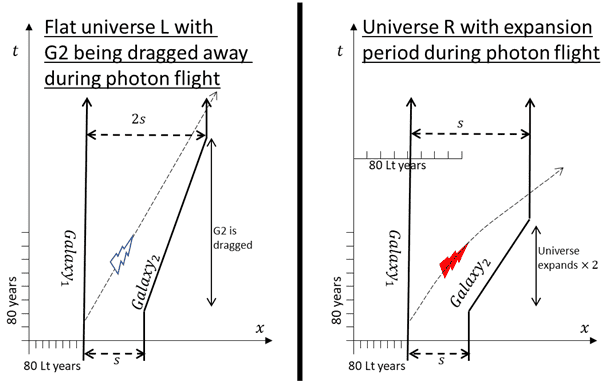
Here's Sean Carroll's thought experiment:
We have flat universe L on the left with two galaxies separated by distance ## s##. A photon is emitted from galaxy 1, galaxy 2 is quickly propelled to a separation of ##2s##, galaxy 2 stops and the photon arrives. Since the galaxies are now not relatively moving there would be no Doppler redshift.
On the right the galaxies are also separated by ## s## but, instead of moving a galaxy, the universe expands by a factor of 2 (it briefly gets a metric like ## ds^2=-dt^2+t^2dx^2##), then stops expanding and then the photon arrives. According to the cosmological redshift formula, the photon has a redshift.
This implies that the galaxies in universe R are still separated by ## s##, because rulers would expand along with everything else. One can also check this by drawing out and back light paths before and after expansion.
This is spooky. It also implies that in our 'expanding' universe distant galaxies are not really moving away! One also wonders how we tell that it's cosmological not Doppler redshift.
Have I got the picture roughly right? The next step will be to compare these to real values like the Hubble constant.
Here's Sean Carroll's thought experiment:
We have flat universe L on the left with two galaxies separated by distance ## s##. A photon is emitted from galaxy 1, galaxy 2 is quickly propelled to a separation of ##2s##, galaxy 2 stops and the photon arrives. Since the galaxies are now not relatively moving there would be no Doppler redshift.
On the right the galaxies are also separated by ## s## but, instead of moving a galaxy, the universe expands by a factor of 2 (it briefly gets a metric like ## ds^2=-dt^2+t^2dx^2##), then stops expanding and then the photon arrives. According to the cosmological redshift formula, the photon has a redshift.
This implies that the galaxies in universe R are still separated by ## s##, because rulers would expand along with everything else. One can also check this by drawing out and back light paths before and after expansion.
This is spooky. It also implies that in our 'expanding' universe distant galaxies are not really moving away! One also wonders how we tell that it's cosmological not Doppler redshift.
Have I got the picture roughly right? The next step will be to compare these to real values like the Hubble constant.