sherrellbc
- 83
- 0
[SOLVED] Having trouble with L298N H-Bridge IC
I cannot understand how this IC works from the block diagram given in the datasheet. I understand the concept of an H-bridge, but cannot figure how this one operates.
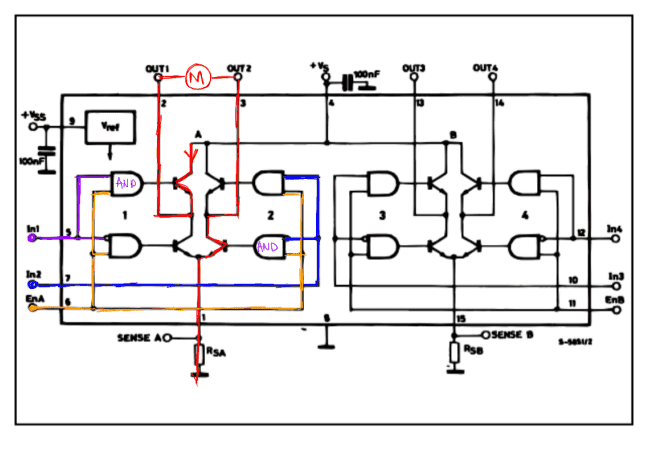
I drew on the schematic to illustrate my confusion.
To run a motor in the given way (red path) you would need to enable the transistor in the top left and bottom right, while disabling the other two. Do to that, the AND gates at the base of those transistors (conducting) need to have two HIGH terminals in order to provide feeder current for the transistors.
However, in order to turn on only those two transistors, you must enable IN1, IN2, and ENA (ENA is simply a pin you enable to power the left H-Bridge of the L298N - is has two as shown).
Given how the wires are connected, there is no way - that I can see apparently - to turn on two diagonal transistors without enabling the other two ..
I obviously must be missing something .. According to what I have read, in order to drive the transistors you need to have IN1 HIGH and IN2 LOW for one direction and the opposite for the other. I just do not see, from this schematic, how that even is possible.
Also note: the ENA/ENB pins are used in conjunction with PWN signals to drive the motor are variable speeds.
-----------------
Here is the original:
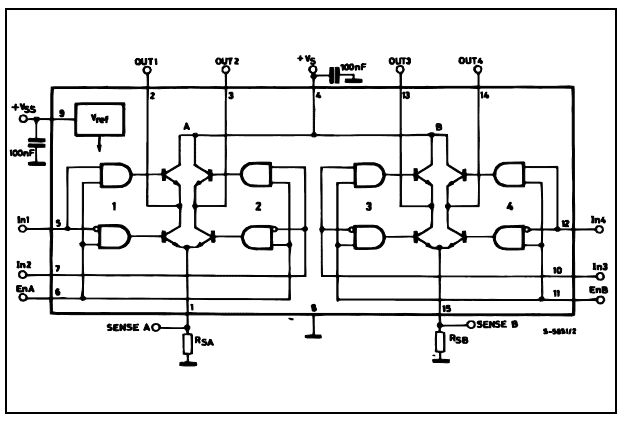
And here is the illustration:
I cannot understand how this IC works from the block diagram given in the datasheet. I understand the concept of an H-bridge, but cannot figure how this one operates.
I drew on the schematic to illustrate my confusion.
To run a motor in the given way (red path) you would need to enable the transistor in the top left and bottom right, while disabling the other two. Do to that, the AND gates at the base of those transistors (conducting) need to have two HIGH terminals in order to provide feeder current for the transistors.
However, in order to turn on only those two transistors, you must enable IN1, IN2, and ENA (ENA is simply a pin you enable to power the left H-Bridge of the L298N - is has two as shown).
Given how the wires are connected, there is no way - that I can see apparently - to turn on two diagonal transistors without enabling the other two ..
I obviously must be missing something .. According to what I have read, in order to drive the transistors you need to have IN1 HIGH and IN2 LOW for one direction and the opposite for the other. I just do not see, from this schematic, how that even is possible.
Also note: the ENA/ENB pins are used in conjunction with PWN signals to drive the motor are variable speeds.
-----------------
Here is the original:
And here is the illustration:
Last edited: