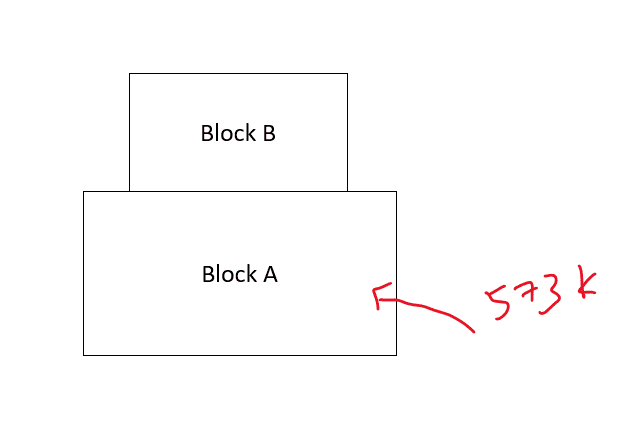
Discussion Overview
The discussion revolves around the heat transfer between two blocks by conduction, specifically how to calculate the time required for one block to reach a certain temperature when placed on another block with a different initial temperature. The focus includes theoretical aspects of conduction, transient heat conduction, and energy conservation principles.
Discussion Character
- Exploratory
- Technical explanation
- Mathematical reasoning
- Debate/contested
Main Points Raised
- One participant seeks to understand how to apply the conduction equation to determine the time for block B to reach 398K.
- Another participant questions whether the temperatures in the blocks will be spatially uniform during equilibration and introduces the transient heat conduction equation.
- A suggestion is made to assume large thermal conductivities and negligible spatial thermal gradients, leading to uniform temperature distributions in the blocks.
- Participants propose using conservation of energy between the two blocks, stating that heat absorbed by block B equals heat lost by block A.
- Several participants discuss applying a surface energy balance at the interface of the blocks, introducing a thermal contact resistance model.
- Questions arise regarding the handling of negligible contact resistance and how that affects transient heat transfer calculations.
- One participant suggests solving the transient heat conduction equation, noting that different materials would have different thermal properties affecting heat flux continuity at the interface.
- Another participant proposes that a numerical solution might be the simplest approach to describe the situation adequately.
- There is a discussion about the idealized nature of the proposed models and the potential need for more realistic approaches after further study.
Areas of Agreement / Disagreement
Participants express differing views on the uniformity of temperatures in the blocks during equilibration, with some suggesting uniform distributions and others indicating potential variations. The discussion remains unresolved regarding the best approach to model the heat transfer accurately.
Contextual Notes
Participants mention simplifying assumptions, such as large thermal conductivities and negligible contact resistance, which may not hold in all scenarios. The discussion also highlights the complexity of transient heat conduction equations and the need for careful consideration of material properties.
Who May Find This Useful
This discussion may be useful for students and professionals interested in heat transfer principles, particularly those studying conduction in mechanical or thermal engineering contexts.