Helmholtz resonator equation. How do I do this? Please help.

  • Context: Undergrad 
  • Thread starter Thread starter Qaiphyx
  • Start date Start date
  • Tags Tags
    Helmholtz Resonator
Join the discussion
Registration is free. Ask a follow-up in this thread, or start your own.
20 replies · 5K views
Qaiphyx
Messages
92
Reaction score
0
Helmholtz resonator equation. How do I do this?? Please help.
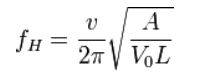
helmholtz.JPG


L = 0
Vo = 473.17 (I think its cubed though I calculated it from 16 ounces, so I should be cubed right??)
A = What I am solving for
F = 480 hz
V= speed of sound which is 340.19 at sea level

If Vo needs to be cubed then A should be squared, but I don't know if I am supposed to do that

Ive put all this down on paper and I am not sure how to run this equation to solve especially when it comes to the square root of a fraction, especially if the fraction is cubed and squared.

How do I do this? Been searching the internet for 2 days now trying to figure this out.
 
Mathematics news on Phys.org
Yes because then the it would be multiplied by Vo and would end in zero. By zero I me L is non existent in the equation, there is no neck to the helmholtz resonator. So L needs to be left out.

By cubed and squared I mean that it asked for Volume, the volume is 473.17 cubic centimeters. So it should be cubed right?? Really stupid question but I just want to make sure that's the case
 
arildno said:
I'm sorry.
What you write is completely incomprehensible.
It doesn't seem that you even know what the number 0 is, nor what an equation is, either.

uh its very comprehensible.
 
No, it is not
1. You can't put 0 in the denominator of an expression.
2. Volume cubed?? The volume stands there without any cubing done at all.
3. Why should you square A? You are to solve for it.
 
arildno said:
No, it is not
1. You can't put 0 in the denominator of an expression.
2. Volume cubed?? The volume stands there without any cubing done at all.
3. Why should you square A? You are to solve for it.

L is now .028448 centimeters. I guess you have to account for the thickness of the metal.

It what sense does the volume sit there without any cubing? Its 473.17 cubic centimeters. So, wouldn't you put in the equation as 473.17^3?

The result of A should be equal to centimeters squared correct? Thats just one other thing I am unsure of. Is that I took the volume and converted it from ounces to cubic centimeters, so how should I input it into the equation?
 
"Its 473.17 cubic centimeters. So, wouldn't you put in the equation as 473.17^3?2
Why?
You have 473.17 cubic centimeters, not 473.17^3 cubic centimeters.

A cubic centimeter is a unit for volume counting.
 
arildno said:
"Its 473.17 cubic centimeters. So, wouldn't you put in the equation as 473.17^3?2
Why?
You have 473.17 cubic centimeters, not 473.17^3 cubic centimeters.

A cubic centimeter is a unit for volume counting.

Ok I understand then, that is what I was unsure of.

Let me try again to see if I can run this equation
 
2wqvdxe.jpg


Thats where I got to, now what? and is it correct?
 
arildno said:
Run an equation?
Shouldn't you solve it for A??

thats what I meant by run it?
 
Here's how you may do it:
1. NEVER insert numbers until your last step, solve it algebraically!
2. We have:
[tex]f_{H}=\frac{v}{2\pi}\sqrt{\frac{A}{V_{0}L}}[/tex]
We multiply with 2pi/v, gaining:
[tex]\sqrt{\frac{A}{V_{0}L}}=\frac{2\pi{f}_{H}}{v}[/tex]
We square both sides,
[tex]\frac{A}{V_{0}L}=\frac{4\pi^{2}{f}^{2}_{H}}{v^{2}}[/tex]
We multiply with V_{0}L, and gain:
[tex]A=V_{0}L\frac{4\pi^{2}{f}^{2}_{H}}{v^{2}}[/tex]
3. NOW, insert numbers to calculate A!
 
arildno said:
3. NOW, insert numbers to calculate A!
If I may add: with units, otherwise you are in for a bad surprise.
 
arildno said:
Here's how you may do it:
1. NEVER insert numbers until your last step, solve it algebraically!
2. We have:
[tex]f_{H}=\frac{v}{2\pi}\sqrt{\frac{A}{V_{0}L}}[/tex]
We multiply with 2pi/v, gaining:
[tex]\sqrt{\frac{A}{V_{0}L}}=\frac{2\pi{f}_{H}}{v}[/tex]
We square both sides,
[tex]\frac{A}{V_{0}L}=\frac{4\pi^{2}{f}^{2}_{H}}{v^{2}}[/tex]
We multiply with V_{0}L, and gain:
[tex]A=V_{0}L\frac{4\pi^{2}{f}^{2}_{H}}{v^{2}}[/tex]
3. NOW, insert numbers to calculate A!

Thank you!
 
DrClaude said:
If I may add: with units, otherwise you are in for a bad surprise.

Har har har. Sorry I am not a pro with math.
 
If you just plug in the numbers, as you did in post #11, you will get the wrong answer because your units won't match.
 
Ok I did 240 hertz instead, so an octave lower, and got 1033.4 that looks a bit better.
 
So basically if what I have come up with is 9cm will give 120herts and 4.5 will give 60hertz.
 
Just to be sure, the speed of sound need to be converted to the same units that I am using for the resonator correct? In this case, centimeters
 
Well, to get the simplest correct expression, you should use the SAME scales for the same type of units.

For example, 10 meters divided by 20 centimeters equals 10m/(20cm)=0.5 m/(cm).

A rather simpler expression is to remember that 1 meter=100 cm, so that 0.5 m(cm)=0.5*100(cm)/(cm)=50