Help-Improving runtime complexity of the method

Click For Summary

Discussion Overview

The discussion focuses on improving the runtime complexity of a method designed to find the largest cell sequence where the sum of the elements is divisible by 3. Participants explore various algorithmic approaches and optimizations, including the potential for reducing complexity from O(n^3) to O(n^2) or better.

Discussion Character

  • Exploratory
  • Technical explanation
  • Debate/contested
  • Mathematical reasoning

Main Points Raised

  • One participant suggests that the current method has a runtime complexity of O(n^3) and proposes a solution that could achieve O(n^2), asking for further improvements.
  • Another participant points out that the method may be inefficient due to repeated summation and suggests maintaining a running total to optimize the process.
  • A third participant introduces Kadane's maximum subarray algorithm as a potentially more efficient alternative, linking to external resources for further reference.
  • A later post provides a C implementation of Kadane's algorithm, demonstrating its functionality and noting the change in complexity.
  • One participant expresses a desire to find an algorithm that achieves O(N) complexity for the specific problem of determining the size of the largest sequence with a sum divisible by 3, providing an example for clarification.

Areas of Agreement / Disagreement

Participants express differing views on the best approach to optimize the method, with no consensus on a single solution or algorithm. Multiple competing strategies are discussed, including maintaining a running sum and applying Kadane's algorithm.

Contextual Notes

Some participants' suggestions depend on specific assumptions about the input data and the nature of the problem, which may not be universally applicable. The discussion does not resolve the mathematical steps or the exact definitions of the problem being addressed.

Who May Find This Useful

Readers interested in algorithm optimization, particularly in the context of runtime complexity in programming, may find this discussion relevant.

moshiko
Messages
2
Reaction score
0
Hello everyone,
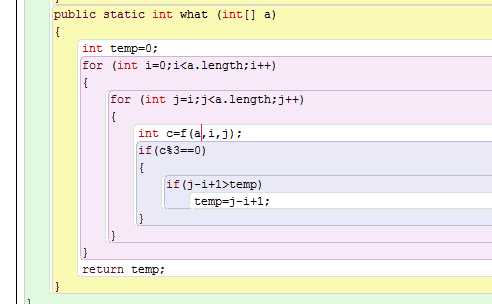
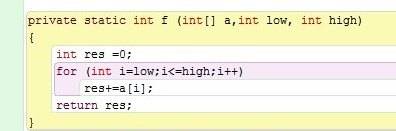
Looking for a more efficient solution to method 'what', in terms of run-time complexity and space.
The method finds the largest cell sequence that the organs sum is divided by 3.(Correct me if I'm wrong)
As it seems runtime complexity here is O(n ^ 3).
I came to solution of O(n ^ 2), is there a more effective solution? Explain please,
Thanks for the helpers !
HrtOq9r.png
NT6Oi4w.jpg
 
Technology news on Phys.org
It seems you are resumming things over and over in the f method

f(a,0,3) means sum elements a[0..3]

then you do f(a,0,4) which means sum elements a[0..4]

why not remember the sum and just add a[4] to it?

This will eliminate the innermost loop in the f method.
 
As a good rule of thumb, correct algorithms have the potential to contribute the most to efficiency.

If I understand what this code is supposed to do, I would consider a different algorithm - Kadane's maximum subarray algorithm.
https://en.wikipedia.org/wiki/Maximum_subarray_problem
 
Hmm - found this in my code store, made simple example in C
Code:
#include <stdio.h>
#include <stdlib.h>
#include <limits.h>

// Kadanes Algorithm  in C
// Parameters:
// a array of integers
// sz number of elements in the array

int max_sum_subarr(int *a, const size_t sz)
{
    int i=0;
    int local_mx = INT_MIN;
    int mx_ending = 0;
    for (i = 0; i < sz; i++)
    {
        mx_ending = mx_ending + a[i];
        if (local_mx < mx_ending)
            local_mx = mx_ending;
        if (mx_ending < 0)
            mx_ending = 0;
    }
    return local_mx;
}
int main(int argc, char **argv)
{
   size_t sz=7;
   int a[7]={1 , 4, -1, -7, 3, 2, 1 };
   
   printf("maximum sub array = %d\n", max_sum_subarr(a, sz) );
   
   return 0;
}

Note the complexity change.
 
I need to find algorithm to method that return the size of largest sequence that his amounts divisible by 3, in O N complexity..
for example, for array {0,0,1,1,1,1,1} the method return 5 . {0,0,1,1,1}
 

Similar threads

  • · Replies 2 ·
Replies
2
Views
2K
  • · Replies 13 ·
Replies
13
Views
3K
Replies
4
Views
2K
  • · Replies 4 ·
Replies
4
Views
3K
Replies
7
Views
2K
  • · Replies 0 ·
Replies
0
Views
2K
Replies
29
Views
6K
  • · Replies 3 ·
Replies
3
Views
2K
  • · Replies 1 ·
Replies
1
Views
4K
  • · Replies 65 ·
3
Replies
65
Views
8K