Help Me Solve My Diagram Problem: Calculating Center of Mass

Click For Summary
SUMMARY

This discussion focuses on calculating the center of mass (COM) for two triangles using integral calculus. The user initially attempted to apply the formula COM(x) = (1/M)∫ x dm, where dm = μ * dx * y, but encountered errors in their calculations. Key insights include the realization that for uniform mass density, the center of mass corresponds to the centroid of the triangles, which can be determined geometrically. The final correct COM for the system is established as 2.5, leveraging the symmetry of the setup.

PREREQUISITES
  • Understanding of integral calculus, specifically the application of definite integrals.
  • Familiarity with the concept of center of mass and centroids in geometry.
  • Knowledge of mass density and its role in calculating COM.
  • Experience with geometric properties of triangles and their medians.
NEXT STEPS
  • Study the properties of centroids for various geometric shapes.
  • Learn advanced techniques in integral calculus, focusing on applications in physics.
  • Explore symmetry in physical systems to simplify calculations.
  • Practice solving problems involving center of mass for composite shapes.
USEFUL FOR

Students and professionals in physics, engineering, and mathematics who are involved in mechanics and geometric analysis, particularly those working with center of mass calculations.

jisbon
Messages
475
Reaction score
30
Homework Statement
Two identical uniform triangular metal played held together by light rods. Caluclate the x coordinate of centre of mass of the two mass object. Give that mass per unit area of plate is 1.4g/cm square and total mass = 25.2g
Relevant Equations
-
Not sure what I went wrong here, anyone can help me out on this? Thanks.
EDIT: Reformatted my request.
Diagram:
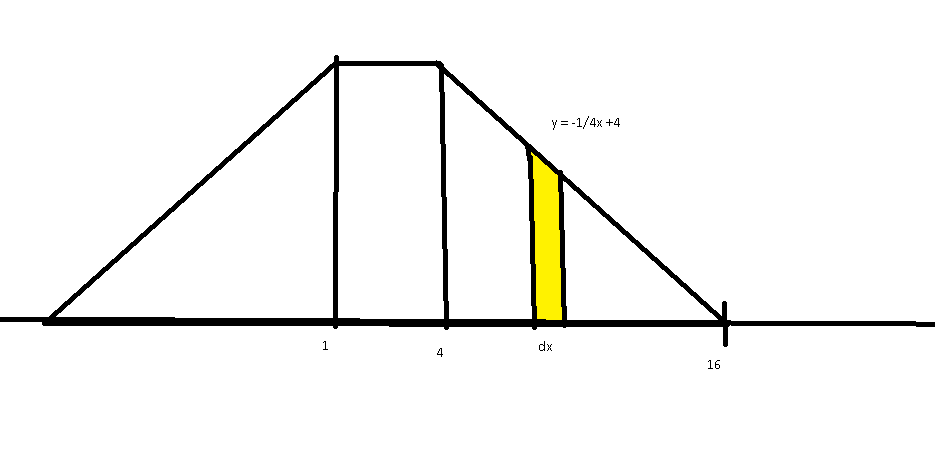
1567423208963.png

So as far as I know to calculate the center of mass for x, I have to use the following equation:
COM(x):
##\frac{1}{M}\int x dm##
And I also figured that to find center of mass, I will have to sum the mass of the 2 plates by 'cutting' them into stripes, giving me the following formula:
##dm = \mu * dx * y## where ##\mu## is the mass per unit area.
So subbing in the above equation into the first, I get:
##\frac{1}{M}\int x (\mu * dx *y) ##
##\frac{\mu}{M}\int xy dx##
Since the 2 triangles are identical, I can assume triangle on the left has equation ##y = 1/4x +4##
This is the part where I'm not sure. Do I calculate each of the triangle's center of moment, sum them and divide by 2? Or am I suppose to use another method?
Regardless of what, supposed I am correct:

COM for right triangle:
##\frac{\mu}{M}\int_{4}^{16}x(\frac{1}{4}x+4) dx## = 8 (expected)

COM for left triangle:
##\frac{\mu}{M}\int_{-11}^{1}x(-\frac{1}{4}x+4) dx## = 5.63...

Total COM = ##8+5.63/2## which is wrong :(

Thanks
 
Last edited:
Physics news on Phys.org
Your equations are hard to read (writing them here would help) and you don't explain what you do either.
If the x-axis is horizontally why don't you just use the symmetry of the problem?
 
If the mass density of the two triangles is uniform, then there is a pure geometric method to find the center of mass, that depends only on the shape of the triangles. But I am not sure whether you are allowed to use this method. Anyway for uniform mass density the center of mass is the so called centroid or barycenter of the triangle, which is the point that the three medians of the triangle intersect.
 
mfb said:
Your equations are hard to read (writing them here would help) and you don't explain what you do either.
If the x-axis is horizontally why don't you just use the symmetry of the problem?
Delta2 said:
If the mass density of the two triangles is uniform, then there is a pure geometric method to find the center of mass, that depends only on the shape of the triangles. But I am not sure whether you are allowed to use this method. Anyway for uniform mass density the center of mass is the so called centroid or barycenter of the triangle, which is the point that the three medians of the triangle intersect.
Updated my question :)
 
Certainly there is something wrong with that 5.63... Do the integral again.
and I believe the integral must be $$\int_{-11}^{1}x(x/4+\frac{11}{4})dx$$
 
Delta2 said:
Certainly there is something wrong with that 5.63... Do the integral again.
and I believe the integral must be $$\int_{-11}^{1}x(x/4+\frac{11}{4})dx$$
Realized I used the wrong equation, answer turns out to be -7.16666...
It's still wrong though :/
 
Use the integral I posted at post #5 the correct y(x) for the left triangle is ##y=\frac{x+11}{4}##. You ll find the x-coordinate for the center of mass of the left triangle to be -3.
 
  • Like
Likes jisbon
Delta2 said:
Use the integral I posted at post #5 the correct y(x) for the left triangle is ##y=\frac{x+11}{4}##. You ll find the x-coordinate for the center of mass of the left triangle to be -3.
Oh yes the y intercept :/ I 'think' too much about identical, even the intercepts :/ Thanks tho :) Answer is 2.5 :)
 
  • Like
Likes Delta2
jisbon said:
Answer is 2.5
Right.
Note that 2.5 is exactly the middle between the two triangles. The setup is symmetric, it can't be anywhere else. Finding symmetries like this can often save lengthy calculations.
 

Similar threads

  • · Replies 25 ·
Replies
25
Views
2K
  • · Replies 9 ·
Replies
9
Views
1K
  • · Replies 9 ·
Replies
9
Views
3K
  • · Replies 3 ·
Replies
3
Views
2K
Replies
3
Views
1K
  • · Replies 19 ·
Replies
19
Views
4K
  • · Replies 8 ·
Replies
8
Views
2K
  • · Replies 21 ·
Replies
21
Views
1K
  • · Replies 17 ·
Replies
17
Views
2K
Replies
15
Views
3K