Help my understanding of DC generators please

  • Thread starter Thread starter james weaver
  • Start date Start date
  • Tags Tags
    Dc Generators
Click For Summary
SUMMARY

This discussion focuses on the design and feasibility of a small, portable hydroelectric generator intended for charging devices like cell phones. The participant is using a 12V, 60RPM DC motor with a rated current of 0.06 amps, which is insufficient for direct charging of most phones that require 0.5 to 1.5 amps. Key insights include the importance of voltage for charging capability and the relationship between RPM, voltage, and current. The conversation also highlights the need for a Buck/Boost DC-DC converter to manage varying input voltages and suggests considering alternative battery types, such as NiMH, for safety and practicality.

PREREQUISITES
  • Understanding of basic electrical theory and components
  • Familiarity with DC motors and their specifications
  • Knowledge of Buck/Boost DC-DC converters
  • Basic principles of hydropower and torque calculations
NEXT STEPS
  • Research "Buck/Boost DC-DC converters" for voltage regulation in variable input scenarios
  • Explore "hydropower calculations" to derive power output based on water flow and head
  • Investigate "12V 10W DC generators" for suitable alternatives to the current motor
  • Learn about "NiMH battery charging" for safer and more efficient energy storage
USEFUL FOR

Engineering students, hobbyists in renewable energy projects, and individuals interested in building small-scale hydroelectric generators for practical applications.

james weaver
Messages
28
Reaction score
4
Thread moved from the technical forums to the schoolwork forums
Hello, I am currently working on a engineering project for school and have been tasked with researching the basics of electrical theory. We are building a small, portable hydroelectric generator for the purposes of charging a cell phone or other small electrical devices. I already have the motor set aside which will be a 12V, 60RPM DC motor.
https://www.amazon.com/dp/B072N84JX7/?tag=pfamazon01-20

I'm afraid I do not know much about electrical engineering but have been reading/watching videos on the basics of how generators work and their anatomy, however I still have some unanswered questions I am hoping you guys could help me with.

1) According to the link, this motor has a rated current of 0.06 amps, and I believe most phones draw in the range of 0.5 to 1.5 amps. Does this mean that it will be insufficient to charge at all or that it will simply take longer?

2) If the generator drops below the 60 RPM that it's rated for, will it still supply a charge to the battery? And what happens if it goes above the RPM? I'm still a little confused on how voltage, current and rpm are related quantitatively. Any resources would be helpful.

3) Do you think the 60 RPM motor would be the best option or should I choose something higher?

4) Would this setup be a feasible option for charging a backup battery? Let's say I just want to leave it running all day when I'm out camping, is there a way to calculate a rough estimate of how long it would take to charge a typical 12V battery?

I know these questions are probably overly generalized but I'm not sure where else to start. Any help appreciated, thanks.
 
Physics news on Phys.org
james weaver said:
1) According to the link, this motor has a rated current of 0.06 amps, and I believe most phones draw in the range of 0.5 to 1.5 amps. Does this mean that it will be insufficient to charge at all or that it will simply take longer?
Voltage determines whether the battery can be charged at all, current determines how fast the battery can charge. If your phone battery needs 4.3V and you only give it 3V, then it's not charging no matter how long you leave it connected or what the supplied amperage is.
 
  • Like
Likes   Reactions: james weaver
james weaver said:
We are building a small, portable hydroelectric generator for the purposes of charging a cell phone or other small electrical devices.
Can you post the full project requirements statement? How much water "head" are you guaranteed for this power conversion? How much flow rate can you count on?

When you have a situation where the input voltage can vary above and below the target output voltage, you use a special kind of power converter circuit to do that conversion. Do a Google search on Buck/Boost DC-DC converters.
 
I would suggest giving up on the phone battery for now. There is some extra complexity in the Li-Ion battery charging interface usually. You're probably not really charging the phone battery, but supplying power to a charge regulator inside the phone which does the actual charging. Plus phones are expensive and people get mad if you break them (or even take them away for 5 minutes, LOL). How about just charging some NiMH batteries, which are cheap and safer than Li-Ion batteries, fire-wise. The voltage required is lower than a phone, or you could put two in series for higher voltage if you like. Honestly, if I was doing this for real I would probably not have a battery at all, I'd substitute resistors (or an electronic load) to have more control for collecting performance data.
 
  • Like
Likes   Reactions: phinds
I would, however the project is already set. Fortunately, my professor said that it is alright if the final product is insufficient for practical uses as long as it can be shown by thorough analysis.
 
berkeman said:
Can you post the full project requirements statement? How much water "head" are you guaranteed for this power conversion? How much flow rate can you count on?

When you have a situation where the input voltage can vary above and below the target output voltage, you use a special kind of power converter circuit to do that conversion. Do a Google search on Buck/Boost DC-DC converters.
The system would be placed in a shallow creek or small river. I've attached a conceptual drawing that should help.
 

Attachments

  • pic.jpg
    pic.jpg
    33.3 KB · Views: 160
There are existing products for this application. Can you post links to those products and address what their design decisions were? :smile:
 
This is pretty much the exact same thing we are trying to build


I think I have a better idea now on what I want. I would like to derive an expression for the net torque on the shaft as a function of the velocity of the water. The dimensions and mass of the fan blades are software generated and are precisely known ( i have the part in inventor). From there, I can work towards a more general function the relates the water velocity to output voltage and current. I have an understanding of classical mechanics so I think I could figure it out, but would probably need a little help.
 
  • #10
Ok thank you this helps. Here's one more question that I can't find a straightforward answer to:

When the manufacturer give the rated torque and current for a motor (in this case it is 6.5kg-cm and 0.06 amps), is that with the assumption that it is operating at the specified rpm? (in this case it's 60 rpm)
 
  • #11
james weaver said:
Ok thank you this helps. Here's one more question that I can't find a straightforward answer to:

When the manufacturer give the rated torque and current for a motor (in this case it is 6.5kg-cm and 0.06 amps), is that with the assumption that it is operating at the specified rpm? (in this case it's 60 rpm)
That thing you linked is advertised as a motor, not a generator. It has a reduction gear that you don't need. It says Reduction Ratio: 1:57.7, which is very high.

That reduction gear may lose most of the power. It is not clear on which side of the gear they quote the torque and the 60 RPM. It it 60 RPM on one side and 60/57.7 RPM on the other, or is it 60*57.7 on one side and 60 on the other?

Why are you asking about torque anyhow? Power is the useful number to have. RPM can also be important.
 
  • Informative
Likes   Reactions: berkeman
  • #12
Yes i realized when I tried to move the shaft with my fingers that the reduction ratio was way to high. What do you think a good rpm would be for a hydroelectric generator? Maybe 300?

The reason I am interested in torque is because I want to derive a function that relates the velocity of a moving stream to the generator rpm, although maybe a different approach would be better.
 
  • #13
james weaver said:
The reason I am interested in torque is because I want to derive a function that relates the velocity of a moving stream to the generator rpm, although maybe a different approach would be better.
The equations you need are in post #9. It includes flow rate, not velocity.

Here's a completely engineered solution. We don't have your complete project requirements, so using a garden hose as your water source may be allowed.
1650402489255.png


If you bought it, it might come with a data sheet that gives the parameters needed to make an analysis. For example, a similar unit's ad includes this curve.

1650402533703.png

Here's a generator that comes with several gears that allow you to experiment with speeds. It is meant for wind generators, but you could adapt to hydro.

1650402836389.png


A search for "12V 10W DC generator" will reveal very many other products offered. I don't think you understand that the turbine is more difficult to design and make than the generator. A propeller mounted in moving water is a poor choice. A water wheel is more realistic.

This video shows a simple DIY micro hydro project using a water wheel, and a used car alternator. Note how they used pulleys and belts to make the water wheel RPM different than the generator RPM.

For general advice, it is a mistake to select components first. Take some time looking at other successful micro hydro DIY projects first. Do this search, and watch several videos.

https://www.youtube.com/results?search_query=DC+micro+hydro+DIY
 
  • Informative
  • Like
Likes   Reactions: berkeman and james weaver
  • #14
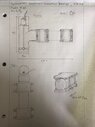
Ok, thank you. I guess what I am really trying to figure out is if there is a way to make a rough calculation of how long it would take to fully charge a typical cell phone battery (say ~4000 mAh) as a function of flow rate given the specs of my generator (may have to pick one with a higher rpm). I have derived an expression for the number of coulumbs as a function of flow rate and time and have attached it. Could someone please let me know if it is correct and how I can use it to estimate charge time? Thank you.
 

Attachments

Similar threads

  • · Replies 25 ·
Replies
25
Views
7K
  • · Replies 5 ·
Replies
5
Views
3K
  • · Replies 2 ·
Replies
2
Views
2K
Replies
34
Views
5K
  • · Replies 41 ·
2
Replies
41
Views
7K
Replies
21
Views
2K
  • · Replies 16 ·
Replies
16
Views
4K
Replies
9
Views
2K
Replies
2
Views
2K
  • · Replies 9 ·
Replies
9
Views
2K