How Can I Create a Diagram That Shows Dependent Answers?

  • Thread starter Thread starter rons
  • Start date Start date
  • Tags Tags
    Diagram
Click For Summary
SUMMARY

This discussion centers on creating a diagram that illustrates dependent answers, specifically focusing on the relationship between Answer A and Answer B. Participants recommend understanding the mathematical concepts of "torque" and "moments" as essential for accurately depicting these dependencies. A Wikipedia article on torque is suggested as a foundational resource for grasping these concepts. Engaging with the article and asking questions in the forum is encouraged for further clarification.

PREREQUISITES
  • Understanding of "torque" and "moments" in physics.
  • Familiarity with diagramming techniques for visualizing dependencies.
  • Basic mathematical skills to interpret torque-related problems.
  • Ability to engage in forum discussions for collaborative learning.
NEXT STEPS
  • Read the Wikipedia article on torque to grasp the fundamental concepts.
  • Practice creating diagrams that show dependencies using tools like Lucidchart or Microsoft Visio.
  • Explore advanced topics in physics related to torque and moments for deeper understanding.
  • Post specific questions in the forum about torque and moments to clarify any uncertainties.
USEFUL FOR

This discussion is beneficial for students, educators, and professionals in physics or engineering fields who are looking to visualize and understand the relationships between dependent answers in problem-solving scenarios.
rons
Messages
3
Reaction score
2
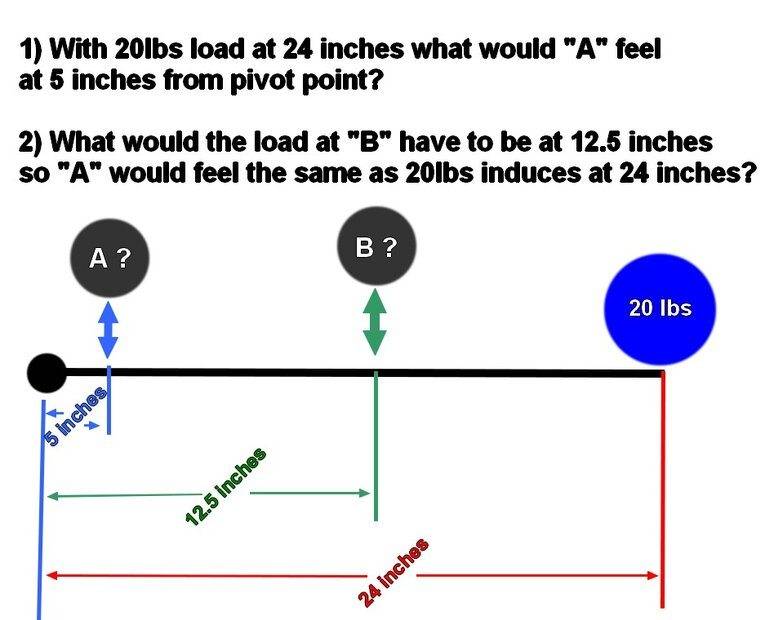
Hi , I asked in the general forum and it was suggested to ask this here, hoping someone can help. I made this diagram to depict the two answers, I'm looking for. Answer B is dependent on answer A. Thanks so any that can help :)
levereage question.jpg
 
Engineering news on Phys.org
Welcome again to PF. :smile:

Are you familiar yet with the concepts of "torque" and "moments"? That is the math you will use to work on such problems. Have a read through this Wikipedia article to see if it helps, and post your questions about that article here so we can help clear up any confusions you have.

https://en.wikipedia.org/wiki/Torque
 
OK, I'll see if I can work through that, not familiar with any of that :)
 
I think you'll pick it up pretty quickly. Post any questions about the article here so we can help. :smile:
 
ok thanks!
 
I have encountered a vertically oriented hydraulic cylinder that is designed to actuate and slice heavy cabling into sections with a blade. The cylinder is quite small (around 1.5 inches in diameter) and has an equally small stroke. The cylinder is single acting (i.e. it is pressurized from the bottom, and vented to atmosphere with a spring return, roughly 200lbs of force on the spring). The system operates at roughly 2500 psi. Interestingly, the cylinder has a pin that passes through its...

Similar threads

  • · Replies 7 ·
Replies
7
Views
1K
  • · Replies 12 ·
Replies
12
Views
3K
  • · Replies 14 ·
Replies
14
Views
2K
  • · Replies 7 ·
Replies
7
Views
3K
Replies
44
Views
5K
  • · Replies 17 ·
Replies
17
Views
2K
  • · Replies 28 ·
Replies
28
Views
4K
Replies
0
Views
2K
  • · Replies 12 ·
Replies
12
Views
1K
Replies
9
Views
2K