mdaugird said:
so looking at the watt meter, how does a commercial meter have a VA and KW reading that is different on an "instantaneous" basis.
Let's take a look at a wattmeter.
The 330k and 20 k resistors divide tha 120V down to a manageable size signal for volts,
and the 10 ohm resistor gives a second signal that's proportional to current.
The 633 does an instant by instant multiplication of those two signals.
The rightmost opamp averages that product.
[PLAIN said:
http://electronicdesign.com/energy/what-s-difference-between-watts-and-volt-amperes][/PLAIN]
The concept for calculating the real power for ac circuits is straightforward, though performing the calculation is much more difficult. To get the power in watts, you need to know the instantaneous voltage with time, v(t), and the instantaneous current with time, i(t). When you multiply these together, you get the instantaneous power with time, p(t).
Since this instantaneous power is changing over time, we need to get an average value, so we integrate the power over a period of time and divide by the time period to get the average. That gives us the watts dissipated by the device in a circuit with voltage v(t) across it and current i(t) through it for the period of time evaluated. Assuming that the voltage and current are both periodic waveforms of period T, the strict mathematical way to express the power calculation for a periodic waveform of period T is:
So while this may be easy to visualize, it is not easy to calculate. Even the measurement of real power in watts for ac circuits requires specialized equipment (a wattmeter) because the voltage and current waveforms must be measured over a precise period of time, the measurements must be simultaneous, and the average must be calculated over the measurement time period. A standard multimeter can’t make this type of power measurement.
now
if volts = Vsin(ωt) and amps is Asin(ωt)
the product is VAsin
2(ωt) = (1-cos(2ωt) ) /2 note double frequency
and notice that value is never negative , the math says so. I can believe that math ,even if only because volts and amps have same sign at every instant.
Okay, so just to make things interesting let's shift current by 90 degrees so it's all wattless reactive power
volts = Vsin(ωt) and amps is Acos(ωt)
the product is VAsin(ωt)cos(ωt) = ( VA sin(2ωt) ) / 2 , again note double frequency
and notice this time math says it's not offset so averages zero.
Intuitively, volts and amps have opposite signs half the time so the products will be half negative and half positive probably averaging zero.
Now let's take a look at the two inputs to the analog wattmeter for the second case
(mainly because i couldn't find waveforms for the first case)
here's the waveforms you'd see with an oscilloscope
what they call "power" is instantaneous volts X instantaneous amps, output of the multiplier, observe it's double frequency and has no offset
the straight line is averaged power signal.
Hmmm. The wattmeter reports zero watts for a pure reactive load
If you replaced the reactive load with a resistive one
power = (1-cos(2ωt) ) /2
that blue double frequency power wave would shift up to reflect the 1 in that equation
and it'd shift over to realign the zero points
and the wattmeter would report its nonzero average
it has no choice , Mother Nature made math that way
usually if math says something is so Mother Nature won't disagree.
I love electronics because it's so close to math.
I'm awkward at math , but that circuit i can visualize and work in my head. (I think my mild autism helps...)
old jim
edit - oops i notice my waveforms start with voltage at peak instead of current at peak . Would have been better for me to have chosen Volts as cosine and Amps as sine
mea culpa i seem always to get things backward and it's frustrating
but i do stand behind the math.
I hope dear readers will forgive my clumsiness.
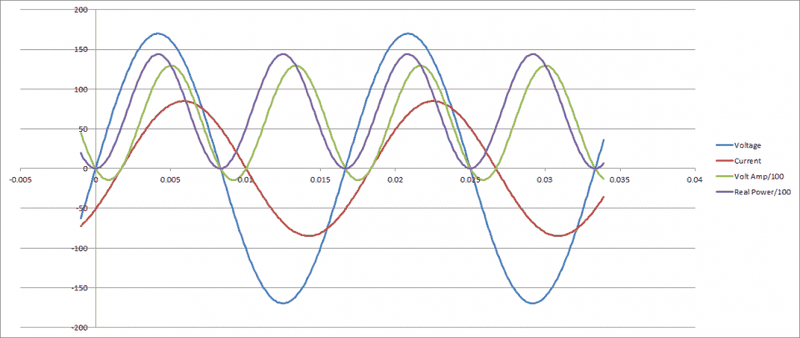 attach a spreadsheet?