Help with an inclined plane problem

Click For Summary

Homework Help Overview

The original poster presents a problem involving a mechanical design for a drinks optic, specifically focusing on a scenario with an inclined plane that moves horizontally while a pin moves vertically. The goal is to determine the angle theta in relation to various forces and friction coefficients at the threshold of movement, while ignoring gravity.

Discussion Character

  • Exploratory, Assumption checking, Problem interpretation

Approaches and Questions Raised

  • Participants discuss the importance of identifying all relevant forces acting on both the pin and the wedge. There are inquiries about the relationship between the forces Fmove and Fdown, particularly why they are considered equal at the threshold of movement. The original poster mentions balancing forces and the impact of friction coefficients on the system.

Discussion Status

Some participants have provided guidance on how to approach the problem by suggesting the need to write down all forces and consider the normal forces involved. There is an ongoing exploration of the mechanics involved, with no explicit consensus reached yet on the best way to proceed.

Contextual Notes

The original poster notes a lack of existing resources that directly address this specific scenario, indicating a unique challenge. There is also mention of design constraints regarding the forces involved in the mechanism.

DudleySquires
Messages
4
Reaction score
0
Hello folks. After a while lurking I've finally got a problem that I need some help with!

1. Homework Statement

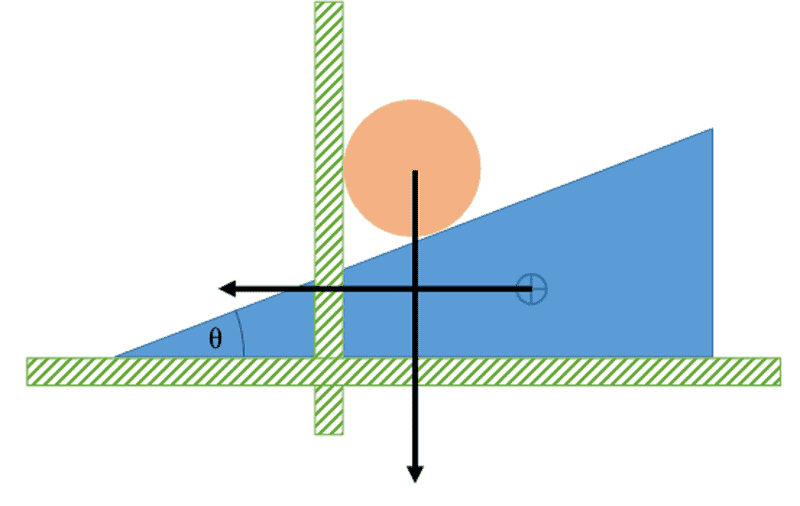
I'm designing an adaptor for a drinks optic and have translated one of the aspects of the design into the following problem. There is plenty of stuff on the net about simple inclined plane problems but not quite like this.
D8lTb1U.png


In this problem the blue wedge can only move horizontally, constrained by the fixed green floor. The orange pin (viewed here end on) can only move vertically. It doesn't roll and is constrained by the fixed green wall.

The idea of this mechanism (if you haven't already guessed) is that the pin is raised by pushing the wedge under it.

The pin is pressed down by force Fdown.
The wedge is moved horizontally by Fmove.
Ignore gravity.

I need to determine the angle theta in terms of Fdown, μa & μb at the threshold of moving.

As I say, lots of stuff on the net on inclined planes, friction / frictionless, accelerating / equilibrium, but none quite the same as this where the inclined plane is moving under the pin.

Homework Equations


At threshold of moving Fmove = Fdown.
ΣFx = ΣFy = 0
μwall-pin = μpin-wedge = μa.
μwedge-floor = μb.

The Attempt at a Solution


I've drawn that many FBDs that it's not worth uploading them all. Suffice to say I know about component forces but I just can't figure how to make everything balance.

Thank you please!
 
Physics news on Phys.org
hi, I'm glad you're posting interesting problems!
uh, you should probably write down all the important forces, acting on the pin, and acting on the wedge. Then you can start thinking about balancing things afterwards.
So maybe start with the pin. Which frictional forces are acting on it, and which external forces are acting on it? Also remember the normal forces.
 
DudleySquires said:
At threshold of moving Fmove = Fdown.
Why would that be? Those two forces act at right angles.
 
haruspex said:
Why would that be? Those two forces act at right angles.

One of the design constraints is that the force to activate the adaptor Fmove must be <= the force without the adapter Fdown. So I'm trying to deal only with the limit case where they are the same.
 
Here's where I've got to. I've got as far as balancing the pin, then the wedge, and now I'm considering how the friction & perp forces between wall and pin should be accounted for.

JuVtZeO.jpg


KfsY862.png


I've used a friction coefficient of 0.3, which has resulted in the "slip" beginning at ~17deg. When that happens, the wall begins to react some of the force, which also sets up a new perp and associated friction force between the wall and pin. I suppose that any perp force that cannot be reacted by the friction force will have to be reacted by the ground, which is in addition to the vertical force that is already present.
 
Last edited:
Must admit to being surprised at having created a problem which it appears that nobody has tackled before. As I say I can find nothing on the net. Even if I modify the question to say something like find what value of Fmove is required to move the pin upwards, in terms of theta and the friction coefficients, there is still nothing out there that I can find.
 
DudleySquires said:
One of the design constraints is that the force to activate the adaptor Fmove must be <= the force without the adapter Fdown. So I'm trying to deal only with the limit case where they are the same.
Ok, but then you should have written |Fmove | =|Fdown |, and it should have been as part of the problem description. "Relevant equations" is for standard equations, such as conservation laws.
You need to introduce unknowns for the three normal forces. You do not know in advance what these are. They're not simply components of the force needed to balance gravity. I would suggest not assuming |Fmove | =|Fdown | yet - you can plug that in at the end.
On the roller, you have six forces: gravity, the propulsive force, two normal forces and two frictional forces. Write out two equations containing them.
Likewise the wedge, with its five forces.
Since either nothing moves or sliding occurs at all surfaces, you can take the frictional forces to be at maximum everywhere.
That gives you four equations and four unknowns: the three normal forces and theta. Solve.
 

Similar threads

Replies
13
Views
4K
  • · Replies 19 ·
Replies
19
Views
3K
  • · Replies 1 ·
Replies
1
Views
3K
  • · Replies 4 ·
Replies
4
Views
7K
  • · Replies 3 ·
Replies
3
Views
2K
  • · Replies 5 ·
Replies
5
Views
2K
  • · Replies 4 ·
Replies
4
Views
4K
  • · Replies 1 ·
Replies
1
Views
2K
  • · Replies 2 ·
Replies
2
Views
1K
  • · Replies 1 ·
Replies
1
Views
8K