Integration convention for action in Spacetime and Geometry 1.132

4 replies · 3K views · last reply
George Keeling
Gold Member
Messages
183
Reaction score
42
I am reading Spacetime and Geometry by Sean Carroll. In section 1.10 on classical field theory, he uses this formula (1.132)
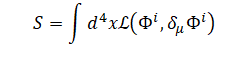
Equation S = ∫ d^4x L(Φ^i, δ_μ Φ^i), where S is the action, L is the Lagrangian density, and Φ^i are the fields with derivatives δ_μ Φ^i.

The curly L is a Lagrange density. S is an action, Φ is a vector potential.

Could the integral also be written as follows?
Mathematical expression: a four-fold integral sign followed by L(Φ^i, δ_μ Φ^i) dx dy dy dt, where L is a Lagrange density.
 
Attachments
  • Equation S = ∫ d^4x L(Φ^i, δ_μ Φ^i), where S is the action, L is the Lagrangian density, and Φ^i are the fields with derivatives δ_μ Φ^i.
    shortintegral.png
    1.1 KB · Views: 1,039
  • Mathematical expression: a four-fold integral sign followed by L(Φ^i, δ_μ Φ^i) dx dy dy dt, where L is a Lagrange density.
    longintegral.png
    1.3 KB · Views: 711
Yes, assuming you mean ##dx\, dy\, dz\, dt##. One reason for using ##d^4x## instead is to save space, and to not emphasize any particular order for the iterated integrals. (There is also a little matter of the fact that the integral over a region is only equivalent to iterated integration over a series of intervals when the region and function being integrated satisfy certain properties, such as Fubini's theorem, but this is not really a big deal most of the time.)
 
  • Like
Likes   Reactions: George Keeling
I did indeed mean dx dy dz dt. Thank you, I liked your answer!