Help with integration conventions in "Spacetime and Geometry" by Sean Carroll

Click For Summary

Discussion Overview

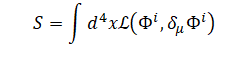
The discussion revolves around integration conventions as presented in "Spacetime and Geometry" by Sean Carroll, specifically focusing on the notation used for integrals in classical field theory. Participants explore the implications of using different forms of integration notation.

Discussion Character

  • Technical explanation

Main Points Raised

  • One participant asks whether the integral can be expressed in terms of individual differentials (dx, dy, dz, dt) instead of the compact notation d4x.
  • Another participant responds affirmatively, explaining that using d4x is often a matter of convenience and avoids emphasizing the order of integration. They also mention conditions under which iterated integrals are equivalent to integrals over regions, referencing Fubini's theorem.
  • A third participant confirms their understanding and appreciation of the explanation provided.
  • A fourth participant provides a link to a related discussion on the forum for further reference.
  • The initial poster expresses satisfaction with the responses received.

Areas of Agreement / Disagreement

Participants generally agree on the convenience of using d4x for integration, but there is no explicit consensus on the necessity or implications of different notations.

Contextual Notes

The discussion does not address specific conditions under which the equivalence of integration forms holds, nor does it resolve the implications of using different notation in various contexts.
George Keeling
Gold Member
Messages
183
Reaction score
42
I am reading Spacetime and Geometry by Sean Carroll. In section 1.10 on classical field theory, he uses this formula (1.132)
shortintegral.png

The curly L is a Lagrange density. S is an action, Φ is a vector potential.

Could the integral also be written as follows?
longintegral.png
 

Attachments

  • shortintegral.png
    shortintegral.png
    1.1 KB · Views: 1,005
  • longintegral.png
    longintegral.png
    1.3 KB · Views: 676
Physics news on Phys.org
Yes, assuming you mean ##dx\, dy\, dz\, dt##. One reason for using ##d^4x## instead is to save space, and to not emphasize any particular order for the iterated integrals. (There is also a little matter of the fact that the integral over a region is only equivalent to iterated integration over a series of intervals when the region and function being integrated satisfy certain properties, such as Fubini's theorem, but this is not really a big deal most of the time.)
 
  • Like
Likes   Reactions: George Keeling
I did indeed mean dx dy dz dt. Thank you, I liked your answer!
 
That's enough thanks!
 

Similar threads

  • · Replies 11 ·
Replies
11
Views
4K
  • · Replies 1 ·
Replies
1
Views
2K
  • · Replies 5 ·
Replies
5
Views
3K
  • · Replies 7 ·
Replies
7
Views
2K
  • Poll Poll
  • · Replies 5 ·
Replies
5
Views
13K
  • · Replies 4 ·
Replies
4
Views
2K
  • · Replies 1 ·
Replies
1
Views
2K
  • · Replies 3 ·
Replies
3
Views
3K
  • · Replies 2 ·
Replies
2
Views
2K
  • · Replies 3 ·
Replies
3
Views
3K