Help with science experiment magnets/force/acceleration/speed

Click For Summary
SUMMARY

This discussion focuses on developing a science experiment for school children aged 12, utilizing two strong neodymium magnets to explore the relationships between distance, force, acceleration, and speed. Participants emphasize the importance of safety, particularly avoiding collisions that could cause the magnets to shatter. Key insights include the need to present general statements about the increasing force and speed as magnets approach each other, while simplifying complex concepts like acceleration for a young audience. Suggestions include measuring equilibrium distances with added weights to illustrate force versus distance relationships.

PREREQUISITES
  • Understanding of basic physics concepts such as force, speed, and distance.
  • Familiarity with neodymium magnets and their properties.
  • Knowledge of safe experimental practices, especially with strong magnets.
  • Ability to simplify scientific concepts for a younger audience.
NEXT STEPS
  • Research the principles of magnetism and how force varies with distance.
  • Explore safe experimental setups for demonstrating magnetic forces to children.
  • Learn about the differences between velocity and acceleration in simple terms.
  • Investigate engaging ways to present physics concepts to young learners.
USEFUL FOR

Educators, science communicators, and anyone involved in teaching physics concepts to children, particularly those interested in hands-on experiments with magnets.

RonWerner
Messages
2
Reaction score
1
TL;DR
2 magnets start being attracted to each other and will increase speed until colliding. What can I say about the force/accelleration/speed?
Sorry, I guess I should have remembered all of this from my school days, but right now I have forgotten so much that I need some help.

I am developing some simple experiments for school children (age ca. 12). This one involving magnets.

I am not asking for detailed calculations, that is way beyond the scope of this experiment. I need some help with NOT saying stupid things.

The plan is to make some simple device with 2 strong neodymium magnets, attracted to each other, with increasingly high speed, but not exactly colliding, as that would potentially damage the magnets.

What can I say about the speed of the moving magnets? What about the accelleration? What about the force?

Put it this way: what can I say for every centimeter the magnets come closer to each other? What kind of mathematical relationship is there? Is there a linear or exponential relationship?

Hopefully somebody can help me to some simple answers! Thanks in advance!

Ron Werner
Norway
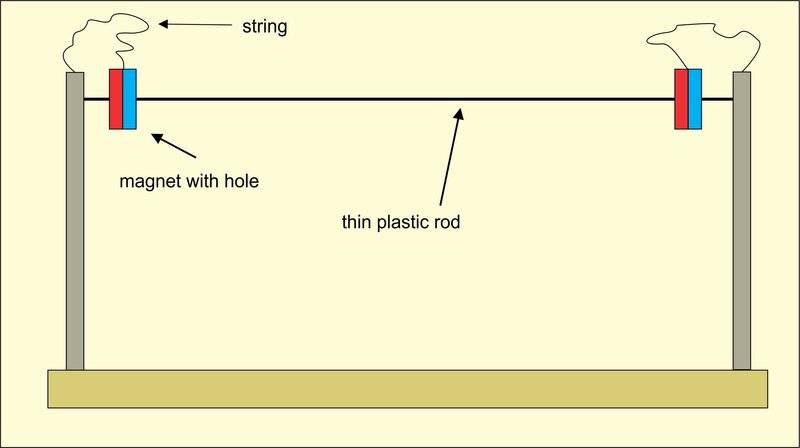
MAGNET EXPERIMENT.jpg
 
Physics news on Phys.org
I think it will be difficult to get numbers out using your arrangement. Perhaps you might consider rotating your drawing 90° so that the thin rod is vertical with the magnets placed in repulsion. Measure the weight of the top magnet and the equilibrium distance between the top and bottom magnets. That is your first data point. Then add (non-magnetic) weights on the top magnet and record the new equilibrium distances.

This should give you a plot of Force vs. distance. You should be able to show that doubling the mass does not halve the distance as most people might think. You might even be able to extract an approximate power law for the force.
 
Many thanks for your reply!

For my project, the precise numbers are not important. I need to be able to present general statements about the relationship between distance/force/acceleration/speed. Remember, the target group are young school children without any background in physics. I want to rouse their curiosity and hopefully they become seriously interested in this subject.
 
Put up an actylic safety barrier!!

Those magnets are very likely to explode if they collide (likely breaking your string), sending high speed razor sharp shards everywhere.

Safety first!
 
RonWerner said:
I need to be able to present general statements about the relationship between distance/force/acceleration/speed. Remember, the target group are young school children without any background in physics.
As the distance decreases, the force, acceleration, and speed all increase. But the notion of an increasing acceleration is beyond the scope of a young school child. I wouldn't even mention acceleration. Speed and distance are part of their experiential understanding, but force (how hard the pull) will be confused with distance. You need an exercise where they measure force if you want the lesson to be worthwhile. Something like what's suggested in Post #2, even if not as detailed.
 
RonWerner said:
Many thanks for your reply!

For my project, the precise numbers are not important. I need to be able to present general statements about the relationship between distance/force/acceleration/speed. Remember, the target group are young school children without any background in physics. I want to rouse their curiosity and hopefully they become seriously interested in this subject.
OK, let's consider the relationship between distance/force/acceleration/speed." They may not have a background in physics but they have formed opinions about how the physical world around them is put together. They may not know ##y=\frac{1}{2}gt^2## but they do know that walking off the edge of a cliff is very bad idea.

If you want to clarify the ##y-v-a## relationship, you need to deal with the 800 pound gorilla in the room I am talking about the Aristotelian preconception that motion implies force. Here is a suggestion.

Push a small block across a table at constant speed. Note that as long as your finger is pushing, the block is moving. When you remove your finger the block stops. When your finger pushes again, the block resumes its motion. Ask the audience what they conclude from this.

Obvious (but wrong) answer established after many hours of playing with toys: For an object to move a force must act on it. The idea that constant speed along a straight line implies zero acceleration never enters the picture.

Set that aside and do a second experiment. Ask the audience to watch carefully what you are about to do. Throw the block straight up in the air and watch it go up and then come down. Then ask "While the block is moving up, how many forces act on it and what are they?" Most likely you will hear something like "Gravity and the force of the hand." Time to move in for the kill. "But my hand isn't touching the box while it's moving up." The argument is even more persuasive if you stick your hand in your pocket while the block is moving up.

Finally, the differentiation between velocity and acceleration. "What is the acceleration of the block when it is at the top of its trajectory?" Those who reply with "zero" should be made aware that this answer violates the well known observation that "what goes up must come down."

Of course, you don't have to follow my specific suggestions, but I think that liberating your students' minds from their preconceptions is important. If you want your presentation to take hold, removing the obstacles of Aristotelian preconceptions is a good first step.
 
This seems like we're approaching it from the wrong direction. What are you trying to teach? Then we can discuss the right setup to do that.
 

Similar threads

  • · Replies 7 ·
Replies
7
Views
2K
  • · Replies 51 ·
2
Replies
51
Views
5K
  • · Replies 11 ·
Replies
11
Views
2K
  • · Replies 5 ·
Replies
5
Views
2K
  • · Replies 24 ·
Replies
24
Views
4K
  • · Replies 1 ·
Replies
1
Views
552
  • · Replies 42 ·
2
Replies
42
Views
3K
Replies
8
Views
2K
  • · Replies 16 ·
Replies
16
Views
2K