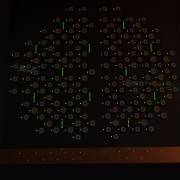
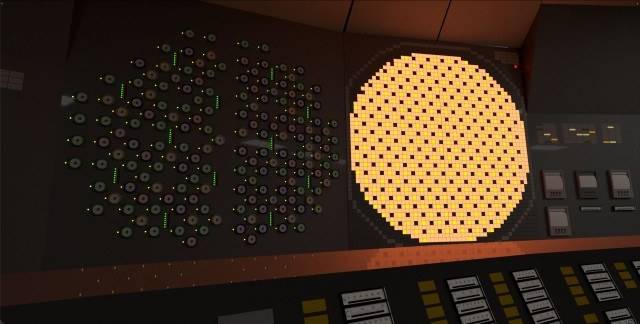
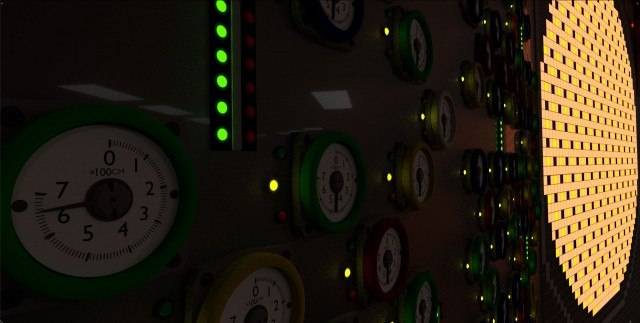
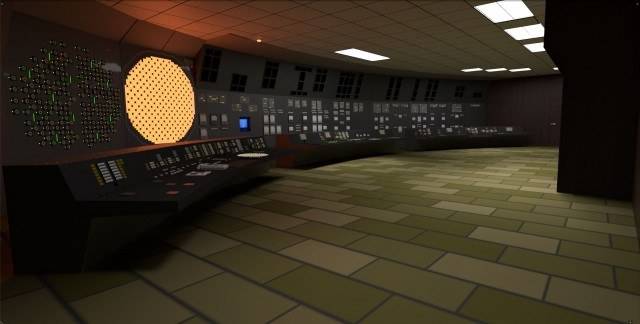
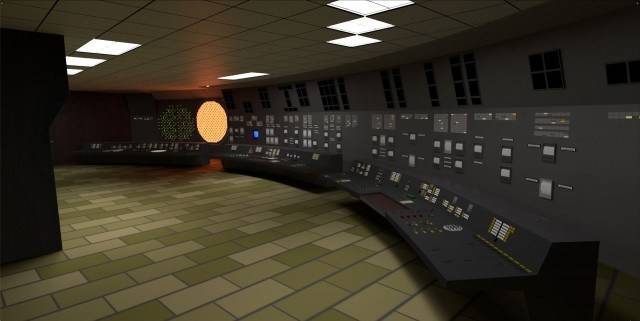
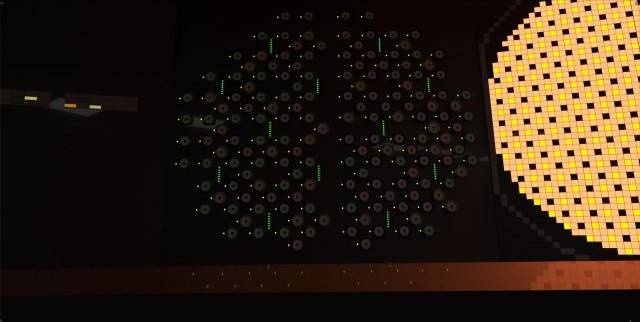
Here is a 3D model I made of the RBMK reactor control room

Click For Summary
SUMMARY

The forum discussion centers on a 3D model of the RBMK-1000 reactor control room created using Blender 3D, inspired by the HBO miniseries about Chernobyl. The model is approximately 95% complete, requiring additional elements like chairs and a central desk, along with improved textures and lighting. The rendering was performed using the Cycles engine on an Nvidia GeForce GTX 1080, with each frame taking around 5 minutes to render. The discussion also touches on the potential for creating a real-time VR training simulator based on this model.

PREREQUISITES
  • Familiarity with Blender 3D modeling software
  • Understanding of Cycles rendering engine
  • Knowledge of Nvidia CUDA processing technology
  • Basic concepts of 3D animation techniques
NEXT STEPS
  • Explore advanced Blender 3D modeling techniques
  • Learn about optimizing rendering times in Cycles
  • Research VR development tools compatible with Blender
  • Investigate creating real-time simulations using Blender's game engine
USEFUL FOR

3D artists, animators, VR developers, and anyone interested in nuclear power plant simulations or training applications.

ElliotSmith
Messages
167
Reaction score
104
Summary: The new HBO miniseries inspired me to use blender 3D to re-create the Chernobyl control room.

The HBO miniseries about Chernobyl inspired me use a 3D modeling program called Blender to re-create the RBMK-1000 reactor control room of the Chernobyl nuclear power plant.

It's about 95% done, it just needs some chairs, a large desk in the center of the room, and maybe some more textures and better lighting.
5.jpg
1.jpg
2.jpg
3.jpg
4.jpg
5.jpg
 
  • Like
Likes   Reactions: Greg Bernhardt, DaveC426913, artis and 1 other person
Computer science news on Phys.org
Here is a link where you can view the full-resolution screenshots.

https://www.artstation.com/artwork/A9gQBq
 
  • Like
Likes   Reactions: berkeman
Nice work. I've been recently reintroducing myself to using Blender for doing modeling. (I've had it for some time, I was just tending to use Moray and POV-ray more.) Lately I've been focusing more on using its animation features.

Was this done with the Blender or cycles render? I tend to use Blender rendering engine when it comes to animations as, on my computer, the cycles render is slow and it takes forever to generate all the frames. ( I did one 700+ frame animation with cycles that took weeks to completely render. Doing only so many frames overnight each day. At 24 frames per sec, that was a lot of time investment for a 30 sec animation, just for rendering.)
 
Janus said:
Nice work. I've been recently reintroducing myself to using Blender for doing modeling. (I've had it for some time, I was just tending to use Moray and POV-ray more.) Lately I've been focusing more on using its animation features.

Was this done with the Blender or cycles render? I tend to use Blender rendering engine when it comes to animations as, on my computer, the cycles render is slow and it takes forever to generate all the frames. ( I did one 700+ frame animation with cycles that took weeks to completely render. Doing only so many frames overnight each day. At 24 frames per sec, that was a lot of time investment for a 30 sec animation, just for rendering.)

It took around 5 minutes to render a single frame.

I'm using Nvidia GeForce GTX 1080 CUDA processing.

And yes, it was rendered in cycles.
 
ElliotSmith said:
It took around 5 minutes to render a single frame.

I'm using Nvidia GeForce GTX 1080 CUDA processing.

And yes, it was rendered in cycles.
By contrast just this, at a resolution of just 640x360, took 18 min on my dinosaur of a computer with cycles.
0136.png


And until it dies completely, I have little hope of convincing my wife that it needs to be replaced. :frown:
 
Janus said:
By contrast just this, at a resolution of just 640x360, took 18 min on my dinosaur of a computer with cycles.
View attachment 243770

And until it dies completely, I have little hope of convincing my wife that it needs to be replaced. :frown:

When your computer eventually dies, you should look into getting one with an Nvidia GPU, because of CUDA processing.
 
I spent 18 years building training simulators for such control rooms. Your simulation looks like a lot of fun to me. In fact, if it could be made to work in real time and paired with a VR headset, and responsive to user actions like twisting a knob, I could see making a training simulator with only a virtual control room for the operators. You might miss a little of the ergonomics, but not much. It would cost perhaps 5 million dollars less than a conventional simulator, and it could be used by trainees whenever and wherever they are.
 
ElliotSmith said:
When your computer eventually dies, you should look into getting one with an Nvidia GPU, because of CUDA processing.
Pretty much anything would be an improvement. By the way, that render was from the animation I was referring to. You can see the entire 28 sec video here:


It was a pretty basic animation with just the camera following a path through the model. I added the ambient background sound later.

A bit more complex animation using sound is this one. It actually uses sound clips to control aspects of the animation ( flashing lights), which I then used in the final soundtrack.
 
  • Like
Likes   Reactions: Tea Monster
anorlunda said:
I spent 18 years building training simulators for such control rooms. Your simulation looks like a lot of fun to me. In fact, if it could be made to work in real time and paired with a VR headset, and responsive to user actions like twisting a knob, I could see making a training simulator with only a virtual control room for the operators. You might miss a little of the ergonomics, but not much. It would cost perhaps 5 million dollars less than a conventional simulator, and it could be used by trainees whenever and wherever they are.
Blender does have a game engine, which would allow you to create a real-time simulation, Though I haven't experimented with it yet. You can also create stereoscopic renders. Either the type that uses the red-blue glasses, or by rendering two separate images for left and right eye views when using either the Blender or Cycles render, but does not seem to be a feature available with the game engine.
 
  • #10
anorlunda said:
I spent 18 years building training simulators for such control rooms. Your simulation looks like a lot of fun to me. In fact, if it could be made to work in real time and paired with a VR headset, and responsive to user actions like twisting a knob, I could see making a training simulator with only a virtual control room for the operators. You might miss a little of the ergonomics, but not much. It would cost perhaps 5 million dollars less than a conventional simulator, and it could be used by trainees whenever and wherever they are.

Really? That sounds awesome! Here is the .blend file if you, or someone you know, could turn this into a real VR training simulator for RBMK operators.

https://1drv.ms/u/s!Ansq7V5Mt2BrghE8DaXK5mt7R0oe

Important Note: It's not 100% accurate, I had to do some improvisation in areas where I didn't have detailed reference images of, such as the instrument panels and whatnot. It needs a complete overhaul.

But it's a good foundation to work with.
 
Last edited:
  • #11
Janus said:
You can see the entire 28 sec video here:
Pretty cool. What's that thing on the left wall around 0:20? A drinking fountain?

243908
 
  • #12
berkeman said:
Pretty cool. What's that thing on the left wall around 0:20? A drinking fountain?

View attachment 243908
I have no idea. I doubt they ever gave it an actual function. As far as the filming the TV show goes, it was a movable prop that could be put in different spots as needed. This "walk-through" animation shows pretty much the entire extent of the corridor set used in shooting the show. They had a number of these type of things that could be used to dress the set. This way they could make the same set look like different parts of the ship.
So, for example, the door shown leads to a turbo lift. You'd shoot the actors walking into it with the prop there, and then shoot them walking out with it gone, giving the illusion that the turbo-lift took them somewhere else.
 
  • Like
Likes   Reactions: berkeman
  • #13
Check out my other 3D work, here.

https://www.artstation.com/outer_haven
 

Similar threads

Replies
22
Views
4K
  • · Replies 2 ·
Replies
2
Views
3K
  • · Replies 1 ·
Replies
1
Views
2K
Replies
2
Views
2K
Replies
1
Views
2K
  • · Replies 1 ·
Replies
1
Views
2K
  • · Replies 1 ·
Replies
1
Views
5K
  • · Replies 7 ·
Replies
7
Views
7K
Replies
7
Views
3K
  • · Replies 83 ·
3
Replies
83
Views
18K