SUMMARY
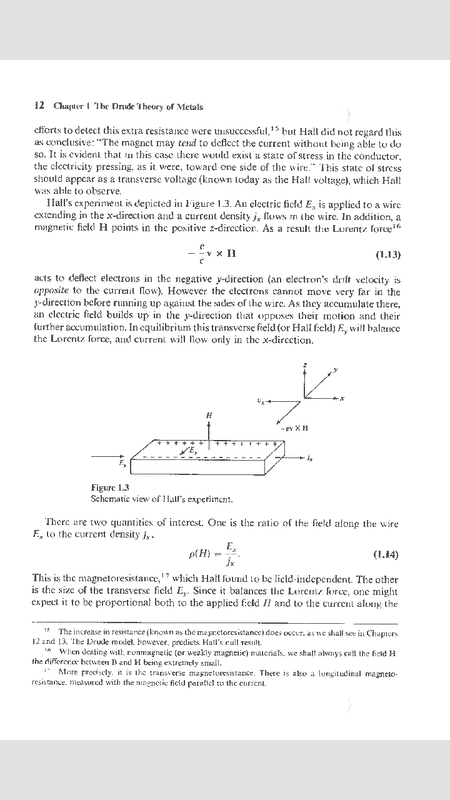
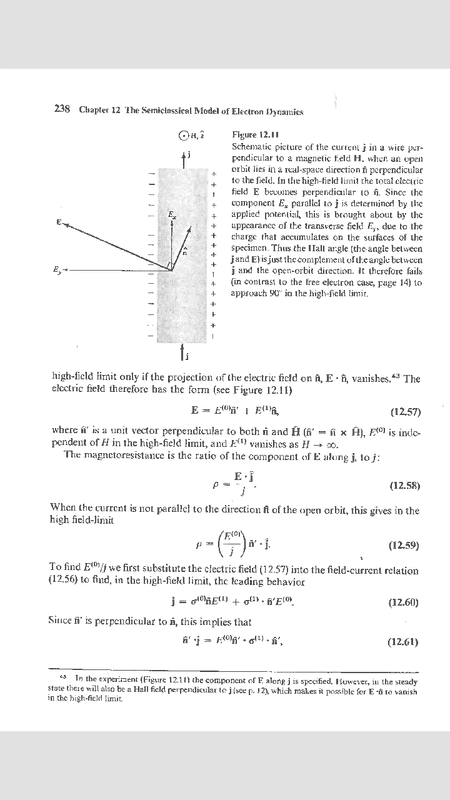
The forum discussion centers on the discrepancies between two diagrams in Ashcroft & Mermin's solid state physics book, specifically regarding the Hall Effect. Participants highlight that the diagrams illustrate different concepts, with the second diagram addressing the Hall Effect under high field strength conditions, which differs from the ordinary Hall Effect. Key points include the orientation of the magnetic field (B field) and the electric field (E field), as well as the implications of positive and negative charge carriers. The discussion emphasizes the need for clarity in scientific illustrations to enhance understanding.
PREREQUISITES
- Understanding of the Hall Effect in solid state physics
- Familiarity with magnetic field orientation and notation (e.g., circles with dots and crosses)
- Knowledge of charge carriers and their behavior in magnetic fields
- Basic principles of solid state physics as presented in Ashcroft & Mermin's textbook
NEXT STEPS
- Study the Hall Effect under varying field strengths and its implications on material behavior
- Research the differences between ordinary and high-field Hall Effect phenomena
- Examine the role of charge carriers in magnetic fields, focusing on positive and negative carriers
- Review the illustrations in Ashcroft & Mermin's solid state physics book for clarity and accuracy
USEFUL FOR
Students and educators in physics, particularly those focusing on solid state physics and the Hall Effect, as well as researchers exploring high-field phenomena in materials.