Highest probability of finding an electron

Click For Summary
The discussion centers on understanding the probability density of finding an electron in a one-electron atom, specifically in a lithium ion (Li2+). The key point is that the square of the wave function represents the probability density, and when considering three-dimensional space, the volume element must be taken into account. This leads to the integration over spherical coordinates, resulting in a probability density that incorporates the volume of a sphere. The clarification provided highlights the relationship between the wave function, probability density, and the integration process necessary for calculating the likelihood of finding the electron at a specific distance. Overall, the discussion emphasizes the importance of understanding both one-dimensional and three-dimensional probability calculations in quantum mechanics.
PhoenixWright
Messages
20
Reaction score
1
Hello.

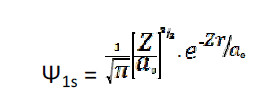
I have found an exercise that reads: "The wave function of a one-electron atom is:
2uejqz9.jpg
[1s orbital, atom: Li2+ What will be the most likely distance to locate the electron?"

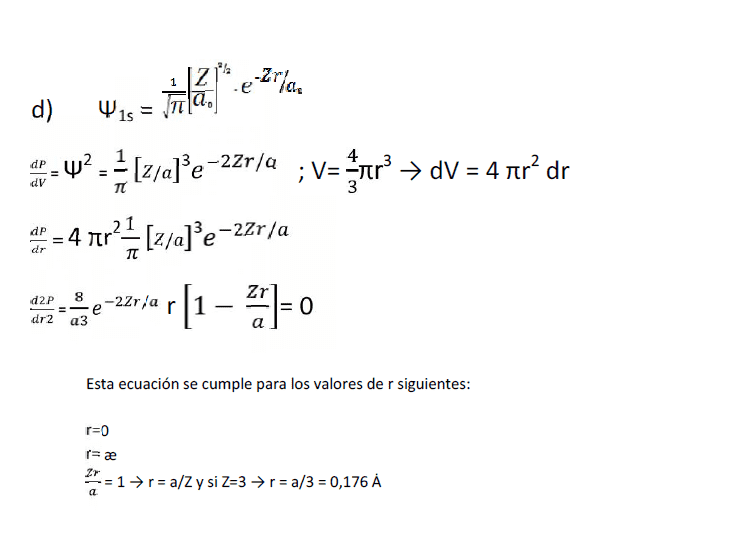
Solution of exercise is:
2u5ri0y.jpg


My question is: Why the square of the probability density is dP/dV, and therefore the volume formula is used?

I had always done this exercise by the square of the wave function, deriving the function and finding the maximum... I don't know why it's used the volume of a sphere here...

Thank you!
 
Physics news on Phys.org
I will give a 1D example. An integral ##P(x) = \int_{a}^x |\psi(x')|^2 dx'## gives the probability of finding a particle between any constant ##a## and ##x##, differentiating ##P(x)## with respect to ##x## gives ##|\psi(x)|^2##.
 
Thank you!

Sorry, but I don't understand the relation between this:

blue_leaf77 said:
I will give a 1D example. An integral ##P(x) = \int_{a}^x |\psi(x')|^2 dx'## gives the probability of finding a particle between any constant ##a## and ##x##, differentiating ##P(x)## with respect to ##x## gives ##|\psi(x)|^2##.

and the volume of the sphere... I had never done this type of exercise in this way, so I don't understand why this exercise is different...

I don't have advanced knowledge, since I'm starting...

Thanks!
 
blue_leaf77 said:
I will give a 1D example. An integral ##P(x) = \int_{a}^x |\psi(x')|^2 dx'## gives the probability of finding a particle between any constant ##a## and ##x##, differentiating ##P(x)## with respect to ##x## gives ##|\psi(x)|^2##.
Define a function ##F(x)## such that
$$
|\psi(x)|^2 = \frac{d F(x)}{dx}
$$
So,
$$
\frac{d P(x)}{dx} = \frac{d}{dx} \int_{a}^x |\psi(x')|^2 dx' = \frac{d}{dx} (F(x) - F(a)) = \frac{dF(x)}{dx} = |\psi(x)|^2
$$
For 3D case, the logic may be slightly elaborate as it involves three variables but the intuition from 1D case can be directly applied. In the current problem, the radial probability ##P(r)## between a point ##r'=a## and ##r## is defined by
$$
P(r) = \int_a^r \int_0^{\pi} \int_0^{2\pi} |\psi_{1s}(r')|^2 r'^2 \sin \theta dr' d\theta d\phi = \int_a^r |\psi_{1s}(r')|^2 4\pi r'^2 dr'
$$
Taking derivative with respect to ##r##
$$
\frac{d P(r)}{dr} = \frac{d}{dr}\int_a^r |\psi_{1s}(r')|^2 4\pi r'^2 dr' = |\psi_{1s}(r)|^2 4\pi r^2
$$
 
  • Like
Likes PhoenixWright
Thank you very much, blue_leaf77. Now I have understood correctly.
 
Another way to look at it...
PhoenixWright said:
My question is: Why the square of the probability density is dP/dV, and therefore the volume formula is used?
The square of the modulus of the wave function is the probability density, i.e., ##dP/dV = \| \psi(\vec{r}) \|^2##. This is one of the basic assumptions of quantum mechanics.

The probability ##dP## of finding the particle in an infinitesimal volume ##dV## around the point ##(r, \theta, \phi)## is given by
$$dP = \| \psi(r, \theta, \phi) \|^2\,dV = \| \psi(r, \theta, \phi) \|^2r^2\,dr\,d(\cos\theta)\,d\phi.$$ If you want the probability of finding the particle at a distance ##r=r_0##, you have to sum over all possibilities meeting this criterion. That is, you need to integrate over the angles. Because the wave function is spherically symmetric, you end up with
$$dP_r = \int_0^{2\pi} \int_{-1}^1 \| \psi(r) \|^2r^2\,dr\,d(\cos\theta)\,d\phi = 4\pi r^2 \| \psi(r) \|^2\,dr.$$ In other words, the marginal probability density ##f_r(r)## is given by ##f_r(r) = 4\pi r^2 \| \psi(r) \|^2##.

I had always done this exercise by the square of the wave function, derivingdifferentiating[/color] the function and finding the maximum... I don't know why it's used the volume of a sphere here.
 
  • Like
Likes PhoenixWright
Thank you, Vela. My questions have been clarified. It is always good to see two ways.
 

Similar threads

  • · Replies 21 ·
Replies
21
Views
2K
  • · Replies 1 ·
Replies
1
Views
2K
Replies
5
Views
2K
  • · Replies 10 ·
Replies
10
Views
2K
  • · Replies 5 ·
Replies
5
Views
2K
  • · Replies 1 ·
Replies
1
Views
1K
  • · Replies 3 ·
Replies
3
Views
4K
  • · Replies 4 ·
Replies
4
Views
1K
  • · Replies 36 ·
2
Replies
36
Views
8K
  • · Replies 3 ·
Replies
3
Views
3K