Homework question from economics

Click For Summary

Homework Help Overview

The discussion revolves around a problem in economics involving differential equations related to equilibrium in a dynamic model. The original poster is seeking to understand how to solve for equilibrium values of consumption (c*) and capital (k*) using the provided differential equations.

Discussion Character

  • Exploratory, Mathematical reasoning, Problem interpretation

Approaches and Questions Raised

  • The original poster presents two differential equations and seeks clarification on how to proceed to find equilibrium values. They question the validity of setting the derivative of the function equal to a specific value based on their equations. Other participants discuss the implications of the equations and suggest checking assumptions about the derivatives.

Discussion Status

Participants are actively engaging with the problem, with some providing insights into the relationships between the variables and suggesting methods to determine equilibrium values. There is an acknowledgment of a mistake in the original equations, leading to further exploration of the correct approach.

Contextual Notes

There are constraints regarding the clarity of posted images, which affects the ability of participants to fully engage with the problem. The original poster has indicated a need for understanding rather than simply obtaining answers.

beaf123
Messages
40
Reaction score
0
< Mentor Note -- thread moved to HH from the technical math forums, so no HH Template is shown >

Hi, I have already delivered the homework so my reason for asking is because I want to/ need to understand it.
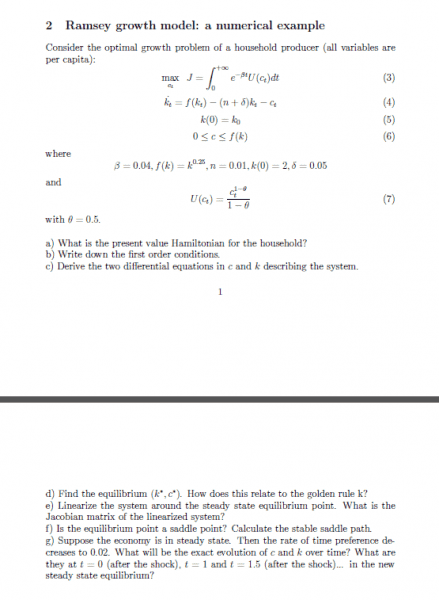
upload_2015-3-12_17-38-42.png


I am at question d. I have found the two differential equations.

They are:

c° = -1/0,5 * ( f'(k) - 0,04)Ct

and

k° = f(k)-0,06kt -Ct

In equilibrium both c° and k° will be zero so both equations can be set equal to zero.

But how do you proceede from here, to find k* and c*? Can you set f'(k) = 0,25K^-0,75 + 2 since f(k) = k^0,25 and k(0) = 2?

If I have explained it too bad I can elaborate. I hope someone can help me:)
 
Last edited:
Physics news on Phys.org
beaf123 said:
< Mentor Note -- thread moved to HH from the technical math forums, so no HH Template is shown >

Hi, I have already delivered the homework so my reqson for qsking is becquse I want to/ need to understand it.

View attachment 80248

I am at question d. I have found the two differential equations.

They are:

c° = -1/0,5 * ( f'(k) - 0,04)Ct

and

k° = f(k)-0,06kt -Ct

In equilibrium both c° and k° will be zero so both equations can be set equal to zero.

But how do you proceede from here, to find k* and c*? Can you set f'(k) = 0,25K^-0,75 + 2 since f(k) = k^0,25 and k(0) = 2?

If I have explained it too bad I can elaborate. I hope someone can help me:)

The posted images are too small on my screen, and I cannot enlarge them. My eyes are not as good as they once were, so your images are unreadable to me, reading glasses and all. If you post larger images or---better still---type it all out (as per PF standards), then I will be willing to help.
 
Thanks. I will post a lager picture tomorrow.
 
upload_2015-3-13_14-47-51.png
I have answered until c),

question d) is:

d) Find the equilibrium (k* c*).

And its here I am struggeling. I have my two equations, and all the needed numbers, so all I want to do is solve the two equations for C and K.
 
Last edited:
beaf123 said:
< Mentor Note -- thread moved to HH from the technical math forums, so no HH Template is shown >

Hi, I have already delivered the homework so my reason for asking is because I want to/ need to understand it.

View attachment 80248

I am at question d. I have found the two differential equations.

They are:

c° = -1/0,5 * ( f'(k) - 0,04)Ct

and

k° = f(k)-0,06kt -Ct

In equilibrium both c° and k° will be zero so both equations can be set equal to zero.

But how do you proceede from here, to find k* and c*? Can you set f'(k) = 0,25K^-0,75 + 2 since f(k) = k^0,25 and k(0) = 2?

If I have explained it too bad I can elaborate. I hope someone can help me:)

If ##c^{o}## means ##dc/dt##, etc., and if your two differential equations are correct (I have not checked) then the answer to your questions is YES. You need ##dc/dt = 0##, so if ##c \neq 0## you need ##f'(k^*) = 0.04##. Thus, you can determine ##k^*##. You also need ##dk/dt = 0##, so ## 0 = f(k^*) - 0.06 k^* - c^*##, so you can determine ##c^*##
 
Thank you. I found a mistake in my differential equation. It should be:
c° = -1/0,5 * ( f'(k) - 0,10)Ct

So this gives:

f`(k) = 0,10
0,25k^-0,75=0,10
k^-0,75=0,4
k=0,4^(-1/0,75)
k*= 3,393
which again gives

c*= 3,393^0,25-0,06(3,393)
c*=1,153

Thanks again for the help. Would you get the same answer if you inserted ct = f(k) - 0,06kt into the first equation?
 
beaf123 said:
Thank you. I found a mistake in my differential equation. It should be:
c° = -1/0,5 * ( f'(k) - 0,10)Ct

So this gives:

f`(k) = 0,10
0,25k^-0,75=0,10
k^-0,75=0,4
k=0,4^(-1/0,75)
k*= 3,393
which again gives

c*= 3,393^0,25-0,06(3,393)
c*=1,153

Thanks again for the help. Would you get the same answer if you inserted ct = f(k) - 0,06kt into the first equation?

Try it for yourself!
 

Similar threads

  • · Replies 5 ·
Replies
5
Views
2K
  • · Replies 3 ·
Replies
3
Views
2K
  • · Replies 5 ·
Replies
5
Views
2K
Replies
2
Views
2K
  • · Replies 3 ·
Replies
3
Views
2K
  • · Replies 9 ·
Replies
9
Views
9K
Replies
5
Views
2K
  • · Replies 22 ·
Replies
22
Views
3K
  • · Replies 6 ·
Replies
6
Views
2K
Replies
2
Views
1K