Homework question from economics

Join the discussion
Registration is free. Ask a follow-up in this thread, or start your own.
6 replies · 2K views
beaf123
Messages
40
Reaction score
0
< Mentor Note -- thread moved to HH from the technical math forums, so no HH Template is shown >

Hi, I have already delivered the homework so my reason for asking is because I want to/ need to understand it.
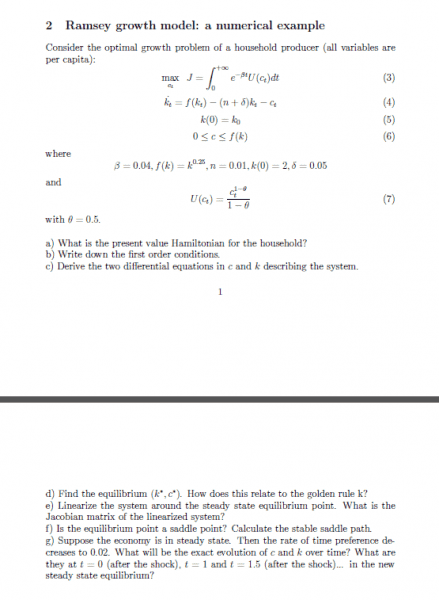
upload_2015-3-12_17-38-42.png


I am at question d. I have found the two differential equations.

They are:

c° = -1/0,5 * ( f'(k) - 0,04)Ct

and

k° = f(k)-0,06kt -Ct

In equilibrium both c° and k° will be zero so both equations can be set equal to zero.

But how do you proceede from here, to find k* and c*? Can you set f'(k) = 0,25K^-0,75 + 2 since f(k) = k^0,25 and k(0) = 2?

If I have explained it too bad I can elaborate. I hope someone can help me:)
 
Last edited:
Physics news on Phys.org
beaf123 said:
< Mentor Note -- thread moved to HH from the technical math forums, so no HH Template is shown >

Hi, I have already delivered the homework so my reqson for qsking is becquse I want to/ need to understand it.

View attachment 80248

I am at question d. I have found the two differential equations.

They are:

c° = -1/0,5 * ( f'(k) - 0,04)Ct

and

k° = f(k)-0,06kt -Ct

In equilibrium both c° and k° will be zero so both equations can be set equal to zero.

But how do you proceede from here, to find k* and c*? Can you set f'(k) = 0,25K^-0,75 + 2 since f(k) = k^0,25 and k(0) = 2?

If I have explained it too bad I can elaborate. I hope someone can help me:)

The posted images are too small on my screen, and I cannot enlarge them. My eyes are not as good as they once were, so your images are unreadable to me, reading glasses and all. If you post larger images or---better still---type it all out (as per PF standards), then I will be willing to help.
 
Thanks. I will post a lager picture tomorrow.
 
upload_2015-3-13_14-47-51.png
I have answered until c),

question d) is:

d) Find the equilibrium (k* c*).

And its here I am struggeling. I have my two equations, and all the needed numbers, so all I want to do is solve the two equations for C and K.
 
Last edited:
beaf123 said:
< Mentor Note -- thread moved to HH from the technical math forums, so no HH Template is shown >

Hi, I have already delivered the homework so my reason for asking is because I want to/ need to understand it.

View attachment 80248

I am at question d. I have found the two differential equations.

They are:

c° = -1/0,5 * ( f'(k) - 0,04)Ct

and

k° = f(k)-0,06kt -Ct

In equilibrium both c° and k° will be zero so both equations can be set equal to zero.

But how do you proceede from here, to find k* and c*? Can you set f'(k) = 0,25K^-0,75 + 2 since f(k) = k^0,25 and k(0) = 2?

If I have explained it too bad I can elaborate. I hope someone can help me:)

If ##c^{o}## means ##dc/dt##, etc., and if your two differential equations are correct (I have not checked) then the answer to your questions is YES. You need ##dc/dt = 0##, so if ##c \neq 0## you need ##f'(k^*) = 0.04##. Thus, you can determine ##k^*##. You also need ##dk/dt = 0##, so ## 0 = f(k^*) - 0.06 k^* - c^*##, so you can determine ##c^*##
 
Thank you. I found a mistake in my differential equation. It should be:
c° = -1/0,5 * ( f'(k) - 0,10)Ct

So this gives:

f`(k) = 0,10
0,25k^-0,75=0,10
k^-0,75=0,4
k=0,4^(-1/0,75)
k*= 3,393
which again gives

c*= 3,393^0,25-0,06(3,393)
c*=1,153

Thanks again for the help. Would you get the same answer if you inserted ct = f(k) - 0,06kt into the first equation?
 
beaf123 said:
Thank you. I found a mistake in my differential equation. It should be:
c° = -1/0,5 * ( f'(k) - 0,10)Ct

So this gives:

f`(k) = 0,10
0,25k^-0,75=0,10
k^-0,75=0,4
k=0,4^(-1/0,75)
k*= 3,393
which again gives

c*= 3,393^0,25-0,06(3,393)
c*=1,153

Thanks again for the help. Would you get the same answer if you inserted ct = f(k) - 0,06kt into the first equation?

Try it for yourself!