Homework questions I've been stuck on for hours

  • Topic:
  • Thread starter ozgunozgur
  • Start date
  • Tags Tags
    Homework
21 replies · 3K views · last reply
ozgunozgur
Messages
27
Reaction score
0
I am trying to solve these questions for hours :/
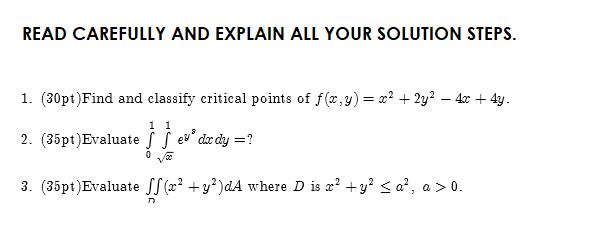
Printed exam questions: 'READ CAREFULLY AND EXPLAIN ALL YOUR SOLUTION STEPS.' 1. (30pt) Find and classify critical points of f(x,y) = x^2 + 2y^2 - 4x + 4y. 2. (35pt) Evaluate the double integral from x=0 to 1, y=sqrt(x) of e^(y^3) dx dy. 3. (35pt) Evaluate the double integral over D of (x^2 + y^2) dA, where D is x^2 + y^2 <= a^2, a > 0.
 
Last edited by a moderator:
Let's begin with the first problem...what have you tried so far?
 
MarkFL said:
Let's begin with the first problem...what have you tried so far?
 
Attachments
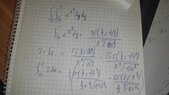
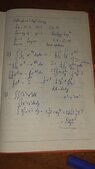
  • Handwritten notes on lined paper with three numbered calculus problems: a critical point analysis of f(x,y)=x^2+2y^2-4x+4y, a double integral of e^(8y) with its reversed-order evaluation, and a double integral of (x^2+y^2) over a disk of radius a.
    15928385796822879765791749130436.jpg
    896.6 KB · Views: 124
Yes, I agree with your finding of a minimum at \((2,-1)\). It is a global minimum. For the second problem, isn't the integrand:

$$e^{y^8}$$ ?
 
MarkFL said:
Yes, I agree with your finding of a minimum at \((2,-1)\). It is a global minimum. For the second problem, isn't the integrand:

$$e^{y^8}$$ ?
Ah sorry. My third question is true? And second is a bit problem.
 
MarkFL said:
Yes, I agree with your finding of a minimum at \((2,-1)\). It is a global minimum. For the second problem, isn't the integrand:

$$e^{y^8}$$ ?
Isn't it gamma function for 8y?
 
I did question 2. Is it true? Can you help me?
 
Attachments
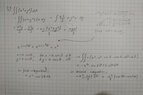
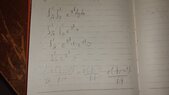
  • Handwritten calculus working on lined paper: the double integral from sqrt(x) to 1 and 0 to 1 of e^(y^8) dy dx, then inner integration steps, ending with an integral of e^(y^8) dy from sqrt(x) to 1 set equal to expressions involving gamma functions.
    15928456190493196839927833324338.jpg
    673 KB · Views: 162
Please help me for second question, I guess I have to draw a sketch. Can you draw it full?
 
Can you review my answer?
 
Attachments
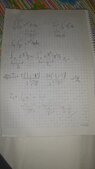
  • Handwritten calculus working on squared paper: a double integral from 0 to 1 of e^(y^8) dx dy with inner limits sqrt(x) to 1, then an antiderivative step for the inner integral, and a final outer integral of I dx from 0 to 1 set up with a factor of one third and gamma-function terms.
    15928553076661717351012422939825.jpg
    952.8 KB · Views: 147
The use of exponential integral and gamma functions goes beyond what I was taught in Calc 2. We did multi-variable calculus in Calc 3, but still worked with elementary functions. I can't help you with this problem. Perhaps someone else can.
 
Questions 1 and 3 are fairly straight forward applications of multivariable Calculus with elementary functions.
So I think question 2 must also be such a straight forward application.
Looks to me as if the question should read:
$$\int_0^1 \int_{\sqrt x}^1 \exp(y^3)\,dy\,dx=\,?$$
That is, with power $3$, and with the variables of integration swapped.
Now we can solve it by swapping the order of integration, which is likely intended. And yes, a graph may help.
 
Klaas van Aarsen said:
Questions 1 and 3 are fairly straight forward applications of multivariable Calculus with elementary functions.
So I think question 2 must also be such a straight forward application.
Looks to me as if the question should read:
$$\int_0^1 \int_{\sqrt x}^1 \exp(y^3)\,dy\,dx=\,?$$
That is, with power $3$, and with the variables of integration swapped.
Now we can solve it by swapping the order of integration, which is likely intended. And yes, a graph may help.
I'm not skilled in this part. Please help continue.
 
ozgunozgur said:
I'm not skilled in this part. Please help continue.
Please show an attempt to swap the order of integration.
Or otherwise give us a clue in some detail where you are stuck.
You should have an example in your textbook that shows how it is done.
If you can't find such an example, you might take a look at this example.
 
Klaas van Aarsen said:
Please show an attempt to swap the order of integration.
Or otherwise give us a clue in some detail where you are stuck.
You should have an example in your textbook that shows how it is done.
If you can't find such an example, you might take a look at this example.
 
Attachments
  • Handwritten double integral working on squared-grid paper: integral of (x^2+y^2) dA, converted to polar substitutions x = a cos θ and y = a sin θ, with dA = dx dy, leading to a^4 terms and cos 2θ and sin 2θ expressions.
    95428730-d38e-4d4a-becf-123fd4055c05.jpg
    148.4 KB · Views: 125
  • Handwritten calculus working on grid paper: a double integral of e^(y^3) over 0 to 1 in x and sqrt(x) to 1 in y, rewritten as integrals with y^2 limits, then split into integrals I1 and I2 with substitution u = y^3.
    15928649774658391540250730827351.jpg
    1 MB · Views: 149
Now that Klaas has figured out what #2 is actually supposed to be, let's look first at the region over which we are to integrate:

Graph of the region between the curve y = sqrt(x) and the line y = 1 for x from 0 to 1, shaded green, with axes labelled 0, 0.5 and 1.


Reversing the order of integration, we may write:

$$I=\int_0^1\int_0^{y^2} e^{y^3}\,dx\,dy$$

Can you proceed?
 
For question 3 we should use a switch to polar coordinates:
\begin{tikzpicture}
\filldraw[green!70,draw=gray] (0,0) circle (2.5);
\draw[help lines] (-3.2,-3.2) grid (3.2,3.2);
\draw[->] (-3.4,0) -- (3.4,0);
\draw[->] (0,-3.2) -- (0,3.2);
\draw foreach \i/\x in {-2.5/-a,2.5/a} { (\i,0) node[below] {$\x$} };
\draw foreach \i/\y in {-2.5/-a,2.5/a} { (0,\i) node[ left ] {$\y$} };
\end{tikzpicture}
\[ \iint_D (x^2+y^2)\,dA = \int_0^a \int_0^{2\pi} r^2 \cdot r\,d\theta \,dr \]
 
Thank you very much.
https://ibb.co/0XxGrDr
https://ibb.co/ZKNtgZy
I rearranged I wonder if I wrote extra or are we going right?
 
I was sent the other solut. Can you edit these two solving. https://ibb.co/c6S7r8n