Homotopy Class vs Fundamental Group.

Click For Summary

Discussion Overview

The discussion revolves around the concepts of homotopy classes and the fundamental group in topology, exploring their definitions, relationships, and implications in the context of paths in a space, particularly in relation to holes in that space. Participants examine the distinctions and similarities between these concepts, considering both theoretical and practical aspects.

Discussion Character

  • Debate/contested
  • Technical explanation
  • Conceptual clarification

Main Points Raised

  • Some participants suggest that homotopy classes consist of paths that can be continuously deformed into each other while keeping endpoints fixed, questioning the necessity of defining the fundamental group with identical endpoints.
  • Others argue that the fundamental group is specifically concerned with homotopy classes where the start and end points are the same, leading to different implications in spaces with holes.
  • It is noted that in a space with a hole, paths can be classified into different homotopy classes based on which side of the hole they pass, indicating that self-intersection does not affect homotopy class membership.
  • Some participants assert that in a plane without holes, there is only one homotopy class, while the presence of a hole introduces multiple classes, potentially leading to an infinite number of elements in the fundamental group, which can be isomorphic to the integers based on winding around the hole.
  • There is a discussion about the winding number of paths around holes, with some participants expressing uncertainty about how this relates to the classification of paths and the fundamental group.

Areas of Agreement / Disagreement

Participants express both agreement and disagreement on various points, particularly regarding the relationship between homotopy classes and the fundamental group, as well as the implications of holes in the space. The discussion remains unresolved on certain aspects, such as the specifics of the winding argument and its interpretation.

Contextual Notes

Participants mention that the definitions and implications of homotopy classes and the fundamental group depend on the specific characteristics of the space being considered, such as the presence of holes and the nature of the paths involved. There is also a lack of consensus on the conventions used for winding numbers.

FallenApple
Messages
564
Reaction score
61
They seem the same to me. So I can have many paths between a and b that are continuously deformable into each other while keeping the endpoints fixed. We say these function form a equivalence class [f]. This should be regardless if the endpoints are the same or not.

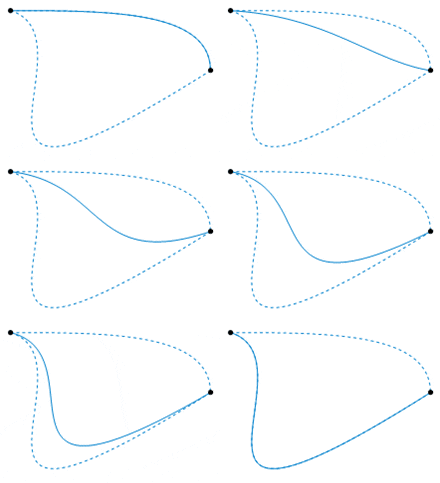
The fundamental group seems to be the same situation where the endpoints are the same. So why would they define it as all such [f]. That doesn't make too such sense. If I draw a bunch of lines between a and b, they are all homotopic to each other, and hence we would have one equalvalence class. [f]. How can we have a set? Could it be that there's a set [g] homotopic but not to elements in [f]? Would it be something like a path between a and b but with a self intersecting loop in between?

So the following image, source wiki, would it show one such subset of an equivalence class. One with no loops in between? So if I imagine a path inbetween those two points, where there is a self intersecting loop somewhere, then trying to warp it into one of the paths in the image seem like it would tear the curve by contracting an infinite amount of points into a cusp.
HomotopySmall.gif
 

Attachments

Last edited:
Physics news on Phys.org
If the range set in which the paths' images lie has a hole (eg consider the number plane with the origin removed) then there will be two homotopy classes, subdivided according to which side of the hole the path passes.

Whether a path crosses itself does not generally have any relation to whether it is the same homotopy class as another path.

The elements of the fundamental group are just the homotopy classes for the case where the start and end points are identical.
 
  • Like
Likes   Reactions: FallenApple
andrewkirk said:
If the range set in which the paths' images lie has a hole (eg consider the number plane with the origin removed) then there will be two homotopy classes, subdivided according to which side of the hole the path passes.

Whether a path crosses itself does not generally have any relation to whether it is the same homotopy class as another path.

The elements of the fundamental group are just the homotopy classes for the case where the start and end points are identical.

That makes sense. Because the hole makes the path at the hole undefined. Essentially cutting the function.

So in the plane, with no holes, since self intersection is allowed, we have only one element in the group. Just one class. If there is a hole, we have two group elements, one of each subdivision. And we use classes as elements because just one class has an infinite amount of elements, and choosing different ones from the same class adds nothing qualitatively new.
 
FallenApple said:
That makes sense. Because the hole makes the path at the hole undefined. Essentially cutting the function.

So in the plane, with no holes, since self intersection is allowed, we have only one element in the group. Just one class. If there is a hole, we have two group elements, one of each subdivision. And we use classes as elements because just one class has an infinite amount of elements, and choosing different ones from the same class adds nothing qualitatively new.
In the plane with a hole, this group is isomorphic to the integers. You have infinitely many elements, not two. Group elements are distinguished by the number of times they wind around the hole.
 
Last edited:
lavinia said:
In the plane with a hole, this group is isomorphic to the integers. You have infinitely many elements, not two. Group elements are distinguished by the number of times they wind around the hole.

Oh, because we are considering the plane? Not just two points? So for two points, there are two classes, the set of paths on one side of the hole, and the set of classes on the other side of the hole. So it is like one is positive and the other is negative. But there are infinitely such pairs of points. So we have isomorphism to the integers.

But I don't see the winding argument though. Is it something like this image?

Fundamental_group.svg


So there are two sets. One with a hole, and one without? Or is it a clockwise counter clockwise argument? So each loop is paired.
 
Last edited:
FallenApple said:
Oh, because we are considering the plane? Not just two points? So for two points, there are two classes, the set of paths on one side of the hole, and the set of classes on the other side of the hole. So it is like one is positive and the other is negative. But there are infinitely such pairs of points. So we have isomorphism to the integers.

But I don't see the winding argument though. Is it something like this image?

Fundamental_group.svg


So there are two sets. One with a hole, and one without? Or is it a clockwise counter clockwise argument? So each loop is paired.
I thought you meant the fundamental group. If you are not talking about loops then you don't have a group.

Still with two points, a curve starting at one of the points can wind around the hole some number of times before reaching the second point. This curve will not be homotopic to a curve that does not wind around the hole.
 
@FallenApple Just adding to what @lavinia said: although there is no group structure, there will be a bijection between the homotopy classes and the integers, such that the paths in the homotopy class associated with integer n wind around the hole n times before reaching the end. If n is positive (negative) they wind clockwise (anticlockwise). [or maybe the convention works the other way - if there is a convention. I forget. ]
 
  • Like
Likes   Reactions: FallenApple

Similar threads

  • · Replies 2 ·
Replies
2
Views
2K
  • · Replies 15 ·
Replies
15
Views
7K
  • · Replies 9 ·
Replies
9
Views
4K
  • · Replies 6 ·
Replies
6
Views
4K
  • · Replies 7 ·
Replies
7
Views
2K
  • · Replies 13 ·
Replies
13
Views
3K
  • · Replies 3 ·
Replies
3
Views
3K
  • · Replies 1 ·
Replies
1
Views
3K
  • · Replies 15 ·
Replies
15
Views
3K
  • · Replies 4 ·
Replies
4
Views
3K