Horizontal deflection of a vertically loaded cantilever

Click For Summary

Discussion Overview

The discussion centers on the horizontal deflection of a cantilever beam subjected to a vertical load at its free end. Participants explore the implications of this deflection in the context of beam theory, particularly focusing on the assumptions made in classical mechanics and the potential need for more advanced theories.

Discussion Character

  • Exploratory
  • Technical explanation
  • Debate/contested
  • Mathematical reasoning

Main Points Raised

  • One participant questions whether the horizontal deflection is considered in the derivation of vertical deflection using Castigliano's theorem, suggesting that the parabolic nature of deflection might be relevant.
  • Another participant explains that Euler-Bernoulli beam theory makes simplifying assumptions, including small slopes and the behavior of the neutral plane, which may not account for horizontal deflection unless specific conditions are met.
  • A different viewpoint suggests that in practical applications, horizontal deflection may be negligible unless the beam is bent through a large angle, providing a mathematical approximation using Pythagorean theorem.
  • One participant expresses a desire for a more elegant relationship than the Timoshenko derivation that does not rely heavily on assumptions, emphasizing the importance of acknowledging these assumptions in engineering design.
  • Another participant discusses the progression of assumptions in learning about beam behavior, from small strains and displacements to more complex scenarios involving large rotations and nonlinear material behavior.

Areas of Agreement / Disagreement

Participants express differing views on the significance of horizontal deflection and the applicability of various beam theories. There is no consensus on whether the assumptions of classical beam theory adequately address the complexities of real-world applications.

Contextual Notes

Limitations include the reliance on simplifying assumptions in classical beam theory, which may not hold in all scenarios, particularly when large deflections or rotations are involved. The discussion highlights the need for careful consideration of these assumptions in practical engineering contexts.

Who May Find This Useful

This discussion may be of interest to students and professionals in mechanical engineering, civil engineering, and related fields who are exploring the behavior of cantilever beams under load and the implications of different beam theories.

makepeace
Messages
2
Reaction score
0
Hello you clever people,

I'm having a bit of a logical problem with the deflection of a simple uniform cantilever beam loaded with a downward force on the free end.
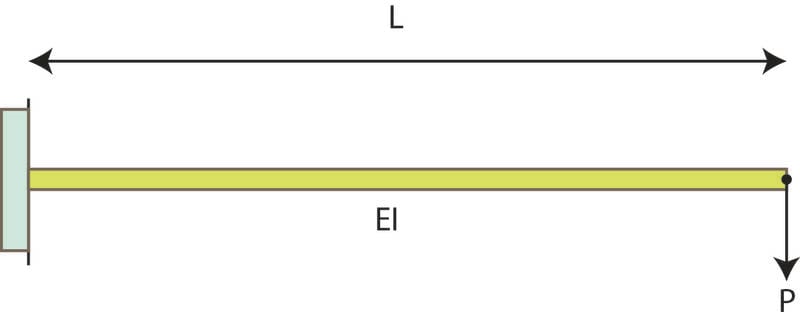
image.jpg


My intuition is that the beam would do something like this:
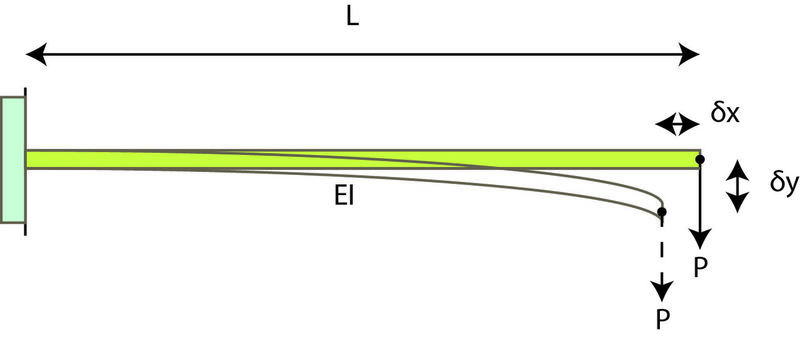
image.jpg


But most literature, and my mechanics of solids course at uni says this happens:
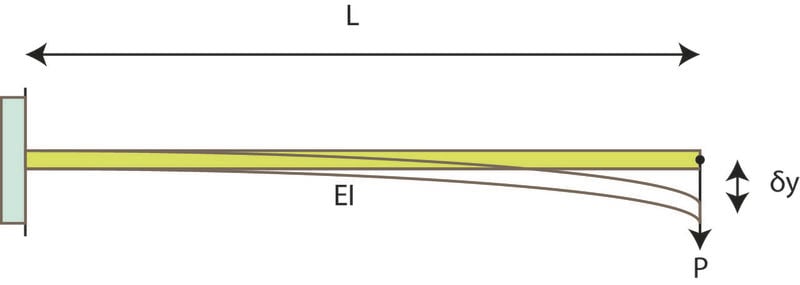
image.jpg


We're using Castigliano's theorem and so far we get that δy=PL3/3EI , but I'm convinced that there should be a horizontal component to the deflection.

If so,

Firstly: Is this horizontal deflection factored into the above derivation and if so how would one calculate the horizontal deflection? Could you just use the parameterization of the parabolic nature of the deflection?

or I guess you could work it out for from the slope?

Secondly: If the horizontal deflection isn't factored in, how would you derive it? I would imagine that the elastic strain due to the vertical deflection would have an effect on the horizontal deflection and vice versa until you reach your equilibrium point for the structure.

I hope that I'm just being silly and WAY overthinking this, please excuse if this is a trivial/stupid question.

P.S. please excuse my horrid drawings, and their size - couldn't figure out how to change that.
 
Last edited:
Engineering news on Phys.org
Euler-Bernoulli beam theory makes certain simplifying assumptions about the deflected behavior of a beam:

1. the slopes along the beam are small.
2. plane cross-sections remain plane after deflecting.
3. the region where there is zero bending stress is called the neutral plane or the neutral axis. This is due to the fact that, using the cantilever shown, the top fibres are in tension and the bottom fibers are in compression, so there must be a line somewhere in between, where the bending stress = 0.

http://en.wikipedia.org/wiki/Euler–Bernoulli_beam_theory

If there is no axial stress, there is no change in the length of the neutral plane.

There are more advanced beam theories available, which account for the effects of different loads and which don't use the simplifying assumptions of the Euler-Bernoulli beam. There are different large-deflection theories available, so that the more general relationship between the radius of curvature of the beam and the bending moment is utilized. For short or very deep beams, there are theories which account for shear deflection of the beam cross section.

http://en.wikipedia.org/wiki/Timoshenko_beam_theory

Unless one specifically needs to account for any of these exotic conditions, the regular Euler beam theory gives good results sufficient for engineering accuracy with a minimum amount of calculation. The other, more general, beam theories require much more calculation effort.
 
You are right in theory, but in practice it doesn't matter unless the "beam" is bent through a large angle - for example something more like a leaf spring than a structural beam.

You can estimate how much difference it makes with the crude assumption that the beam remains straight and pivots at the fixed end. If the length is ##L## and the deflection is ##D##, by Pythagoras's theorem the horizontal distance changes to ##\sqrt{L^2 - D^2}## which is approximately $$L(1 - \frac{D^2}{2L^2}).$$

If the deflection is 1% of the length of the beam, the length would only change by about 0.005% .
Even if the beam deflects by 10% of its length, the length only changes by about 0.5%.

This question goes back at least as far as Bernouilli. You might be interested in http://www.eecs.berkeley.edu/Pubs/TechRpts/2008/EECS-2008-103.pdf
 
Last edited:
Thanks both of you for your useful answers! Glad I'm not as psychotic as the peers I've discussed this with think I am.

I wonder if there is not some more elegant relationship that one could come up with than the Timoshenko derivation but that isn't as assumptive as the Pythagorean result.

I get what you're saying in terms of practicality, but to me it doesn't seem like a thing one should just gloss over. I mean I don't think many of my peers even fully acknowledge the assumptions we've been making, and since the course I'm taking (mechanics of solids II) is in the Mechanical/Electro-Mechanical stream - those assumptions could have some ill follow-throughs in the stuff that we end up designing.
 
As with learning most topics, you have to take it one step at a time.

The simplest assumption (which you are learning) is that the structure has small strains and small displacements. That ignores everything except the linear terms in the math. The shortening of the beam is a quadratic term, as my simple estimate showed.

The next simplest assumption is small strains but the complete structure can have large rotations (like the leaf spring example). That means you can still have a linear relationship between stress and strain.

The most general assumption is that the strains can be large, which in practice also means the material behavior is nonlinear.

The small strain small displacement assumptions are useful for many real world engineering situations, and they are the only ones where you can do much with hand calculations. Once you go beyond that, you need to use computer models to solve anything except very idealized problems.
 

Similar threads

Replies
3
Views
3K
Replies
9
Views
4K
  • · Replies 8 ·
Replies
8
Views
4K
Replies
36
Views
5K
Replies
33
Views
6K
  • · Replies 3 ·
Replies
3
Views
2K
Replies
4
Views
2K
  • · Replies 5 ·
Replies
5
Views
6K
Replies
4
Views
7K
Replies
3
Views
2K