How can a ball rise higher than originally dropped?

  • Context: Undergrad 
  • Thread starter Thread starter FallenApple
  • Start date Start date
  • Tags Tags
    Ball Rise
Click For Summary

Discussion Overview

The discussion revolves around the mechanics of a ball bouncing on a surface, specifically examining how friction affects the normal force, bounce height, and bounce angle. Participants explore the implications of friction on the ball's motion, including the conversion of angular momentum and the relationship between horizontal and vertical velocities during the bounce.

Discussion Character

  • Exploratory
  • Technical explanation
  • Debate/contested

Main Points Raised

  • Some participants question how friction can lead to a larger normal force, noting that the normal force is typically dependent on vertical impulse, which they argue should remain constant across different scenarios.
  • Others propose that the presence of friction allows for the conversion of angular momentum into deformation, potentially providing an additional boost to the ball's motion.
  • It is suggested that the drawing in question may not indicate a higher maximum height but rather a higher bounce angle, which can be achieved by reducing horizontal velocity or increasing vertical velocity.
  • One participant raises the question of whether a ball bouncing with friction can achieve a higher vertical velocity compared to a frictionless ball, considering the trade-off between linear and rotational kinetic energy.
  • Another participant asserts that including the Earth in the system allows for conservation of angular and linear momentum, implying that no conservation law is violated in this context.

Areas of Agreement / Disagreement

Participants express differing views on the effects of friction on the normal force and the implications for bounce height and angle. There is no consensus on whether the frictional ball can achieve a higher vertical velocity than the frictionless ball, and the discussion remains unresolved.

Contextual Notes

Participants note that the interpretation of the drawing and the relationship between horizontal and vertical velocities are central to the discussion, with some assumptions about the system's closed nature being highlighted.
FallenApple
Messages
564
Reaction score
61
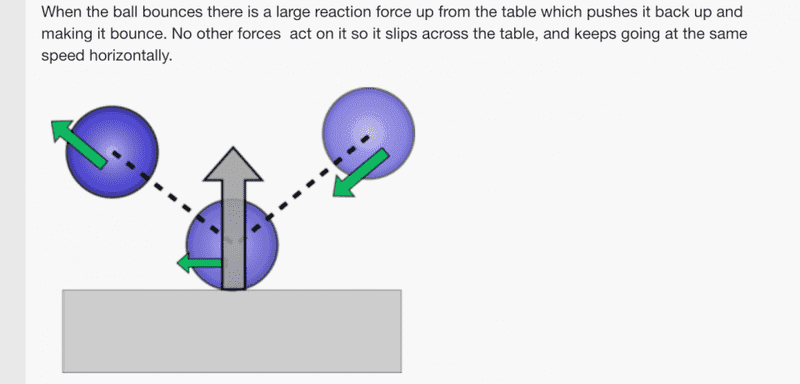
So here is a case where a ball is thrown on the floor with no friction.

NoFric.png
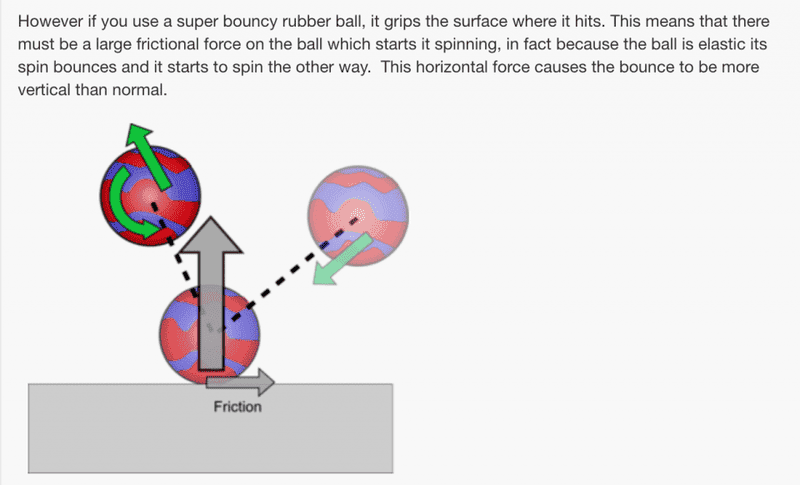
Then is a case with friction
WithFriction.png
Now what I don't understand is how is the presence of friction going to make the normal force larger than usual. The friction is dependent on the normal force, not the other way around. And the normal force is dependent on the vertical impulse, which should the same as the previous case, since the CM of the ball has the same final vertical velocity before impact.
 
Physics news on Phys.org
Well there is angular momentum, the ball when it hits a surface with friction will convert angular momentum into deformation so that would account for an additional boost.
 
FallenApple said:
Now what I don't understand is how is the presence of friction going to make the normal force larger than usual. The friction is dependent on the normal force, not the other way around. And the normal force is dependent on the vertical impulse, which should the same as the previous case, since the CM of the ball has the same final vertical velocity before impact.
You are correct. The normal force would not be larger than normal. But I think that you are misinterpreting the drawing. It is not intended to show that the bounce is reaches a higher maximum height than normal. It is intended to show that the bounce angle is higher than normal.

You can achieve a higher bounce angle in either of two ways: By reducing the horizontal velocity or by increasing the vertical velocity. The text speaks of the former and not the latter.
 
  • Like
Likes   Reactions: FallenApple and Dale
jbriggs444 said:
You are correct. The normal force would not be larger than normal. But I think that you are misinterpreting the drawing. It is not intended to show that the bounce is reaches a higher maximum height than normal. It is intended to show that the bounce angle is higher than normal.

You can achieve a higher bounce angle in either of two ways: By reducing the horizontal velocity or by increasing the vertical velocity. The text speaks of the former and not the latter.

Oh ok. That makes sense. The height must be the same, so the reduced distance(due to friction) traveled in the x direction would cause the hypotenuse to be angled higher.
 
jbriggs444 said:
You are correct. The normal force would not be larger than normal. But I think that you are misinterpreting the drawing. It is not intended to show that the bounce is reaches a higher maximum height than normal. It is intended to show that the bounce angle is higher than normal.

You can achieve a higher bounce angle in either of two ways: By reducing the horizontal velocity or by increasing the vertical velocity. The text speaks of the former and not the latter.

The question remains if the friction-ball can actually jump higher (achieve higher vertical velocity) than the frictionless ball. Without initial rotation, the friction-ball loses linear KE to rotational KE, so the final linear speed is lower than for the frictionless ball. Can the vertical velocity still be higher for the friction-ball, due to the steeper angle? Consider the extreme case of a very flat initial angle.
 
Last edited:
A.T. said:
Can the vertical velocity still be higher for the friction-ball, due to the steeper angle?
I believe so - no conservation law is violated if you include the Earth so that the system is properly closed with regard to conservation of angular and linear momentum.
 

Similar threads

  • · Replies 60 ·
3
Replies
60
Views
6K
Replies
5
Views
1K
  • · Replies 35 ·
2
Replies
35
Views
5K
  • · Replies 11 ·
Replies
11
Views
4K
  • · Replies 32 ·
2
Replies
32
Views
5K
  • · Replies 2 ·
Replies
2
Views
2K
  • · Replies 3 ·
Replies
3
Views
2K
  • · Replies 5 ·
Replies
5
Views
2K
  • · Replies 8 ·
Replies
8
Views
3K
  • · Replies 6 ·
Replies
6
Views
4K