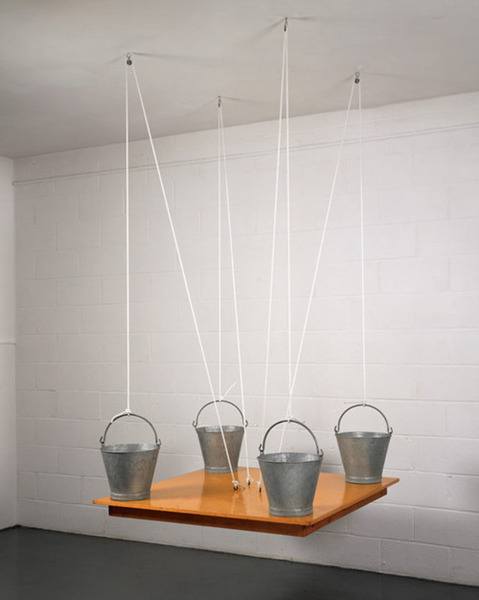
If you start off by imagining that the buckets are not in contact with the table, but static floating slightly over the table surface, then you know that the weight of the four buckets is close to the weight of the table... if you know the angle the ropes make from vertical as they run from the pulleys to the table, you could figure the difference.
If the buckets are too light, the table will fall, if the buckets are just the right weight, the table and buckets will hang without contact, and if the buckets are heavier than that, the whole thing will continue to hang with increasing tension in the ropes... until something breaks.
The critical thing looks like finding the rope tension that suspends the table statically without bucket contact, beyond which the whole thing will hang statically with increasing force between the buckets and table, and increasing rope tension constant throughout their lengths (Vanadium 50's scale under the buckets question).
To treat it mathematically, without motion and the buckets not in contact with the table, the ropes upward vertical component equals the downward vertical component of the weight of the table and buckets. Maybe what you want is a relationship of the force between the buckets and table pressing together, and the increase in tension in the ropes, as a function of bucket weight?
Something like:
Bucket weight = Wb
Table weight = Wt
Rope tension = T
Force between buckets and table = F
Trig adjustment for rope angles = ta
So
F= ta2T(4Wb+taWt) or something like that...?