How can a transistor behave as a switch in the saturated region?

  • Thread starter Thread starter sachin
  • Start date Start date
Click For Summary

Homework Help Overview

The discussion revolves around the behavior of transistors, specifically BJTs, when used as switches in the saturated region. Participants explore the conditions under which a transistor can be considered "ON" or "OFF," particularly focusing on the implications of forward biasing and collector current behavior.

Discussion Character

  • Conceptual clarification, Assumption checking, Exploratory

Approaches and Questions Raised

  • Participants express confusion regarding the relationship between forward bias, collector current, and the transistor's switching states. Questions are raised about the conditions that allow a transistor to function as a switch, particularly in saturation, and the effects of base current on collector current.

Discussion Status

The discussion is ongoing, with participants seeking clarification on the principles of transistor operation. Some have offered insights into the nature of saturation and the role of base current, while others are questioning the assumptions related to voltage and current flow in the context of switching behavior.

Contextual Notes

Participants reference external materials, such as videos and articles, to support their inquiries. There is mention of specific voltage thresholds and the need for forward biasing, as well as the implications of circuit configurations on transistor behavior.

sachin
Messages
61
Reaction score
7
Homework Statement
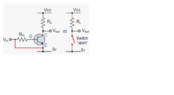
how can a transistor behave as a switch in the saturated region when it is in forward bias mode in the saturation region and the collector current may become zero
Relevant Equations
ic = Vcc / Rl , where ic = collector current, vcc is the potential of the output circuit battery
how can a transistor behave as a switch in the saturated region when it is in forward bias mode in the saturation region and the collector current may become zero,

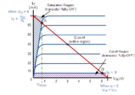
when a transistor is used as a switch im the satruation in region, it is having maximum current but as it is forward biased as it is in the saturation region, the collector current may become zero when the forward bias will be maximum and thereby it will behave as an open switch and will be in the OFF state, where as in the saturation region, it is always ON,

how is it possible, the same we can analyse from the output characteristics of the transistor between collector current and input voltage as given the attached files where the collector current from maximum finally becomes zero,

the confusion comes in 22.30 of the video of mr. h.c verma when he says the collector current may become zero and in 50.30 in the video when he says the collector current is maximum,

,

there is a discussion in quora.com on this but was not convincing to me,

https://www.quora.com/How-does-a-transistor-act-as-a-close-switch-in-the-saturation-region
 

Attachments

  • 1694816657400.png
    1694816657400.png
    8.6 KB · Views: 110
  • input and output circuits.png
    input and output circuits.png
    13.5 KB · Views: 119
Physics news on Phys.org
sachin said:
how can a transistor behave as a switch in the saturated region when it is in forward bias mode in the saturation region and the collector current may become zero,

when a transistor is used as a switch im the satruation in region, it is having maximum current but as it is forward biased as it is in the saturation region, the collector current may become zero when the forward bias will be maximum and thereby it will behave as an open switch and will be in the OFF state, where as in the saturation region, it is always ON,
A switch has two states, ON and OFF. Whether current flows in those two states depends on what the voltage across the switch's terminals is.

I didn't watch the video (that is a big ask, IMO); what is your core question?
 
When a BJT has excess base current w.r.t. the collector current that the attached circuitry can generate, then the collector current does not depend on the base current anymore, it has more than enough. This is called the saturation region because a small change in the base current has a minimal effect on the collector current. In this region the transistor will look like a resistor from collector to emitter. This is the desired "on state" for a transistor switch. The fact that the externally connected circuitry might not induce any current flow doesn't matter. A switch doesn't have to carry current to be on.
 
  • Like
Likes   Reactions: berkeman
berkeman said:
A switch has two states, ON and OFF. Whether current flows in those two states depends on what the voltage across the switch's terminals is.

I didn't watch the video (that is a big ask, IMO); what is your core question?
berkeman thanks for your reply, may i know for the transistor to work why do we need a forward biasing in the base emitter region, cant it be done if we connect just a high voltage battery across the emitter and collector, taking to be a npn transistor, the collector's electrons are pulled by the positive terminal of the battery and the electrons on the emitter side are pushed by the negative terminal of the battery, cant it break the potential barrier developed across the base emitter junction ?
 
Last edited by a moderator:
DaveE said:
When a BJT has excess base current w.r.t. the collector current that the attached circuitry can generate, then the collector current does not depend on the base current anymore, it has more than enough. This is called the saturation region because a small change in the base current has a minimal effect on the collector current. In this region the transistor will look like a resistor from collector to emitter. This is the desired "on state" for a transistor switch. The fact that the externally connected circuitry might not induce any current flow doesn't matter. A switch doesn't have to carry current to be on.
I have a query, while forward biasing the base emitter junction, we give a voltage just more than the barrier potential what is around 0.7 volt, so if we give say 0.9 volt then 0.7 volt is used in breaking the barrier and the rest 0.2 remains for the current to flow, does the PN junction diode have any internal resistance as if its not there using ohm's law, v = i r , 0.2 = i x 0, i = 0.2/0 = infinity what cant be,thanks.
 
also why do we take the output voltage across the the collector and emitter junction and not across the external load resistance, is the external resistance also called the output resistance of the transistor.
 

Similar threads

  • · Replies 6 ·
Replies
6
Views
1K
  • · Replies 5 ·
Replies
5
Views
4K
  • · Replies 7 ·
Replies
7
Views
4K
  • · Replies 4 ·
Replies
4
Views
3K
Replies
68
Views
7K
  • · Replies 4 ·
Replies
4
Views
3K
  • · Replies 1 ·
Replies
1
Views
2K
  • · Replies 62 ·
3
Replies
62
Views
11K
  • · Replies 6 ·
Replies
6
Views
4K
  • · Replies 20 ·
Replies
20
Views
27K