How can both equations for polar coordinates be derived?

Click For Summary

Discussion Overview

The discussion revolves around the derivation of equations for polar coordinates, specifically focusing on the relationship between the position vector and its time derivatives. The scope includes theoretical aspects of vector calculus and the application of differentiation rules.

Discussion Character

  • Technical explanation
  • Exploratory

Main Points Raised

  • One participant presents a derivation of the polar coordinate equations using the chain and product rules, expressing the position vector in terms of unit vectors.
  • Another participant seeks clarification on the notation used, specifically the meaning of the unit vectors e1 and e2.
  • Further clarification is provided regarding the notation, indicating that e_i refers to the standard basis vectors in Cartesian coordinates.
  • A link to an external resource is shared, which is claimed to provide a similar derivation to the one presented in the discussion.
  • One participant asserts that the external resource aligns closely with their earlier explanation.

Areas of Agreement / Disagreement

The discussion includes multiple viewpoints regarding the derivation process, with some participants clarifying terminology while others share their methods. There is no consensus on a single derivation approach, and the discussion remains exploratory.

Contextual Notes

Some participants express uncertainty about vector calculus concepts, and there are unresolved questions regarding the clarity of notation and derivation steps.

putongren
Messages
124
Reaction score
1
Dear All,

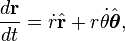
How do you derive both equations below. Let r be the position vector (rcos(θ), rsin(θ)), with r and θ depending on time t.

These equations can be found in wiki under polar coordinates.
33d65d19869f5b9f1637af2da465801c.png


a7c26879c9644e95490242bd842a87eb.png
 
Physics news on Phys.org
This looks just like a staight-forward application of the chain and product rules . . .

Proof: \mathbf{r} = [rcos(\theta), rsin(\theta)]

\mathbf{\hat{r}} = [cos(\theta),sin(\theta)]

\mathbf{\hat{\theta}} = [-sin(\theta),cos(\theta)]


\mathbf{r} = rcos(\theta)\mathbf{e_1} + rsin(\theta)\mathbf{e_2}

\frac{d\mathbf{r}}{dt} = [\dot{r}cos(\theta) - rsin(\theta)\dot{\theta}]\mathbf{e_1} + [\dot{r}sin(\theta) + rcos(\theta)\dot{\theta}]\mathbf{e_2}

Expressing this in terms of our previously defined unit vectors we have that.

\frac{d\mathbf{r}}{dt} = \dot{r}\mathbf{\hat{r}} + r\dot{\theta}\mathbf{\hat{\theta}}

As desired. A similar method could probably be used to get the second result. This is probably a bit sloppy but I'm just learning vector calculus.
 
I'm new to vector calculus too. What does e1 and e2 mean?
 
They're unit vectors.
 
putongren said:
I'm new to vector calculus too. What does e1 and e2 mean?

The notation e_i is often used for the i-th vector in the standard basis. So e_1 is the vector that points in the positive x direction, and e_2 to the positive y direction, etc.
 
Here's a good link I found on deriving those equations: http://mathworld.wolfram.com/PolarCoordinates.html"
 
Last edited by a moderator:
Which is pretty much exactly what I showed!
 

Similar threads

  • · Replies 11 ·
Replies
11
Views
3K
  • · Replies 6 ·
Replies
6
Views
2K
  • · Replies 10 ·
Replies
10
Views
4K
  • · Replies 7 ·
Replies
7
Views
8K
  • · Replies 13 ·
Replies
13
Views
3K
  • · Replies 20 ·
Replies
20
Views
7K
Replies
8
Views
2K
  • · Replies 1 ·
Replies
1
Views
3K
  • · Replies 7 ·
Replies
7
Views
8K
  • · Replies 5 ·
Replies
5
Views
2K
