Undergrad How can generatrices be parallel to the y-axis?

Click For Summary
The discussion centers on understanding the geometry of a boat's hull in relation to buoyancy calculations. The confusion arises from the terminology used in the book, particularly regarding the generatrices being parallel to the y-axis while the cross-section is perpendicular to it. Clarification is provided that the y-axis extends out of the paper, making the generatrices lines along the length of the hull. The book's language is noted as outdated, which contributes to the misunderstanding. Ultimately, the interpretation of the surface element of the hull is confirmed as correct, indicating a rectangle defined by the cross-section and extending along the y-direction.
Adesh
Messages
735
Reaction score
191
TL;DR
How can generatrices be parallel to the y-axis when the cross-section is perpendicular to the y-axis?
CONTEXT: We are finding the the buoyancy force on a boat which is upright in a still water (Fluid at rest) and the only gravity is acting as the external force. So, first we go for imaging a proper geometry of our boat.
See this figure :
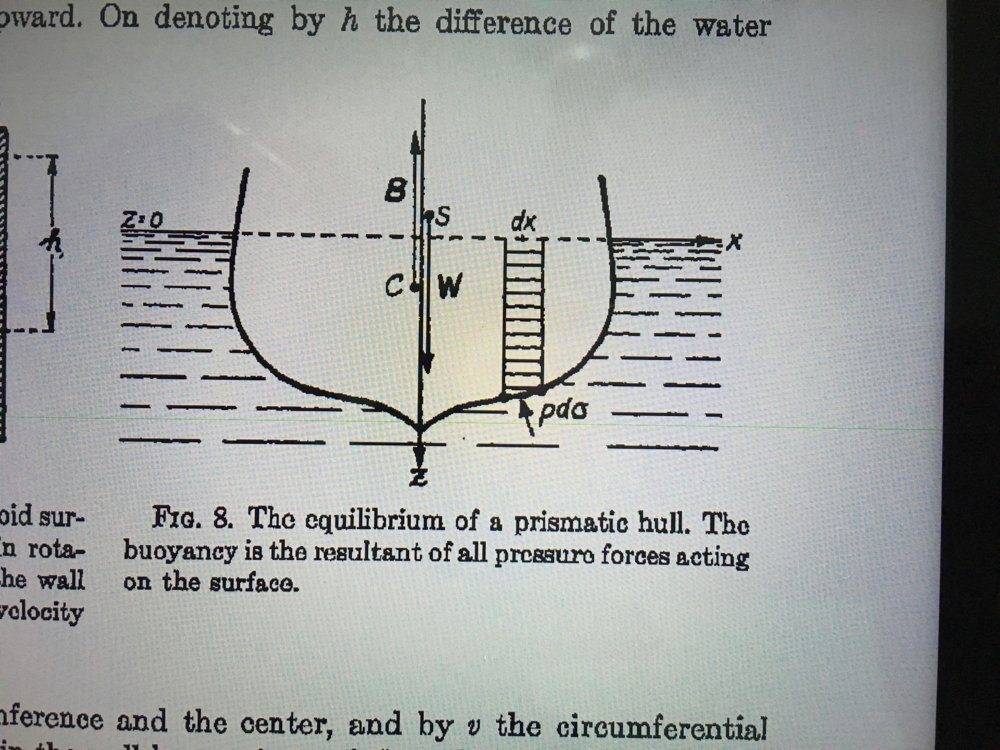
2450BEB5-5D79-49DD-A886-3BFBFED3C2A5.jpeg


For this figure the book writes:
Fig 8 represents a cross-section normal to the longitudinal axis of the boat (positive y-axis forward). Let us think of the hull as the cylindrical surface with generatrices parallel to the y-axis.

I cannot understand what’s going on in the image. First the book writes that the displayed cross-section is perpendicular to the y-axis and then he writes that the generatrices is parallel to the y-axis. Because according to me generatrix is same as the cross-section, because Wikipedia says that a generatrix is something which when moved forms a complete figure.

So, if our main figure-to-be is cylinder (with axis as the y-axis) then our generatrix has to be a circle perpendicular to the y-axis.

Please help!
 
Physics news on Phys.org
You have not read the diagram carefully. The vertical axis is clearly marked "z", so one reasonably assumes that the y-axis is coming out of the paper, perpendicular to the cross section, thus your "problem" is solved.
 
phinds said:
You have not read the diagram carefully. The vertical axis is clearly marked "z", so one reasonably assumes that the y-axis is coming out of the paper, perpendicular to the cross section, thus your "problem" is solved.
How our problem is solved? We knew that y-axis was perpendicular to the cross section. Please explain.
 
Ah, I see. I think the confusion is because the creation of the full boat, based on the cross section, is done by extending appropriate cross sections along the y axis. That is, parallel to the y axis. I misunderstood exactly what you were seeing as the problem where there isn't one.
 
  • Haha
Likes Adesh
Adesh said:
How our problem is solved? We knew that y-axis was perpendicular to the cross section. Please explain.
Your Wiki link, in its example section, says that the generatrices of a cone are straight lines in its surface through its apex, and for a cylinder are straight lines along its length (at least if you treat a cylinder as a limiting case of a cone). I think the book intends something similar for the boat - the generatrices are lines running along the length of the hull. By making them parallel to ##y## it is saying that the hull is remaining the same shape, neither widening nor narrowing, at least at this section of the ship.
 
  • Like
Likes Adesh
Thank you @phinds and @Ibix . The language of the book is quite confusing, because after this much explanation the book writes
Let ##d\sigma## be the surface element of the hull. According, to the simplified form of the hull ##d\sigma= ds ~dy## Where ##ds## is the line element of the cross section.

What does he mean by that? Does he mean that ##d\sigma## is a kind of rectangle whose lengths ##ds## lie on the cross-section and breadth is perpendicular to its length and lies in ##y## direction?
 
Adesh said:
The language of the book is quite confusing
The style of the book looks quite old, both the typeset and the language. I'd suggest something a bit more modern if you are having trouble with the language.
Adesh said:
Let ##d\sigma## be the surface element of the hull. According, to the simplified form of the hull ##d\sigma= ds ~dy## Where ##ds## is the line element of the cross section.

What does he mean by that? Does he mean that ##d\sigma## is a kind of rectangle whose lengths ##ds## lie on the cross-section and breadth is perpendicular to its length and lies in ##y## direction?
You appear to have interpreted this particular passage correctly.
 
  • Like
Likes Adesh

Similar threads

  • · Replies 1 ·
Replies
1
Views
3K
  • · Replies 5 ·
Replies
5
Views
10K
  • · Replies 3 ·
Replies
3
Views
4K
  • · Replies 3 ·
Replies
3
Views
3K
  • · Replies 3 ·
Replies
3
Views
3K
Replies
1
Views
10K
  • · Replies 2 ·
Replies
2
Views
996
  • · Replies 4 ·
Replies
4
Views
2K
Replies
5
Views
6K
  • · Replies 1 ·
Replies
1
Views
4K