How can I add Moments / Torques in different planes?

Click For Summary

Discussion Overview

The discussion revolves around calculating the torque required to rotate a cylinder that is positioned between a stationary wall and a viscous fluid. Participants explore the interaction of circumferential and axial velocities and how these contribute to torque in different planes, raising questions about the nature of torque and forces in this context.

Discussion Character

  • Technical explanation
  • Debate/contested
  • Mathematical reasoning

Main Points Raised

  • One participant describes the setup involving a rotating cylinder with axial and circumferential velocities and seeks to calculate the resultant torque from these components.
  • Another participant asserts that axial torque does not exist and that axial forces should be treated separately from circumferential torque, suggesting a method to combine forces using the Pythagorean theorem.
  • A different participant introduces the concept of axial vectors, suggesting they may be useful in understanding the situation.
  • One participant points out that if the axial viscous drag force is balanced, the net torque from the axial velocity would be zero, questioning the need to sum torques.
  • Another participant proposes analyzing the problem as a screw, considering the pitch and total resistance to rotation.
  • A participant expresses confusion about the role of axial velocity, suggesting it may reduce the required torque, contrary to the idea of neglecting it.
  • One participant provides a formula for drag force and torque, indicating that axial speed neither helps nor hurts under laminar flow conditions, while noting that turbulent flow would have different implications.
  • A participant challenges the consistency of the problem statement regarding the stationary wall and axial velocity, requesting a fluid dynamics analysis to clarify the situation.

Areas of Agreement / Disagreement

Participants express differing views on the nature of axial forces versus torque, with some asserting that axial forces should not be considered as torque, while others argue for the importance of axial velocity in the overall torque calculation. The discussion remains unresolved with multiple competing perspectives on how to approach the problem.

Contextual Notes

There are unresolved assumptions regarding the balance of forces and the nature of the fluid dynamics involved, particularly concerning laminar versus turbulent flow conditions. The definitions and treatment of axial forces versus torques are also points of contention.

vish0096
Messages
3
Reaction score
0
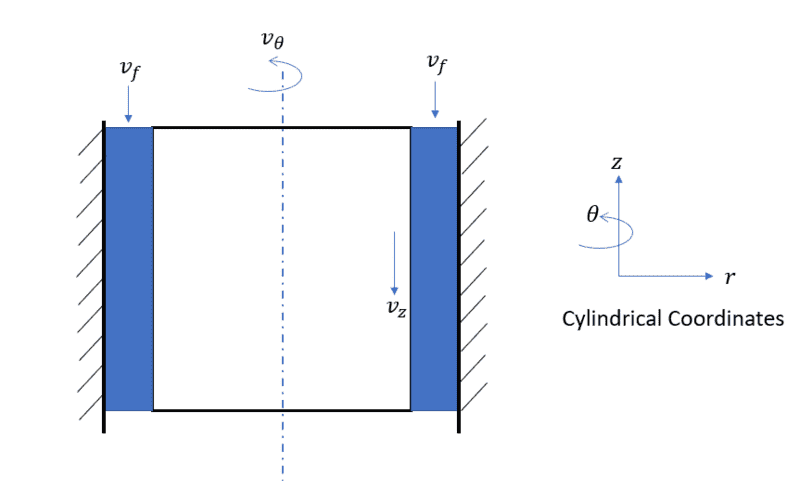
I have a problem as shown in the figure
1620390495205.png

So assume there is a cylinder rotating inside a stationally wall. There is a viscous fluid in between the gap of cylinder wall and outer stationary wall, similar to bearing.
The fluid has some velocity in axial direction also
the outer wall of cylinder has velocity in the downward direction and
Moreover the cylinder is rotating about its axis so it will have a circumferential velocity as well.

Now I actually want to calculate the torque required to rotate this cylinder.
I have calculated the circumferetial and axial velocity
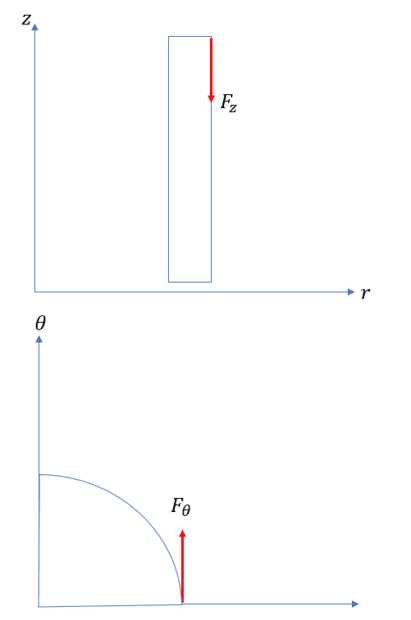
Then from that I have calculated the axial and circumferential component of torque, let say T_theta and T_z
Now how can I calculate the resultant torque?
Problem is these two torque act in two different planes, so I am not understanding how can I add them.
The shear forces causeing the torque are shown in the figure below
1620391111497.png
 
Engineering news on Phys.org
Torque, by definition, is a rotational/circumferential force.

There is no such thing as axial torque; this is just called (linear) force.

Generally, these two components (forces and moments) are kept separate.

You could very well combine them at the surface of the cylinder into a resultant force (not moment/torque); then the circumferential component would implicitly be understood to be a moment (or torque) because of its distance from the axis of rotation.

Edit: Just to go a bit further. T=Fxd. You can divide the total (circumferential) torque by the radius to get the force and simply combine this circumferential force with the axial force using the pythagorean theorem (since they are perpendicular) to get resultant force at the cylinder surface...
 
  • Like
Likes   Reactions: Lnewqban
onatirec said:
There is no such thing as axial torque; this is just called (linear) force.
There are these things called axial vectors for just this circumstance. They are very useful and perhaps you should study them before any more pedagogy.
 
I've gone back and edited this post since my tone was unpleasant. Hutch, I don't appreciate the condescension.

It appears from the problem statement that the axial viscous drag force is balanced on either side, hence the net torque from the axial velocity is zero. OP you left out the axial drag force from the other side of the cylinder.
1620411506005.png

As such, it makes no sense to sum torques (as the T_z would be zero, unless there is some unstated imbalance between the two sides). It would be more appropriate to decompose the loads into forces and combine them as per my first response.

Since this balance of forces from the axial velocity seems immediately apparent to me, I misunderstood a piece of OPs question - thinking they were characterizing the surface force as a torque.
 
Last edited:
  • Like
Likes   Reactions: vish0096 and Lnewqban
Welcome, vish0096!

I agree with @onatirec

I would try this problem like a screw, calculating the "pitch" by relative velocities and the total resistance to be turned and pushed forward.
 
  • Like
Likes   Reactions: vish0096
Thank you, everyone, for your inputs. I am a bit confused about what to do...

So I tend to agree with you that forces because of axial velocity might be balanced.

But I think If I only consider torque due to circumferential force then I might be overestimating the value.

Because if you think of a screw with threads and a screw without threads then off course screw with threads will be much easier to rotate.

So it means axial velocity is actually helping me to reduce required torque so how can I neglect it?
 
We suppose the internal drag is laminar (drag ##\alpha~ v##) then $$ \vec F_{drag}=-\alpha( \vec v_{axial}+\vec v_{circumferential}) $$ where ##\alpha## depends upon contact area and dynamic viscosity. Then $$drag~Torque =-\alpha R v_{circumferential} $$ and $$axial~drag~Force=-\alpha v_{axial}$$ where R is the radius of the cylinder. So the axial speed neither helps nor hurts. Notice if the flow is turbulent, the drag is quadratic, and any additional speed will hurt.
 
  • Like
Likes   Reactions: vish0096
Oh great! That made it very clear thanks!
 
First you say that the outer wall is stationary. Then you say that the outer wall has an axial velocity. Which is it.

I would like to see your fluid dynamics analysis of this system. I have experience in this area. To get the torque, all you need to know is the r##\theta## shear stress at either the inner cylinder or the outer cylinder.
 

Similar threads

  • · Replies 4 ·
Replies
4
Views
2K
  • · Replies 22 ·
Replies
22
Views
7K
Replies
14
Views
3K
  • · Replies 5 ·
Replies
5
Views
5K
  • · Replies 4 ·
Replies
4
Views
4K
  • · Replies 5 ·
Replies
5
Views
4K
  • · Replies 5 ·
Replies
5
Views
10K
Replies
23
Views
3K
  • · Replies 10 ·
Replies
10
Views
6K
  • · Replies 7 ·
Replies
7
Views
21K