Graduate How can I calculate spin Hall conductivity for a 4*4 Hamiltonian?

  • Thread starter Thread starter Mohammad-gl
  • Start date Start date
Click For Summary
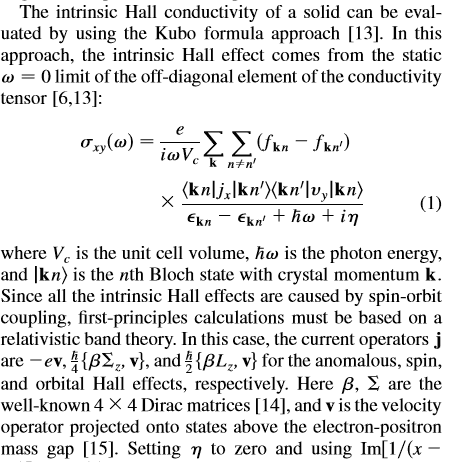
To calculate spin Hall conductivity for a 4 × 4 Hamiltonian, the relevant Dirac matrices are the gamma matrices from the Dirac equation in quantum field theory, which generate the Clifford algebra. The discussion references a formula for spin Hall conductivity and emphasizes the connection between these matrices and the 2x2 Pauli matrices used in spin discussions. The original source for further reading is provided, specifically a DOI link to a relevant paper. The inquiry also seeks clarification on the matrix form of these Dirac matrices. Understanding these concepts is crucial for accurate calculations in this area of physics.
Mohammad-gl
Messages
29
Reaction score
4
TL;DR
Spin Hall conductivity formula
I'm trying to calculate spin Hall conductivity for a 4 × 4 Hamiltonian and I found the attached formula for spin Hall conductivity. What are Dirac matrices for 4× 4 Hamiltonian?
Capture.PNG
 
Last edited by a moderator:
Physics news on Phys.org
I have not checked it but from context I assume these are the Dirac matrices that you are familiar with from the Dirac equation in QFT, i.e. the gamma matrices that generate the Clifford algebra (as the 2x2 Pauli matrices that you are used to when talking about spin are also generators of the Clifford algebra, hence the connection)
 
  • Like
Likes Mohammad-gl
Source?
 
pines-demon said:
Source?
This is the reference.
DOI: 10.1103/PhysRevLett.94.226601
 
  • Like
Likes pines-demon
phyro said:
I have not checked it but from context I assume these are the Dirac matrices that you are familiar with from the Dirac equation in QFT, i.e. the gamma matrices that generate the Clifford algebra (as the 2x2 Pauli matrices that you are used to when talking about spin are also generators of the Clifford algebra, hence the connection)
Thank you. I want to know metrices form.
 
Thread 'Unexpected irregular reflection signal from a high-finesse cavity'
I am observing an irregular, aperiodic noise pattern in the reflection signal of a high-finesse optical cavity (finesse ≈ 20,000). The cavity is normally operated using a standard Pound–Drever–Hall (PDH) locking configuration, where an EOM provides phase modulation. The signals shown in the attached figures were recorded with the modulation turned off. Under these conditions, when scanning the laser frequency across a cavity resonance, I expected to observe a simple reflection dip. Instead...

Similar threads

  • · Replies 0 ·
Replies
0
Views
3K
  • · Replies 0 ·
Replies
0
Views
3K
  • · Replies 1 ·
Replies
1
Views
3K
  • · Replies 7 ·
Replies
7
Views
3K
  • · Replies 1 ·
Replies
1
Views
1K
  • · Replies 6 ·
Replies
6
Views
3K
  • · Replies 6 ·
Replies
6
Views
3K
  • · Replies 156 ·
6
Replies
156
Views
11K
  • · Replies 10 ·
Replies
10
Views
3K
  • · Replies 11 ·
Replies
11
Views
4K