How can I calculate the smallest speed of a proton in a nucleus?

Click For Summary
To calculate the smallest speed of a proton in a nucleus, the initial approach uses the equation p = mv and the relation mvL = ħ/2, leading to a calculated speed of approximately 7.34 x 10^6 m/s. However, this result is deemed incorrect, prompting a query about potential errors in the method. The discussion suggests that the lecturer's approach may involve the lowest energy level of an infinite potential well, which differs from the initial assumptions. Clarification on the correct application of the Heisenberg Uncertainty Principle and the appropriate equations is needed. Understanding these concepts is crucial for accurately estimating the speed of a proton confined within an atomic nucleus.
NoctusPartem
Messages
1
Reaction score
0
Homework Statement
A proton is confined within an atomic nucleus of diameter 4.30 fm.
Estimate the smallest range of speeds you might find for a proton in the nucleus.
Relevant Equations
pL=hbar/2
My approach:

Assuming non-relativistic velocity:
$$p = mv$$

$$mvL = \frac{\bar{h}}{2}$$
$$v = \frac{\bar{h}}{2mL} = \frac{h}{4\pi mL}$$

$$v = (6.626*10^-34) / (4pi * 1.67*10^-27 * 4.3*10^-15)$$
$$v = 7.34*10^6 = .0245c$$

This answer is incorrect. What have I done wrong?

---

Edit: My lecturer's slides include the equation in the form:
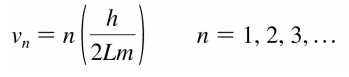
1571447334208.png

I'm not sure if or why this form should be used instead.
 
Last edited:
Physics news on Phys.org
Hi.
I am not sure how incorrect your answer is. What is the right answer by your lecturer ?
 
Hey.
I'm just a first year, so I haven't taken anything related to quantum.
But maybe you may find my attempt at this useful:
1571501547882.png


1571501609185.png

So by pythagoras, the Delta v in three dimensions should be this.
Assuming that the atom is uniform(all deltas are equal):
1571501701025.png
so according to this interpretation "n" should be related to the square root of the number of dimensions... But your lecturer's equation don't square "n" so I'm not sure what is wrong here.
 
NoctusPartem said:
Homework Statement: A proton is confined within an atomic nucleus of diameter 4.30 fm.
Estimate the smallest range of speeds you might find for a proton in the nucleus.
Homework Equations: pL=hbar/2

My approach:

Assuming non-relativistic velocity:
$$p = mv$$

$$mvL = \frac{\bar{h}}{2}$$
$$v = \frac{\bar{h}}{2mL} = \frac{h}{4\pi mL}$$

$$v = (6.626*10^-34) / (4pi * 1.67*10^-27 * 4.3*10^-15)$$
$$v = 7.34*10^6 = .0245c$$

This answer is incorrect. What have I done wrong?

---

Edit: My lecturer's slides include the equation in the form:
View attachment 251429
I'm not sure if or why this form should be used instead.
I'm guessing that you are trying to use the Heisenberg Uncertainty Principle. But, since you don't say what you are trying to do, it's hard to know.

Meanwhile your lecturer seems to be using the lowest energy level for an infinite potential well.
 
The book claims the answer is that all the magnitudes are the same because "the gravitational force on the penguin is the same". I'm having trouble understanding this. I thought the buoyant force was equal to the weight of the fluid displaced. Weight depends on mass which depends on density. Therefore, due to the differing densities the buoyant force will be different in each case? Is this incorrect?

Similar threads

Replies
20
Views
4K
  • · Replies 3 ·
Replies
3
Views
8K
Replies
4
Views
2K
  • · Replies 1 ·
Replies
1
Views
4K
  • · Replies 5 ·
Replies
5
Views
11K
Replies
5
Views
3K
  • · Replies 3 ·
Replies
3
Views
3K
  • · Replies 6 ·
Replies
6
Views
4K
  • · Replies 24 ·
Replies
24
Views
3K
Replies
8
Views
57K