How Can I Design an Underdamped RLC Resonator Below 3kHz?

Click For Summary
SUMMARY

The forum discussion centers on designing an underdamped RLC resonator circuit with a resonance frequency below 3kHz, utilizing a simulated inductor and specific component values. The user initially employed a resistor (RL=1kΩ), a capacitor (C=0.1μF), and an op-amp (NTE941M) powered by dual 9V batteries. Despite achieving a theoretical resonance at approximately 1000 rad/sec with a peak gain of 9.5, the user observed no significant response in practice. Recommendations included adjusting resistor values to ensure R >> RL, which improved the circuit's performance.

PREREQUISITES
  • Understanding of RLC circuit theory and resonance
  • Familiarity with op-amp configurations and power supply requirements
  • Knowledge of FFT analysis for signal measurement
  • Experience with circuit simulation tools like Matlab
NEXT STEPS
  • Research "RLC circuit resonance tuning techniques" to optimize component values
  • Learn about "impedance matching in RLC circuits" to improve performance
  • Explore "advanced op-amp circuit design" for better signal amplification
  • Investigate "FFT analysis methods" for accurate signal response measurement
USEFUL FOR

Electronics engineers, hobbyists designing resonant circuits, and students studying circuit theory who seek practical insights into RLC resonator design and troubleshooting.

swraman
Messages
165
Reaction score
0
Hi,

I thought this would be a simple project but I have not been able to get this to work.

I need to design a circuit that exhibits a resonance below 3kHz. It must be underdamped, and the drive current limited to ~5mA.

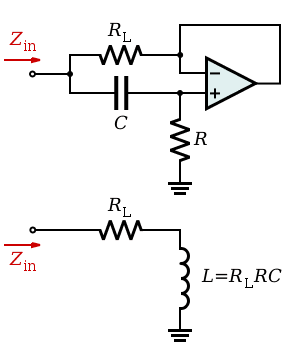
I was usign this as an inductor:
http://en.wikipedia.org/wiki/Gyrator
300px-Op-Amp_Gyrator.svg.png


At the bottom, which simulates the inductor.

My values I am using are:
RL=1kOhm
C = .1uF
R = 10kOhm

these lead to a simulated L=.9

Combining this with a .01uF capacitor, I should get a resonance at about 1000rad/sec, and if I measure the voltage across the capacitor I should see a peak gain of 9.5 (determined analytically using Matlab). But when I put in a broadband random signal into the system, I see nothing when I measure the voltage across the capacitor but it looks exactly like my input broadband signal.

Is there something I am missing?
 
Engineering news on Phys.org
Have you breadboarded something or is this based on a simulation?

In case of simulation, could you show the details of it, schematic, output waveforms etc.?
 
Breadboard. I am using a FFT data acquisition system which measures input and output and calculates a transfer function.

I used simple KVL analysis to generate transfer functions and plot the expected FRF's in Matlab, which gave me the expected peak/resonance. I am using 2 9V batteries (one in negative direction) to power the op amp. I know the op amp works because I can make other circuits with t which operate fine.
 
Could do with a schematic of your test setup, including how your instruments are hooked up (and their make and model).
 
http://www.ocf.berkeley.edu/~sraman/dp/image_circuit.jpg

I am using an NTE941M op amp:
http://www.nteinc.com/specs/900to999/pdf/nte941m.pdf

My V+ and V- terminals are plugged into +/-9V batteries (reverse polarity to get -9V).

http://www.ocf.berkeley.edu/~sraman/dp/board.jpg

I have not shown the 9V batteries plugged in, they attach to terminals 4 and 7 as shown on the datasheet.

My instruments I am using are (I am fairly certain) not the issue. It is a FFT Analyzer by Data Physics Corp. I am using a broadband random generator and measuring the response around the first .01uF capacitor. All are grounded to the breadboards ground and I am making a differential measurement across the capacitor when measuring its response.

Thanks

Raman
 
Last edited by a moderator:
It appears that the RL part of the circuit is working properly...With a broadband random input I get the following output spectrum:

http://www.ocf.berkeley.edu/~sraman/dp/response_r.jpg

Which seems accurate, rolloff around 150Hz. But when I add the capacitor in front of the circuit, I get the following (measuring response across series capacitor), with a possible resonance at 1000hz instead of ~150:
http://www.ocf.berkeley.edu/~sraman/dp/response_c.jpg
 
Last edited by a moderator:
The thing is, in this:
300px-Op-Amp_Gyrator.svg.png


The bottom circuit is only equivalent (approximately) to the top one when R >> R_L.

I assume you got L = 0.9 H from something like:
Z_in = (R_L + j*omega*R_L*R*C) || (R + 1/(j*omega*C) = (1.000e3 + j*0.9000) Ω

for R_L = 1 kΩ, R = 10 kΩ, C = 100 nF, omega = 1 rad/s.

For omega = 10e3 rad/s:
Z_in = (5.500e3 + j*4.500e3) Ω

thus not the impedance you would expect for the circuit in the bottom.

Adjusting the values of the resistors to be more in line with R >> R_L:
Z_in = (1.089e3 + j*9.891e3) Ω

for R_L = 100 Ω, R = 100 kΩ, C = 100 nF, omega = 10e3 rad/s,

which is much more like it should be according to the equivalent circuit in the bottom.

In short, try R1 = 100 Ω, R2 = 100 kΩ instead. I'd expect a resonance frequency of around 1/(2*pi*sqrt(1 H*10e-9 F) ~= 1.6 kHz with a gain of around 20 dB (you're limited by your rails though).
 
Last edited:
Thanks. I knew there must have been some condition I was overlooking for the simulated inductor to work.

I did the best I could with the pieces I have, and used a 250Ohm resistor instead of 100 that you suggest. The response is starting to look much better.
http://www.ocf.berkeley.edu/~sraman/dp/response_c_250ohm.jpg

I don't quite understand why the response levels out at ~3kHz but I am not really concerned with any poles/zeros after the resonance.

I will but the necessary components tomorrow. Thanks for all the help, Ill let you know how it works.
 
Last edited by a moderator:

Similar threads

  • · Replies 3 ·
Replies
3
Views
4K
  • · Replies 7 ·
Replies
7
Views
5K
  • · Replies 10 ·
Replies
10
Views
1K
  • · Replies 8 ·
Replies
8
Views
4K
  • · Replies 9 ·
Replies
9
Views
6K
Replies
8
Views
2K
  • · Replies 7 ·
Replies
7
Views
3K
Replies
5
Views
3K
  • · Replies 5 ·
Replies
5
Views
5K
  • · Replies 1 ·
Replies
1
Views
8K