How can I ensure that my linked cylinders are in perfect sync?

  • Thread starter Thread starter Chantry09
  • Start date Start date
  • Tags Tags
    Confusion Cylinder
Click For Summary

Discussion Overview

The discussion revolves around the synchronization of two linked cylinders in an engine project, specifically focusing on the motion of two pistons (Piston A and Piston B) connected through different pivoting mechanisms. Participants explore the implications of varying lengths of connecting rods and their effects on the pistons' movements throughout the rotation cycle.

Discussion Character

  • Technical explanation
  • Debate/contested
  • Mathematical reasoning

Main Points Raised

  • One participant expresses concern that the differing pivoting mechanisms of Piston A and Piston B may prevent them from being "in phase" during their cycles.
  • Another participant asserts that as long as the center of the crankshaft is aligned with the piston, the pistons will operate 180 degrees out of phase, regardless of the straight length of the shaft.
  • A participant questions whether the travel of the cylinder head for both pistons will be identical at all stages of rotation, suggesting that differing lengths of pivoted shafts could lead to different motions.
  • It is proposed that if the lengths of the connecting rods are the same, the motion of both pistons will be identical.
  • Concerns are raised about the effects of differing lengths of connecting rods on the pistons' movements, with one participant noting that a longer connecting rod results in motion that approximates a perfect sine curve, while shorter rods distort this motion.

Areas of Agreement / Disagreement

Participants express differing views on the effects of connecting rod lengths on piston synchronization. While some agree that identical connecting rod lengths lead to identical motion, others argue that variations in rod lengths will result in different piston movements, indicating a lack of consensus on the implications of these differences.

Contextual Notes

The discussion includes assumptions about the alignment of the crankshaft and the nature of the connecting rods, which may influence the conclusions drawn by participants. There is also mention of mathematical principles, such as Pythagoras' theorem, that are not fully resolved within the conversation.

Chantry09
Messages
59
Reaction score
0
Hi,

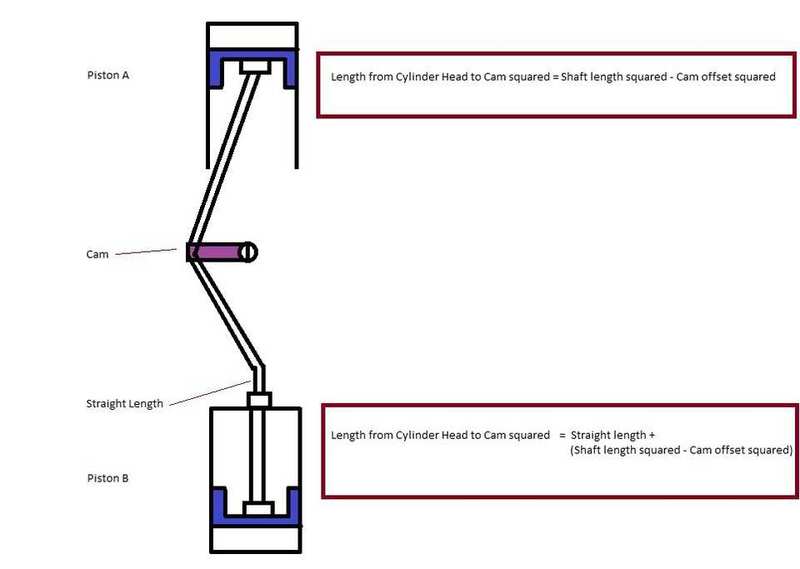
I have a question about one of the engines I am looking at for a project. I am linking two cylinders together. One is a cylinder with a pivoting shaft (piston A), the other piston has a cylinder with a fixed axle so it can only move in and out (piston B). To allow piston be to move with the cam, it will have to be attached to a pivot.
iz5chw.jpg


However, what I am concerned with is, these cylinders have to be "in phase" so they are moving the same speed and are at the same point during the cycle. I am thinking that the difference between the way piston a and piston b are pivoted will mean they will not always be in perfect sync.

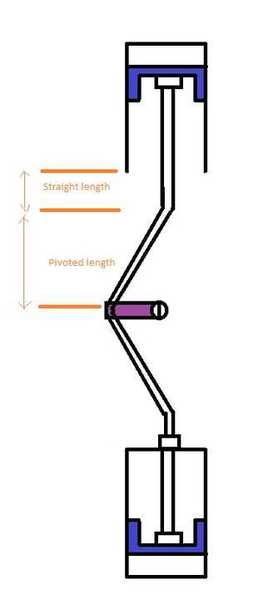
To achieve this, do I need to fix Piston A so that it has the same straight length of shaft and the same pivoted shaft length? As shown in the diagram below:
2me7jab.jpg


Please let me know if I have explained it well enough. I basically want the relationship between the cylinder head moving and the cam moving to be exactly the same on Piston A and Piston B, and I think the increased pivoting length will alter this relationship.
 

Attachments

  • iz5chw.jpg
    iz5chw.jpg
    19 KB · Views: 471
Engineering news on Phys.org
Hi Spadez,
Every point on the piston must move together. So every point on the "straight length" must also move along with the piston. There is no difference in motion between the straight length and piston.

There are two rotational joints, one on the 'cam' (generally called a crankshaft) where it connects to the 'pivoted length' (generally called a connecting rod) and one between the connecting rod and piston. As long as the center of the crankshaft is in line with the piston, the two pistons will operate 180 degrees out of phase with each other, regardless of the length of the straight part.
 
Hi,

Thank you for the reply. That makes sense, but when I consider the length of the shaft that it pivoted, I still am I bit confused. After thinking about this for a little bit, I think the best way I can explain it is the following:

In my first image, will the travel of the cylinder head created by the rotation of the crankshaft be the same for piston 1 and piston 2 at all stages of rotation?

I think they will be different, using Pythagoras' theorem, since the length of the shaft that is allowed to pivot is larger on Piston A. Can someone confirm this? If so, I need it to be the same. Can this only be achieved by having the same length of pivoted shaft on both piston a and piston b?
 
Spadez said:
In my first image, will the travel of the cylinder head created by the rotation of the crankshaft be the same for piston 1 and piston 2 at all stages of rotation?
If the length of the connecting rods is the same, then yes, the motion of the two will be perfectly identical.

Consider what happens if the straight bit is removed such that the two pistons are mirror images of each other. Would you agree their motion is identical in this case? You could put some equations down to prove it to yourself if you doubted that. ... Next, consider what happens when the piston is lengthened slighty. The pivot at the piston hasn't moved, just the length of the piston. Consider the extreme case of a piston that is very long. The pivot at the piston still moves the same way. The length of the piston has no affect on its linear motion.
 
If the length of the connecting rods is the same, then yes, the motion of the two will be perfectly identical.

Ok, I understand all of that. However what happens when the length of the pivoting connecting rod is different between piston A and piston B? Say piston A has a length of 10 cm and piston B has a length of 5cm?

fdc5tf.jpg
 
The longer the connecting rod, the closer the piston movement comes to producing a perfect sine curve. An infinately long piston rod will essentially give you a scotch yoke, which gives you the perfect sine curve.

http://grove.ufl.edu/~wgsawyer/Laboratory/Wear/scotchYoke.gif

As the connecting rod gets shorter, the sine curve becomes distorted. So having two different length connecting rods will result in a slightly different motion for the piston. They will be similar to a sine curve but they won't be exact.
 
Last edited by a moderator:

Similar threads

  • · Replies 45 ·
2
Replies
45
Views
6K
Replies
21
Views
2K
  • · Replies 8 ·
Replies
8
Views
3K
  • · Replies 26 ·
Replies
26
Views
4K
Replies
8
Views
1K
Replies
0
Views
2K
  • · Replies 3 ·
Replies
3
Views
2K
  • · Replies 11 ·
Replies
11
Views
3K
  • · Replies 8 ·
Replies
8
Views
1K
  • · Replies 9 ·
Replies
9
Views
3K