Discussion Overview
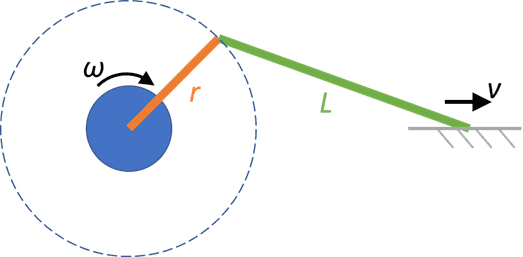
The discussion revolves around the design of a motor-driven hydraulic cylinder mechanism, specifically focusing on achieving a constant linear velocity for the hydraulic piston. Participants explore the relationship between the rotational speed of the motor and the desired linear motion of the piston, considering various mechanical configurations and theoretical formulations.
Discussion Character
- Exploratory
- Technical explanation
- Debate/contested
- Mathematical reasoning
Main Points Raised
- One participant seeks to determine the rotational speed profile needed for a step motor to achieve a constant linear velocity for a hydraulic cylinder piston.
- Several participants argue that the proposed mechanism will not produce constant velocity, suggesting it will instead exhibit sinusoidal motion.
- There is a discussion about the implications of velocity being zero at turnaround points in the piston’s motion, with some participants agreeing on this point.
- One participant suggests that maintaining a nearly constant slider speed would require the crank to accelerate and decelerate rapidly, which could lead to mechanical failure.
- Alternative mechanisms such as ballscrews and rack and pinion systems are proposed, with varying opinions on their feasibility for achieving the desired speed and control.
- Participants discuss the theoretical impossibility of achieving constant velocity due to the nature of acceleration and deceleration in mechanical systems.
- One participant proposes using the piston motion equation to derive a relationship between crank angle and piston position, indicating a mathematical approach to the problem.
Areas of Agreement / Disagreement
Participants generally disagree on the feasibility of achieving constant linear velocity with the proposed design. While some acknowledge the mechanical limitations, others suggest alternative methods or configurations that might work. The discussion remains unresolved with multiple competing views on the best approach.
Contextual Notes
Participants highlight the limitations of the proposed mechanism, including the need for acceleration and deceleration, which complicates the goal of achieving constant velocity. The discussion also touches on the mathematical modeling of the system, indicating that assumptions and definitions play a critical role in the analysis.
Who May Find This Useful
This discussion may be useful for engineers and designers interested in hydraulic systems, motion control, and mechanical design, particularly those exploring the integration of motors with hydraulic actuators.