How Can I Estimate the Cutoff Voltage of a MOSFET From a Graph?

Click For Summary
SUMMARY

The discussion focuses on estimating the cutoff voltage of a MOSFET using graphical data from a lab experiment. Participants suggest plotting √(-Id) against Vgs while ensuring the MOSFET operates in the saturation region, specifically at Vds values of -7V or -8V. The threshold voltage (Vt) can be determined from the intercept of this plot, with an estimated value around -6 volts. The importance of using a drain current versus gate voltage graph is emphasized for more accurate results.

PREREQUISITES
  • Understanding of MOSFET operation and characteristics
  • Familiarity with the saturation region of MOSFETs
  • Ability to interpret graphical data in electronics
  • Knowledge of the equation I_d ∝ (V_{GS} - V_T)^2
NEXT STEPS
  • Learn how to plot √(-Id) vs Vgs for MOSFET analysis
  • Study the effects of channel length and width on MOSFET performance
  • Research the significance of the saturation region in MOSFET operation
  • Explore advanced techniques for measuring threshold voltage in MOSFETs
USEFUL FOR

Electrical engineers, students in semiconductor physics, and anyone involved in MOSFET characterization and analysis will benefit from this discussion.

Lith1um
Messages
1
Reaction score
0
Hi,

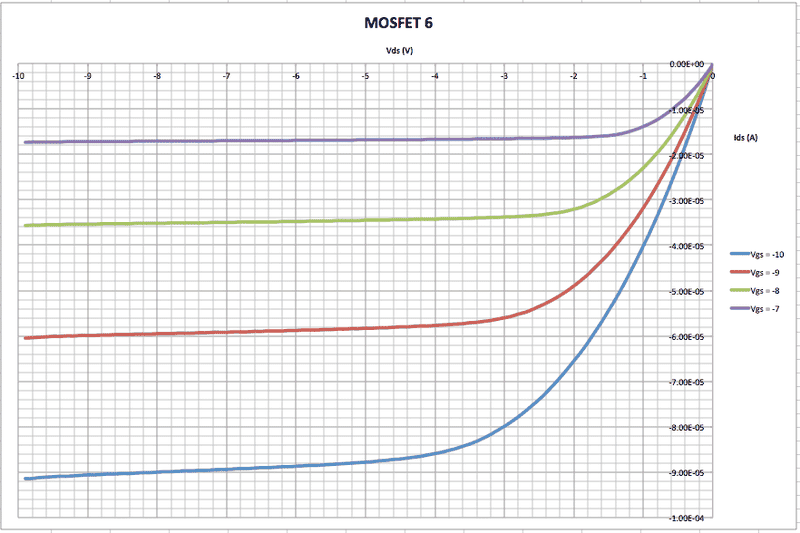
I recently conducted a lab experiment involving several mosfets of varying channel length and width and have plotted Ids against Vds for different values of Vgs (below is one of the graphs).
15oe70l.png

I am now trying to find the threshold voltage of each mosfet using their graphs although I am having trouble figuring out how to do that and cannot find much help that is already online (I'm probably just bad at using google). Any help concerning this would be greatly appreciated.

Thanks,
Alex
 
Engineering news on Phys.org
If you look up the equations for the current of a MOSFET, you will find that in the saturation region:
I_d \propto (V_{GS} - V_T)^2

So, I would choose a value of Vds where the device is in the saturation region (Vds = -7V or -8V looks good), and the plot √(-Id) vs Vgs. The intercept should give you Vt.
 
The threshold voltage is the voltage needed from gate to source to make the FET conduct current from drain to source.

You can estimate this from your graph. It is about -6 volts, because no current flows at any collector voltage unless the gate voltage is at least -6 volts.
 
The threshold voltage is significantly less (in magnitude) than 6V, which you will see if you make the graph I recommended.
 
The question asked was, using THAT graph, how would you estimate the cutoff voltage.

Given that the lowest value of gate voltage given is -7 volts, you could just say " something less than 7 volts".

There may be some non linearity in the turn-on behaviour of the FET but we don't know at this stage.

The graph of drain current vs gate voltage would be much more useful, as you suggest.
 
vk6kro said:
The question asked was, using THAT graph, how would you estimate the cutoff voltage.

Given that the lowest value of gate voltage given is -7 volts, you could just say " something less than 7 volts".

There may be some non linearity in the turn-on behaviour of the FET but we don't know at this stage.

The graph of drain current vs gate voltage would be much more useful, as you suggest.

You're not getting it. You can quantitatively extract the threshold voltage from the graph that the OP has by just generating the plot I suggested. No more measurements are required. This will give you a much more accurate value than "less than 7V".
 

Similar threads

  • · Replies 6 ·
Replies
6
Views
32K
  • · Replies 13 ·
Replies
13
Views
3K
  • · Replies 8 ·
Replies
8
Views
6K
Replies
4
Views
3K
Replies
13
Views
3K
  • · Replies 6 ·
Replies
6
Views
2K
Replies
20
Views
2K
  • · Replies 2 ·
Replies
2
Views
3K
  • · Replies 5 ·
Replies
5
Views
3K
  • · Replies 2 ·
Replies
2
Views
1K