How can I find this formula for the magnetic flux density? (EMagn)

Click For Summary
SUMMARY

The discussion focuses on deriving the magnetic flux density H using the Biot-Savart formula. The user correctly identifies the differential elements in the formula, expressing them in terms of the angle θ and the radius r. The final result for the magnetic flux density H for a semi-infinite wire is given as H = φ (I / 4πr). The discussion also notes that the result for a full wire can be obtained using Ampere's law, yielding twice the semi-infinite result.

PREREQUISITES
  • Understanding of the Biot-Savart law
  • Familiarity with vector calculus and cross products
  • Knowledge of magnetic flux density concepts
  • Basic understanding of trigonometric functions in physics
NEXT STEPS
  • Study the derivation of the Biot-Savart law in detail
  • Learn about Ampere's law and its applications in electromagnetism
  • Explore integration techniques for angular variables in physics
  • Investigate the implications of magnetic fields from different wire configurations
USEFUL FOR

Physics students, electrical engineers, and anyone studying electromagnetism who seeks to understand the derivation of magnetic flux density using the Biot-Savart law.

Boltzman Oscillation
Messages
233
Reaction score
26
Homework Statement
A semi-infinite linear conductor extends between z = 0 and z = inf. along the z- axis. If the current in the inductor flows along the positive z-direction find H(vector) at a point in the x-y plane at a distance r from the conductor.
Relevant Equations
H = I/(4*pi) Integral[( dl x R)/R^2]
I drew an illustration to make this easier:
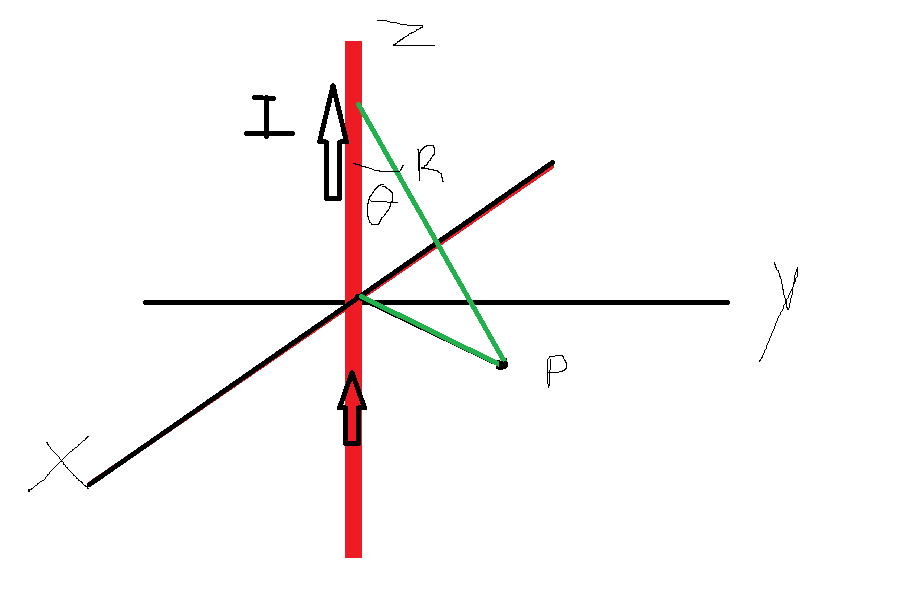
1571355836024.png

Point P is where I wish to find the magnetic flux density H.
Given the Biot-Savart formula:
$$d\textbf{H} = \frac{I}{4\pi}\frac{d\textbf{l}\times\textbf{R}}{R^2}$$
I can let
$$d\textbf{l} = \hat{z}dz$$
and
$$\hat{z}dz\times\textbf{R} = \hat{\phi}sin(\theta_{Rdl})dz$$
Have I done this correctly so far? If so, what should I let R^2 in the Biot-Savart equation be?
 
Physics news on Phys.org
Looks ok. I'll give you a hint: What is ## \frac{r}{R} ##? One other hint is you would do well to also express ## z ## in terms of ## \theta ## and ## r ##, and write ## dz ## as a ## d \theta ## expression, and integrate over ## \theta ##.
 
  • Like
Likes   Reactions: Boltzman Oscillation
Charles Link said:
Looks ok. I'll give you a hint: What is ## \frac{r}{R} ##? One other hint is you would do well to also express ## z ## in terms of ## \theta ## and ## r ##, and write ## dz ## as a ## d \theta ## expression, and integrate over ## \theta ##.
Ah, I think I see what you mean.
$$R = rcsc(\theta)$$
$$z = rcsc^2(\theta)d\theta$$
$$dz = rcsc^2(\theta)d\theta$$
Thus Biot-Savart's law becomes:
Then doing all the integration from 0 to limiting angle will eventually lead me to:
$$H = \hat{\phi}\frac{I}{4\pi r}$$
Of course this is taking into account that this is a semi-infinite line.
thank you for that clarification.
 
  • Like
Likes   Reactions: Charles Link
Very good. :smile:The result for a whole wire running from ## -\infty ## to ## +\infty ## is twice this answer, and can readily be found from Ampere's law. You will likely see that soon also in your coursework.
 

Similar threads

  • · Replies 2 ·
Replies
2
Views
2K
  • · Replies 24 ·
Replies
24
Views
2K
  • · Replies 1 ·
Replies
1
Views
2K
  • · Replies 13 ·
Replies
13
Views
4K
Replies
5
Views
2K
  • · Replies 3 ·
Replies
3
Views
9K
  • · Replies 3 ·
Replies
3
Views
2K
  • · Replies 7 ·
Replies
7
Views
2K
  • · Replies 1 ·
Replies
1
Views
1K
  • · Replies 19 ·
Replies
19
Views
12K